Godzilla VS King Ghidorah!!!

Godzilla VS King Ghidorah ~ 1991, Kazuki Ohmori – Japan

godzilla_vs_kingghidorah_91

Dammit, Toho. This one may take a little while.

So, right off the bat, let’s try to soften the blow with some good news; Godzilla VS King Ghidorah looks great. The monster suits, Godzilla especially, are lookin’ top tier. Also, there is some excellent monster photography, including a few Godzilla shots which are frame worthy. Now. Time to drop the hammer.

 Godzilla VS King Ghidorah is stupid. REALLY, REALLY, REALLY stupid. The plot starts off passable, albeit teeth gnashingly recycled, and then degenerates into utter illogical garbage. Beyond being super convoluted, the real death blow to Godzilla VS King Ghidorah’s integrity is that it centers around time travel, but was written by someone with a staggeringly poor understanding of what time travel actually was. Someone who, had they watched Back To The Future, would not in a million years ever be able to figure out what the fuck was going on. Let’s hop down a line for emphasis here:

THIS IS THE WORST TIME TRAVEL MOVIE I HAVE EVER SEEN.

We’ll get to why in a little bit, but first, let’s delve into the terrible, terrible plot.

THE TERRIBLE, TERRIBLE PLOT- Japan; circa 1991- Godzilla hasn’t been seen for a while. That’s always a bad sign, if he isn’t already stomping you to death, it’s because he’s working out so he can stomp you extra hard tomorrow. Japan, of course, is stressed out about this. Suddenly, wow, would ya look at that, it’s a UFO! I sure hope this isn’t like every other time we’ve had UFOs show up, where it starts out with them being nice and saying they’ve come to help us, but then later we learn it was all a ruse and in fact they have some giant monster related scheme to kill us all. Oh, thank goodness, the people inside the UFO are really nice and say they’ve come to help us. I bet this isn’t going to be like the two hundred and thirty eight previous examples of this happening in a Godzilla movie (It’s exactly like all those other times. Rehash time, everybody).

So, the people in the UFO are (get ready for this) NOT aliens, they’re apparently humans from the distant future! They’ve brought one Japanese girl, the rest of them are all frump faced, red haired white people with giant foreheads/receding hairlines and zero screen charisma whatsoever. Japan just RAIDED the bottom of the Hollywood barrel to recruit as many Caucasians as possible, and you’re going to feel all the money they saved via the power of horrible acting. But I digress; All these future folks tell us that in the future, ain’t no Japan no mo’, on account of Godzilla stomping the shit out of it so many times. So, they’ve come to save it. How? Why, by going back in time again! They just stopped off to pick up a few people. Who are they picking up and why? Well….

THE WHO
1. Kenichiro– A writer of non-fiction books about strange phenomena. At the time of this film he has just uncovered information regarding the origin of Godzilla and is in the process of writing a book about it. The people from the future have his book, and they know 100% of the information he could tell them already. FACT: There is absolutely no reason for them to need to stop and pick him up, and he contributes nothing to their mission. He is brought along for absolutely no practical reason whatsoever, and it benefits the aliens in absolutely no way. He’s the main character.
2. Miki– An employee of some Japanese Paranormal society. Her contributions to this mission also add up to an intense lack of anything whatsoever. She also does nothing. There was no reason for her to come.
3. Professor Mazaki– A dinosaur expert. Guess what? He does nothing for this mission, either.

THE WHY
1. No reason at all.

Here’s the mission: Apparently Godzilla was not always the towering, unkillable champion of city smashing and monster throw-downs that we now know him to be. No, he started his life as a fairly ordinary dinosaur which had somehow managed to survive extinction and used to live on an island in the South Pacific. Why, pre-radiation Godzilla even fought for the Japanese in WWII! It wasn’t until later on that atomic testing had exposed Dino Godzilla to fallout, thereby transforming him into a damn giant monster. The future people’s plan to save Japan involves traveling back in time to that island right smack dab in the middle of WWII (Good news; more bad lines and horrible acting from white people in abundance here) and remove the dino from the island before his radiation exposure. Accompanying our 90’s era Japanese people are:

  1. Some Japanese girl from the future named Emmie– The one future dweller we ever see who isn’t a balding, frump faced ginger.
  2. M-11– an android, the ultimate balding, frump faced ginger, and the single worst character in anything, ever. I hate him.
  3. Dorats – three suspiciously Ghidorah-like, biologically crafted super pets from the future. Why are we bringing those? Uuuuhhhhhh…..
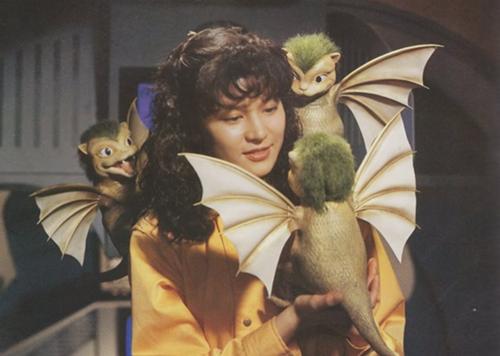
500px-Dorats_and_Emmy

Those are the damn Dorats.

 So, when they find Godzillasaurus, he’s basically dying on a beach. He’s mortally wounded. They could just kill his ass, but that’d be a dick move, so instead they teleport him to the bottom of the Bering Sea, which sounds like it would also kill him, but as this movie teaches us, there is no better, or more safe, place for a wounded person to just lay for hundreds of years without food or oxygen than the bottom of the ocean, it’s like hitting the pause button, you can stay there Indefinitely and just relax. So, they do this. Success! Next they return home, only to find that, oh hell, now instead of Godzilla, the f’ing Dorats have been mutated into Ghidorah, and now we got him rippin’ our shit up. Even worse, evidently this was the future people’s plan all along, they wanted to remove Godzilla from the equation so that Ghidorah could destroy Japan, not save it.

So, for a little bit, that’s a big issue, until the Japanese conclude that their only option is to take a nuclear submarine down into the Bering Sea to atomic blast that somehow not dead dinosaur who has been laying down there mortally wounded on the ocean floor for fifty years and create a brand new Godzilla, which could fight Ghidorah for them. They head down there in their submarine, but in a major act of “Well what do ya know, that’s a coincidence!” There just so happens to have already been a major nuclear incident right at that very spot in the Bering Sea years ago, so when they get there, there already is a Godzilla, fully formed and waiting. Yep. Out of the whole ocean, that’s where the spill was. Terrible, terrible writing. Just unthinkably bad.

So, Godzilla shows up, there’s a big fight, he kills Ghidorah by tearing off one of it’s heads and chucking him the ocean, and then he kills the future people. But then- oh no! We have Godzilla to worry about now! What are we gonna do? Oh, I know, let’s go into the future(?) and get Ghidorah from the bottom of the ocean, make him a cyborg, bring him back, and then kill Godzilla with our new even more dangerous, mechanized monster who we just tried to resuscitate Godzilla to defeat mere hours ago! And THAT’S WHAT THEY DO. WHAT?! This is, in effect, robbing Peter to pay Paul, only to be like “Oh, no, but how to we pay Peter? Oh, wait, I know, we’ll rob Paul!”

So, this is terminally convoluted in a way that is staggering and incredible, but that’s nothing compared to the glaring time travel issues which plague this turkey. Basically, after our heroes go back in time to stop Godzilla’s origin and remove him from history forever, making it so that he NEVER EXISTED in the first place, they return home, and everyone still knows about Godzilla.

WHAT!?!??!?!

Yeah. People remember something that never existed. Remember how Kenichiro was writing a book on Godzilla before he went back and stopped Godzilla from ever having existed? Well, now when he returns home after his mission, in a world where Godzilla never existed, he has a voice-mail message on his answering machine about the Godzilla book he’s working on. When Godzilla DOES appear, people understand him to be “Even bigger than he was before.” WHEN before?! There isn’t supposed to have been a before anymore, you stupid assholes! How did this movie happen?!?! This is a world where THIS conversation could have taken place:

“Hey, man, you remember that horrible monster that used to kill everybody, but then we went back in time to stop him from being born so now he never existed and none of us should have ever heard of him?”
“Oh, you mean Godzilla?”
“Yeah!”
“Oh, yeah, man, I hate Godzilla. He killed my father!”
“Really!”
“Yeah!”
“Well… Is your father alive now, then?”
“No, man, Godzilla killed him.”
“Oh, wow. I bet you’re sure glad Godzilla never existed now, then, huh?”
“Yeah, I just wish he hadn’t ever existed ever before he killed my dad.”

Another thing about time travel, these future assholes control a time machine, so they should be able to go back in time again since they screwed up the first time and didn’t actually stop Godzilla from being born. But they don’t. They conclude that the second (Second, as in, in reference to the first time, which now never happened?) birth of Godzilla was “Unavoidable.” Really? What about if you went back in time to that beach and blew that damn dinosaur’s head off of his body and then threw his fucking corpse into the sun? He was already mortally wounded when you got there, if you just killed him, then: poof, no Godzilla! No? Totally unavoidable, huh?

Apparently, in GVKG anything similar to a dinosaur is essentially unkillable, which makes it weird to think about how they’re all extinct now.

Also, when Emmie goes into the future to dredge up a decapitated (one third decapitated? He’s got three heads, minus one, so how does that work?) Ghidorah who has literally been laying motionless on the bottom of the ocean for 200 years, missing body parts, but still somehow “not dead,” , she has traveled to a world where Japan was permanently destroyed by Godzilla in the 1990’s, there is no Japan, and no Japanese culture. She travels to retrieve Ghidorah in a small submarine co-piloted by a white man who is somewhat reluctant to help her, given that her goal is to save a long extinct culture which he deems to be entirely insignificant. As he does this, while talking to a Japanese girl, he is speaking to her IN JAPANESE. So…. Yeah…. Makes no sense.

Let’s move on. Let’s move on, in fact, to M11.

m112

M11 sucks so, so hard. He’s an android from the future, brought back to carry out the dastardly machinations of our villainous dickhead time travel guys. He has abilities far exceeding the capabilities of a normal human, including enhanced durability, super strength, and a form of travel best called the “Andro-Douche-Glide.” He’s also, in a movie where giant lizard monsters travel through time, the least realistic thing in the entire film. Why? Because WHY would ANYONE, while building an android, chose to build one as stupid looking as this chud? M11 is a frump faced ginger doofus with an average build, receding hairline and less screen-charisma than his co-stars who are actually, literally made out of rubber. It’s clear that Toho really scraped up the worst out-of-work actors Hollywood could spare for their white people in this movie, but M11 is their worst. He sucks so, so bad. He’s also nothing more than an excuse for Toho to rip off The Terminator like crazy, which is embarrassing and the furthest thing from cool.

Maybe the worst thing about Godzilla VS King Ghidorah is that they strayed so far from the source material that they’ve actually managed to lose the thesis statement, this movie doesn’t even seem to possess an awareness that nuclear warfare is a bad thing at all. At a few points throughout the film they almost seem to bemoan the lack of readily available nuclear weapons, and using these weapons weapons is treated as a possible solution to problems more than once throughout the film. That’s a pretty huge jump from the chilling tale of an atomic, city crushing bogeyman that we all loved back in ’54.

On second thought, though, that’s not the worst thing about the movie.
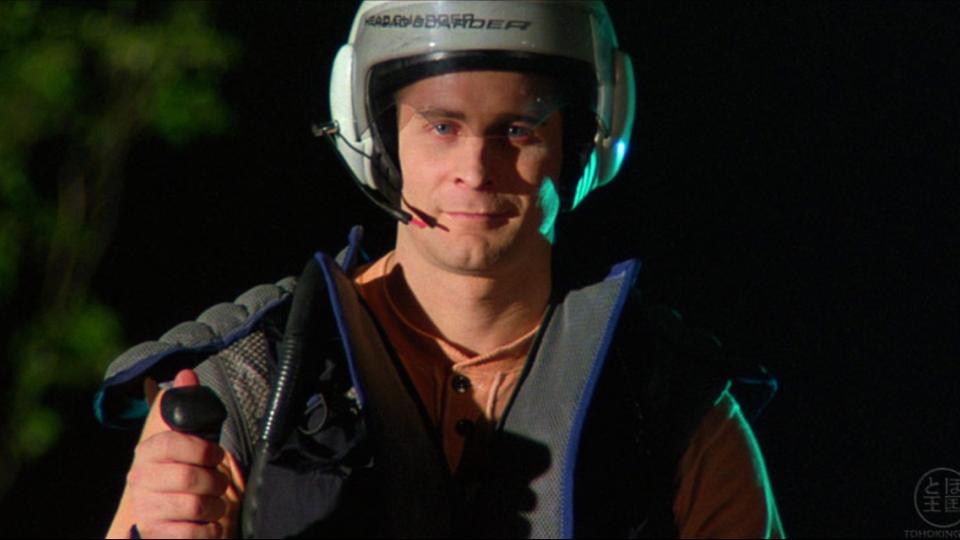
m11 1

Fuck you, M11.

NOTE: Now, while we’re wrapping up, I need to address something. As I have come to understand it, popular G-Fan consensus is that the time travel in this movie DOES make sense, in that the dinosaur they moved into the ocean was actually not the 1954 Godzilla at all, but in fact, the Heisei Godzilla, the creation of which they inadvertently caused themselves, thereby meaning that this film erases nothing, and that this is why everyone still knows about Godzilla when our time traveling nimrods return from their island hopping WWII adventure. Well, that’s a fun little theory, but I’m forced to disregard it, because it’s not expressed in this film at any point, meaning that that is fan speculation, and I don’t review speculation which does not exist in the actual film. Furthermore, that solution, while it does tidy up some loose ends, isn’t less stupid. That would just mean that everyone in the entire movie is a moron, and that’s why no one ever realizes that this time travel was ineffective, and this is never pointed out. No matter how hard we try to contort our perceptions of this film to desperately make it make sense, it doesn’t, not on the screen. Godzilla Vs King Ghidorah is horrible, it’s really, really stupid, it doesn’t make sense, and there is nothing any of us can do about that, no matter how much we wish it weren’t the case. Refusal to accept that is essentially a more mild form of the same phenomena that compels mentally ill people to keep the corpses of loved ones about the house in hopes of creating the illusion that they never died. This movie sucks ass. Let’s not live in denial. Move on.

D
GZ backGZ next

Return of Godzilla/Godzilla 1985!

Return of Godzilla/Godzilla 1985 ~ 1984, Koji Hashimoto (Japan)/1985 R.J. Kizer (USA)

tumblr_m6z2a8VKaT1qla11zo1_1280

After a nine year break, Toho returns with a full on reboot of the Godzilla franchise that ignores a whopping twenty years worth of movie continuity, which isn’t a problem, because ignoring continuity is something Toho has always been excellent at anyway. This time around, we acknowledge only 1954’s Gojira as cannon, and begin with a brand new storyline which would later become known as the Heisei series. Because we’ve taken thirty or so movies and completely thrown them in the trash, we’ve erased Godzilla’s transformation into the grumbling, heroic Guardian monster he had grown into in his later films, and so the monster we see now is again painted more as a horrible, planet-wide menace that must be destroyed. This movie is super, super grim, and when you look at our last dozen outings with Big G, this couldn’t be a more different experience. At the same time, however, because this is still an accurate continuation of the original Godzilla concept, and because previous films have also proven that there is enough room within the Godzilla format for more than one idea, this dramatic shift in tone does not make Return of Godzilla feel like an illegitimate sequel. It still works just fine.

THE PLOT~ Thirty years after the original Godzilla monster attacked Japan and was subsequently destroyed, a second, identical monster surfaces in the Pacific Ocean and starts smashing boasts and killing people. Japan becomes aware of the situation almost immediately, but chooses to suppress this information for fear of causing unnecessary panic amongst the already tense Global Political Stage. Soon, however, they have no choice, as Godzilla strikes down a Soviet Nuclear Submarine and causes a heated international incident. Assuming that only the United States could have been behind the attack on their submarine, the Soviet Union threatens to escalate this situation to full scale nuclear warfare, and Japan is forced to announce the existence of Godzilla as a means of diffusing the situation. This only brings Japan’s government new pressures from both the Americans and the Russians in regards to how to handle this big green bastard and his boat smashin’ ways, and everybody gets super stressed out. The rest of the picture balances Japan’s war with Godzilla and their deep seeded abhorrence of Nuclear weapons with cold war tensions and international bickering, making this film an effective means of addressing where the Nuclear Discussion had moved to in the mid 1980’s. That feels pretty appropriate, given Godzilla’s atomic bomb history, but we also see a lot of Godzilla thrashing about and being shot at, so don’t worry about spending too much time watching old dudes in suits yell at each other.

In terms of our human characters, we have several, but holy shit, who cares? They’re all fine, I guess, but we don’t really care about them all that much. Be honest, we almost never do.

I think Toho kind of assumed that since the later Godzilla films had become so popular with a younger audience, that these kids had now grown up, and were ready for a Godzilla film more their speed, and that’s fair enough. What Return/1985 does best is that it stays true to the concept behind the original Gojira film, while at the same time making it current to the early 80’s, and that’s cool. It’s all about nuclear war, how devastating it can be, what it means for humanity to now possesses this power, and above all, how we can work to avoid using nuclear weapons ever again. As I said before, I think this is a logical place for this franchise to go, and I think they’ve done it pretty well. The tense atmosphere of the Cold War is certainly captured effectively, and the seriousness with which nuclear warfare, and even Godzilla himself, are handled gives the movie a much less schlocky feel. I think it’s entertaining enough, even without another monster for Godzilla to wail on, but if I’m wrong on that, audiences won’t have long to wait for a return to the Monsters V. Monster format, cuz Godzilla Vs. Biolante is just around the corner.

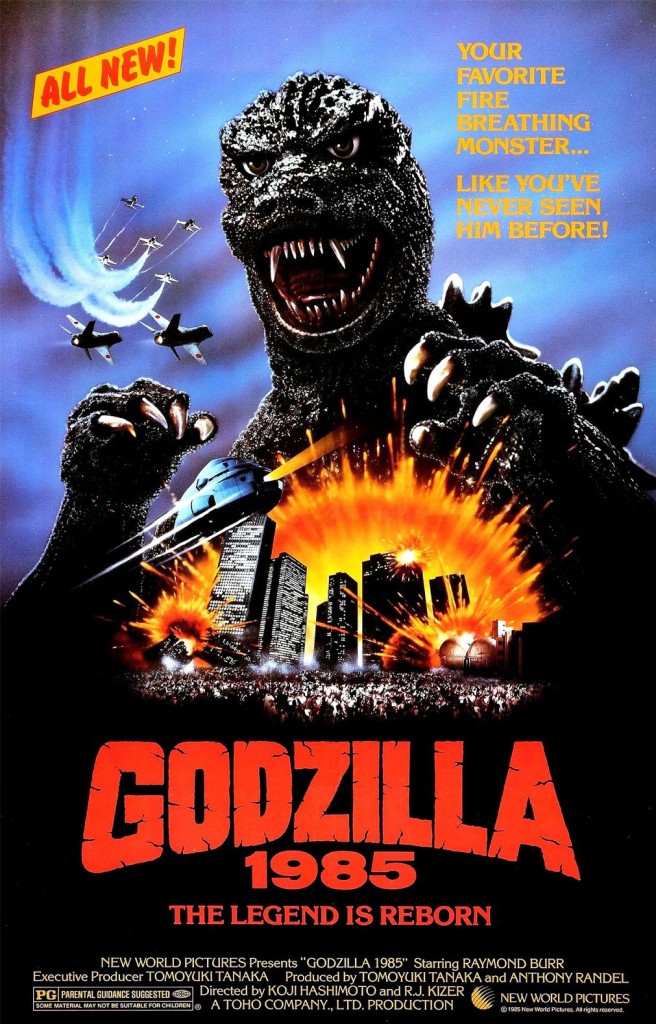
GODZILLA 1985

godzilla-1985-poster

Like Gojira in 1954, Return of Godzilla was also re-edited for American audiences to include footage of white people, because no one knows what would happen if Americans had to watch a movie without white people in it, and for sure, nobody wants to find out. In the case of the original film, the American version became known as Godzilla: King of the Monsters, and in the case of Return of Godzilla, the American version is called Godzilla 1985. In both cases, the special Caucasian-ified American version features celebrated actor Raymond Burr as a journalist named Steve Martin, but to what degree this new footage is imposed on the original, and what effect that has on the film as a whole, could not be more different in Godzilla 1985 than it was in King of the Monsters. We do lose some of the nuclear paranoia, but we still fair MUCH better this time around.

While still a classic film, Godzilla: King of the Monsters was clearly inferior to it’s Japanese sibling, which already had excellent characters and compelling drama BEFORE we crammed in a bunch of white folks. In that case, the addition of Raymond Burr’s character only distanced the audience from the real story, and that softened the film’s impact a great deal. With Godzilla 1985, though, I don’t think this is the case at all. This time around we still spend ample time in Japan with our original characters, and their stories and relationships are not so badly cheated in the same way. Additionally, Raymond Burr adds a special connection to the first film, even if he wasn’t in Gojira we know he was in King of the Monsters, and his character is very well written and acted this time around. The best thing this Westernized version does, however, is that it expands Godzilla’s presence to a global level much better than the Japanese one does. In this version, the Americans learn about Godzilla much sooner, and we come to learn that they are every bit as stressed out about it as the Japanese are, which really elevates the tension. I may be committing some weird form of Godzilla treason here, but I actually like the American version better for exactly these reasons. And Burr is kicking out the Jams, too.

Regardless of which version you see, however, this is a nice entry in the series, and a great way to jumpstart a new slew of giant, monster clobbering adventures. Many of the effects have not held up well for their age, but they shouldn’t slow you down too much, it’s still plenty enjoyable for the seasoned Toho fan.

B-

GZ backGZ next

Terror of Mechagodzilla!!!

Terror of Mechagodzilla ~ 1975, Ishiro Honda – Japan

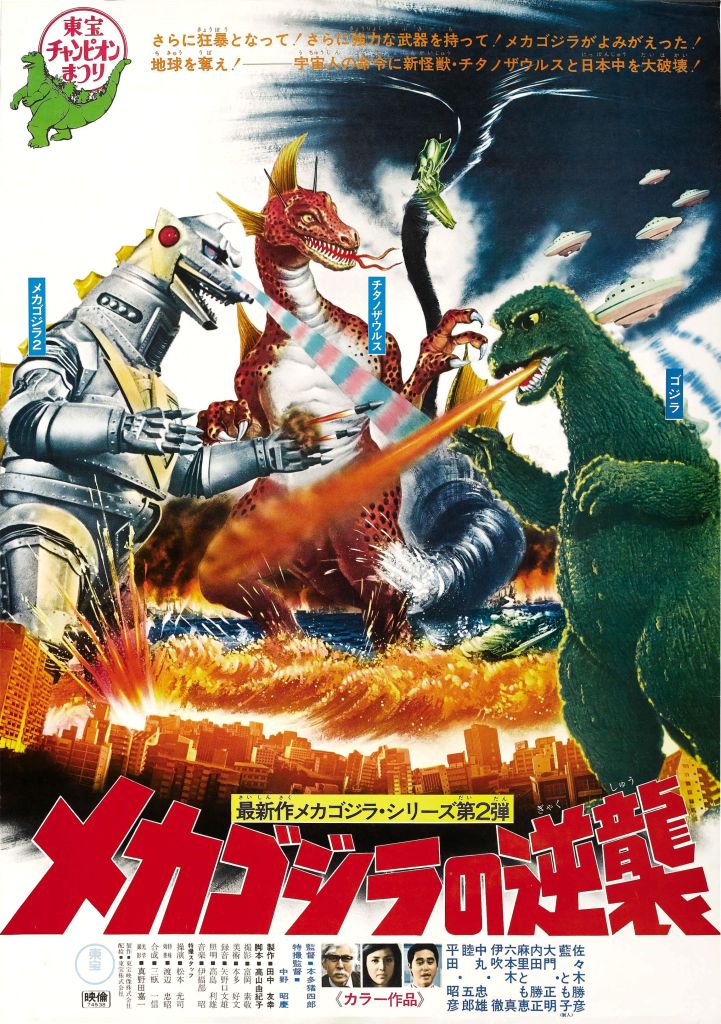
terror_of_mechagodzilla_poster_01

After twenty-one years and fifteen movies, the original Godzilla franchise comes to an end with the solid, yet sadly anti-climactic Terror of Mechagodzilla. This is also the first Godzilla film Ishiro Honda has directed since 1969’s Godzilla’s Revenge, and it’s good to see him back for the finale. Honda pulls out all the stops this time around, embracing more dynamic quick cuts and dramatic camera angles, as well as some hip 70’s split screen techniques, all more typical of fellow Godzilla director Jun Fukuda’s work than of his own. It’s almost like he wanted one more opportunity to prove that he could beat these youngsters at their own game, and it does certainly level the playing field a bit. While Honda’s work is invaluable to the kaiju lexicon, his composition was always governed by more classic sensibilities. With Terror of Mechagodzilla we’ve got that masterful Honda style, but with a little of Fukuda’s zazz thrown in. That’s a strong mix, yo.

The downside: It’s damn aliens again.

MONSTERS-FROM-AN-UNKNOWN-PLANET-REVENGE-OF-MECHAGODZILLA

THE PLOT~ After the destruction of Godzilla’s robot doppelgänger in Godzilla Vs Mechagodzilla, Japanese scientists travel to the supposed undersea wreckage site, in hopes of retrieving the pieces of said robot so that they can use them to do terrible, terrible things (I’m sure), but to their surprise, they instead find Titanosaurus, a huge, aquatic dinosaur, right where Mechagodzilla should be. Oh hell! Titanosaurus’ existence was theorized years ago by a prominent scientist named Dr. Shinji Mafune (played by franchise favorite Akihiko Hirata!), to which the scientific community responded “A dinosaur?! What are you, crazy? Get this guy out of here!” I don’t really understand anyone’s reaction to Titanosaurus in this movie, even the present day scientists act like the discovery of a living dinosaur is a huge deal, when Japan is decimated by warring dinosaurs like, twice a week at this point. Remember, guys? You see dinosaurs every day? You all probably know someone who has been killed by a dinosaur at this point? Why is one more dinosaur so damn mind blowing? Whatever, you guys. Anyway. We Earthlings would soon regret our treatment of Mafune, because after years in isolation and disgrace, this hombre has gone coo coo for cocoa puffs, big time. It’s so bad that he’s actually betrayed mankind and formed a partnership with dastardly space aliens, here to conquer the Earth and wipe out human civilization, so we really should have been nicer to him about his freaking dinosaur.

These aliens need Mafune, because his intellect is so substantial that even a race of beings who have mastered space travel think he’s pretty damn smart. Logically, however, they have to know that they can trust him, so as a means of further guaranteeing Mafune’s loyalty to their evil cause, these aliens use their far-out space-technology to revive his daughter Katsura after she is killed in a lab accident. Granted, she’s a damn cyborg now, but Mafune is good with this. He and the aliens then hatch a two-fold invasion plan; one; Mafune’s state of the art “animal controlling device” is rigged up and used to manipulate Titanosaurus into smashin’ shit and killin’ folks. Two; using technology based on Mafune’s designs, Mechagodzilla is repaired and deployed for a similar purpose. Without Mafune’s knowledge, however, the aliens bind Mafine’s robo-daughter to Mechagodzilla, meaning that if one of them dies, so does the other, just in case the good doctor should decide to flip flop back over to Team Earthling. Looks like Mafune’s really in it for the long haul now.

godzilla-terror-of-mech-polish

Meanwhile, Interpol, aided by a marine biologist called Akira Ichinose, have been sniffin’ around Titanosaurus, as well as the missing Mechagodzilla pieces, and soon the two sides meet in a dance of espionage, gunfire, and shiny, spaceman costumes with stupid helmets. Ichinose develops romantic feelings for Katsura Mafune, unaware that she is 1; In league with would be Earth conquerors from space and 2; A damn cyborg. My favorite line in the movie comes toward the end, when Ichinose discovers the truth about Katusra, and tells her “Even if you are a cyborg, I love you.” We shouldn’t be surprised, this is a culture where grown men have developed committed, romantic relationships with body pillows. A cyborg is like a body pillow in many ways.

Also, Godzilla eventually shows up. He’s not in this thing enough. That’s a major beef for me.

It’s all a mixed bag, as always. While it’s impossible to ignore the significant updates Honda has made to his screen language repertoire, he doesn’t ever employ the use of these more jazzy techniques to the degree that Fukuda does, and they actually stand out more because they’re so isolated to key sequences, like when Titanosarus rises up out of the sea. Fukuda had also pushed the envelope in how violent the monster battles were allowed to get, which included the use blood effects, and that really heightened the drama, Those effect shots are largely absent from this entry (although Mecha-G’s revolving finger-rocket punches a hole in Godzilla’s chest at one point, and that’s pretty heavy). While I don’t want to say that blood is mandatory for Godzilla movies now or ever, it did help add a sense of desperation and risk to the conflicts when it was used well in the past, and it’s hard to step backwards from that without losing some of the momentum the audience has now come to expect.

One thing that Honda does do that surprised me more than a bit; Damn android nipples! While Katsura is being fiddled with and modified by our aliens, we get a weird, uncomfortable gander at her bare chest. Now, see here, Toho, we Westerners have demonized the hell out of that whole region of the female anatomy for centuries, so toss a blanket over her or something. Get back to widespread destruction and the death of human beings, what a woman has under her clothes is a most dark and sinful thing, and we want no part of your freaking space martian peep-show.

Also problematic; the aliens themselves. They don’t even appear to be the same aliens from the prior film, which would really have helped sugarcoat the situation. These aliens come from “Black hole third planet,” and are profoundly uninteresting. Past Godzilla films have done a much better job making their aliens distinct, as well as elevating the Earth Vs Aliens conflict to make it feel more global, and more dramatic. The best example of this was probably Destroy All Monsters, but the aliens in Terror of Mechagodzilla are maybe my least favorite of all the Showa E.T. Interlopers. Truly, they are nothing special, and when you do something over and over and over again for years and years, dammit, you need to make it special somehow.

A highlight I wanted to mention; Akihiko Hirata’s performance as Dr. Mafune. Firstly, he’s been with the franchise from the beginning, so it’s cool having him back in a prominent role as this series comes to a close. He also does a good job in this role even without acknowledging his position as an original cast member, and he’s likely to stand out as especially memorable even if this is the first Godzilla film you watch. He looks like a Japanese Einstein, and his portrayal of a brilliant mind driven to madness is enjoyably manic. While most of the cast is likable, he stands above the rest in Terror of Mechagodzilla as being a real asset.

Beyond it’s glaringly scant Godzilla and monster screen time, the film is pretty solid, but not perfect. Even excluding Gojira, Honda has shot much, much better Godzilla films before this one, And Terror Of Mechagodzilla doesn’t feel like a big enough deal. Past entries in the Showa cannon were made with the understanding that they would be the final Godzilla film, so they managed to go out with a bang in a way that Terror of Mechagodzilla doesn’t. It’s no kind of finale, and it doesn’t even feel deliberately open-ended, the film just ends, as its predecessors had done, and that was that. Given that this was the last time audiences would see Big G for a while, it would have been nice to enjoy a better send off, but I suppose we aren’t often given that luxury in life.

I’m getting all philosophic here!

B

GZ backGZ next

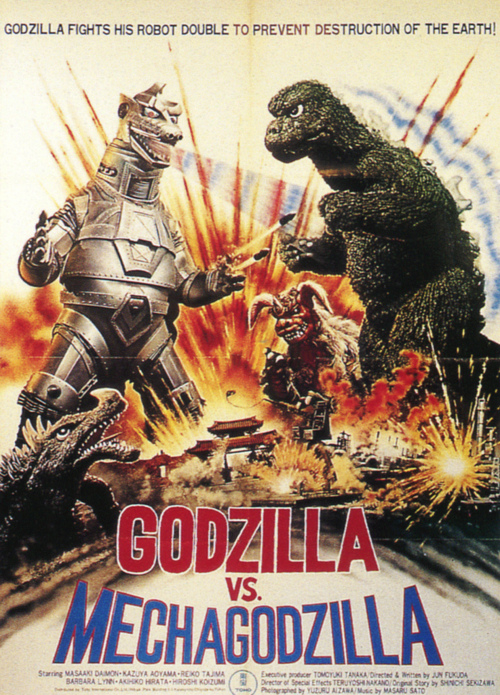
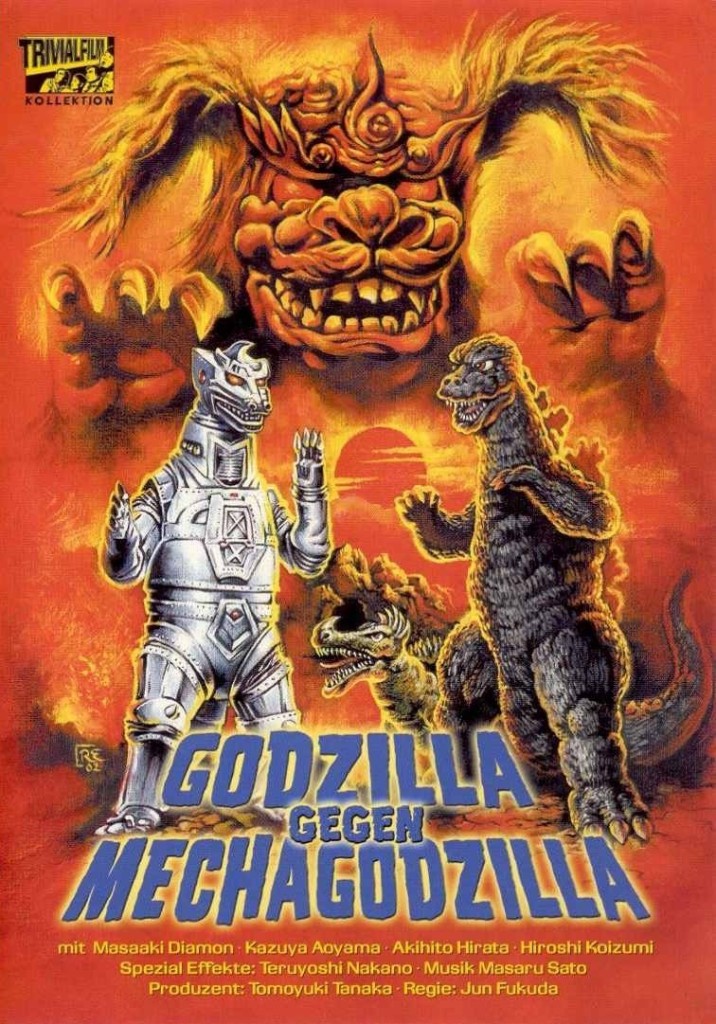
Godzilla Vs Mechagodzilla!

Godzilla Vs Mechagodzilla ~ 1974, Jun Fukuda – Japan

tumblr_lnmdktDHrG1qzfsnio1_500

It’s 1974, and Godzilla Vs Megalon is now a year behind us. Toho, no doubt still coping with the grief of knowing they had birthed Jet Jaguar into the world, decides to get right back on the horse and gives us some of that same old same old; Godzilla Vs Mechagodzilla; yet another movie that would pit Godzilla against a monster controlled by invaders from space. Returning director Jun Fukuda, who had salvaged past alien invader Godzilla films with his Zazzy directing, piles on the Zazz like a damn Zazz-machine, but at this point we’ve seen this exact plot so many times that keeping it zazzy is now easier said than done. I mean, they pile on that zazz, but right now, what we need is a new story. Not zazz.

…It’s still pretty fun, though.

Godzilla-vs.-Mechagodzilla-2

THE PLOT~ While exploring the Japanese Island of Okinawa, archeologists uncover a centuries old mural hidden in deep underground in an ancient cave system. This mural tells of a chilling prophecy, the exact wording escapes me, but essentially it boils down to this:

“A monster is gonna show up to kill everybody, but then more monsters are gonna show up, so it’ll all be cool.”

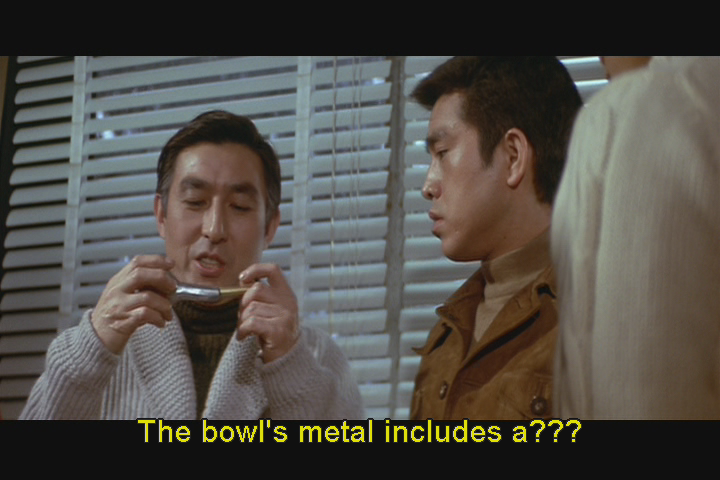
Everybody flips out when this is discovered, even though by my count that prophecy has already come true like, a million times. Whatever. They also find some Space Titanium in the cave, and some serious science shit goes down. How wild and advanced is the science in Godzilla Vs Mechagodzilla? Why, it’s so out there that the Subtitles can’t even keep up!

snapshot20141123184723

The subtitles didn’t even want to try on that word!

Soon, Godzilla pops in for his daily raid. It’s assumed immediately that Big G is the monster spoken of in the aforementioned prophecy, but something isn’t adding up. This new Godzilla sounds sorta funny, he doesn’t have the all too familiar Skreeonk style roar the Japanese have come to recognize… His spines are also shinier, and his dragon breath has a vague space-alien type quality to it… Plus, when Anguirus shows up to spend some quality dino time with his best buddy, Godzilla brutally kicks the shit out of him, which is totally out of character (Godzilla Raids Again). What the hell is going on?

Godzilla-vs-Mechagodzilla-fightHoly smokes! Another Godzilla shows up! The Japanese people’s collective mind is blown. After a short throw down between the two warring twin Godzillas, we discover the truth, the first Godzilla was a mechanized imposter, a robotic replica of Godzilla, who was coated in a false skin, not unlike Arnold Schwarzenegger in The Terminator, and also probably in real life. Of course, this robot Godzilla, forever known as Mechagodzilla, is part of an alien plot to conquer the Earth. The aliens involved are pretty lame. They’re shape shifting gorilla people.
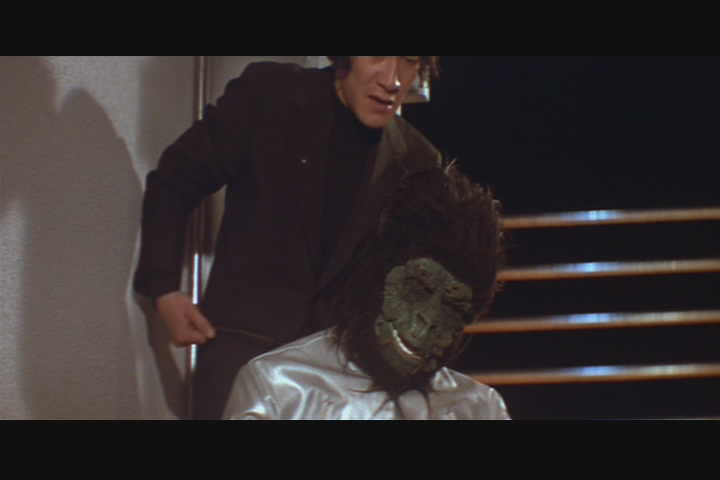
snapshot20141123184952

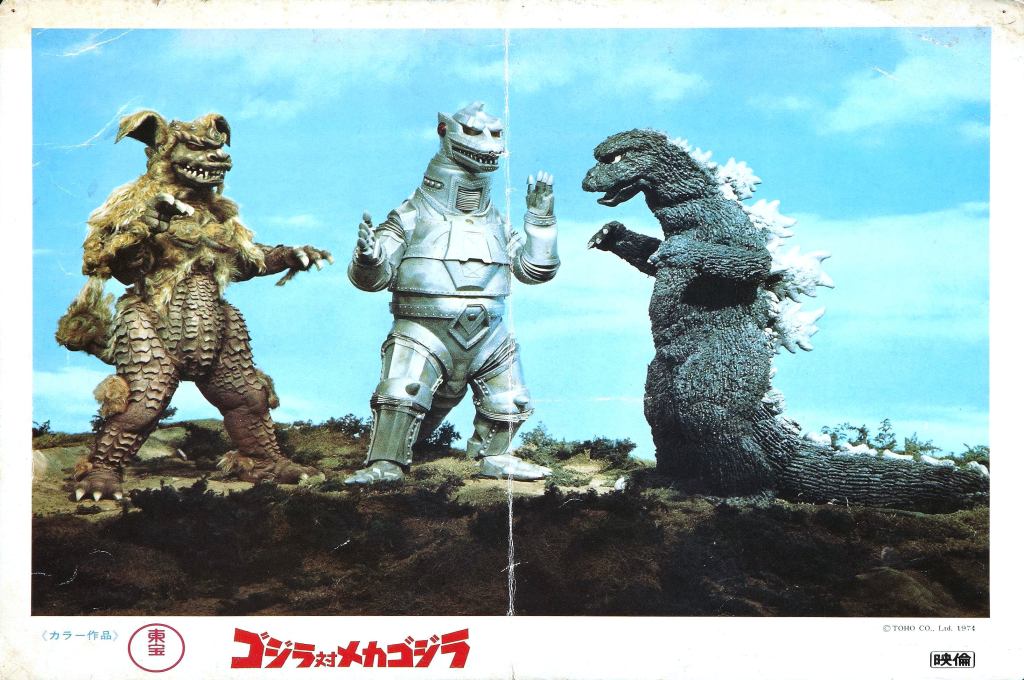
So, As part of the prophecy, King Caesar, the shaggy, lethargic guardian monster of Okinawa, is awoken, and he and Godzilla team up against Mechagodzilla. King Caesar is kind of cool, he’s a bipedal, somewhat humanoid dog/lion type creature, and I’ve never been secretive about my longstanding bias towards monsters with floppy ears. King Caesar makes Jet Jaguar look like a serious mountain of shit, but we don’t actually spend too much time with him, so he isn’t given much of an opportunity to shine. Additionally, his “guardian monster” status is slightly reminiscent of an underdeveloped Mothra, so what little we do get from him isn’t really breaking new ground. King Caesar is a bit of a missed opportunity.

godzilla_vs_mechagodzilla_jlc_01

Anyway, Godzilla and King Caesar put the beat down on Mechagodzilla something fierce, and eventually Earth is saved yet again. The final battle is sorta bloody by Kaiju standards, which is pretty cool. On the profoundly lame and bizarre end of the spectrum, however, Godzilla’s premeditated scheme to take down Mechagodzilla involves him absorbing electricity during a lightning storm so that he can magnetize his body and temporarily(?) possess metal based super powers like Magneto. I don’t know if you were able to actually read that without hemorrhaging, but the same thing happens in Ernest Goes to Jail, so I want you to think about that long and hard before you go to sleep tonight.

v5kae4yuhWgzHgkEaiG82Cow9hQ

Really, the biggest thing this movie has going for it is that it introduced Mechagodzilla, a character who would become a favorite among Godzilla movie buffs. Aside from that, it’s really sort of a lesser entry in the series. The recycled plot is, by this point a pretty major problem to contend with, and nothing else brought to the table feels fresh enough to compensate. What’s here is pretty good, but honestly, not having it be aliens would have made a world of difference at this point. Really, anything else would be better.

We have one more Showa era Godzilla film left, and then Big Green takes a long break.

C+

GZ backGZ next

Godzilla Vs. Megalon!

Godzilla VS Megalon ~ 1974, Jun Fukuda – Japan

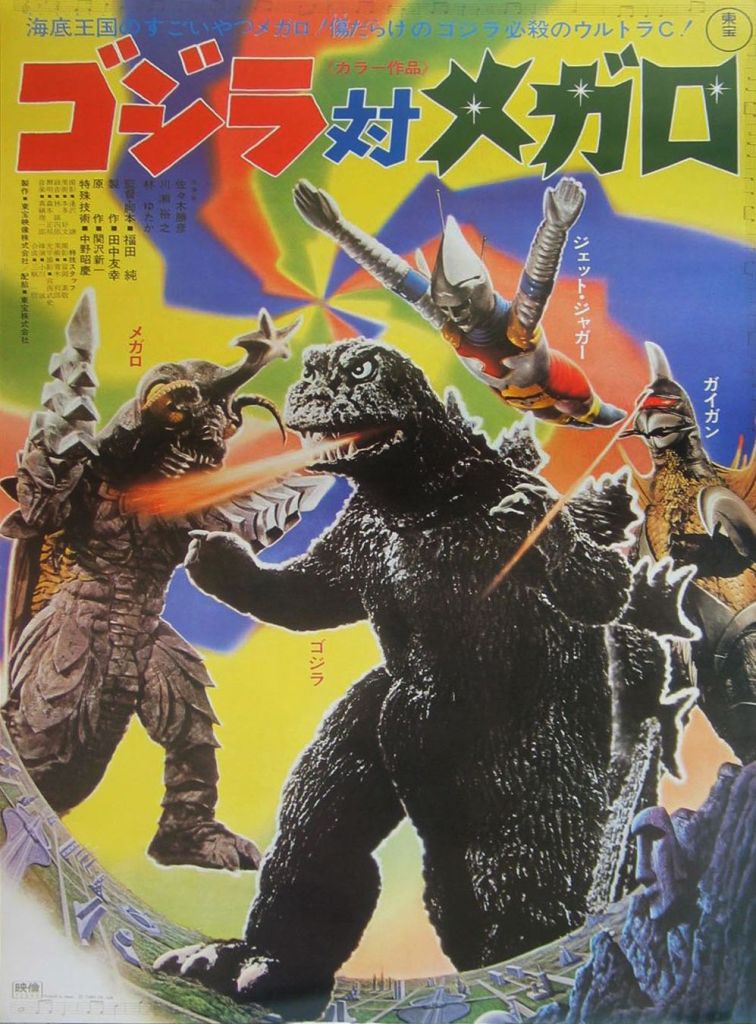
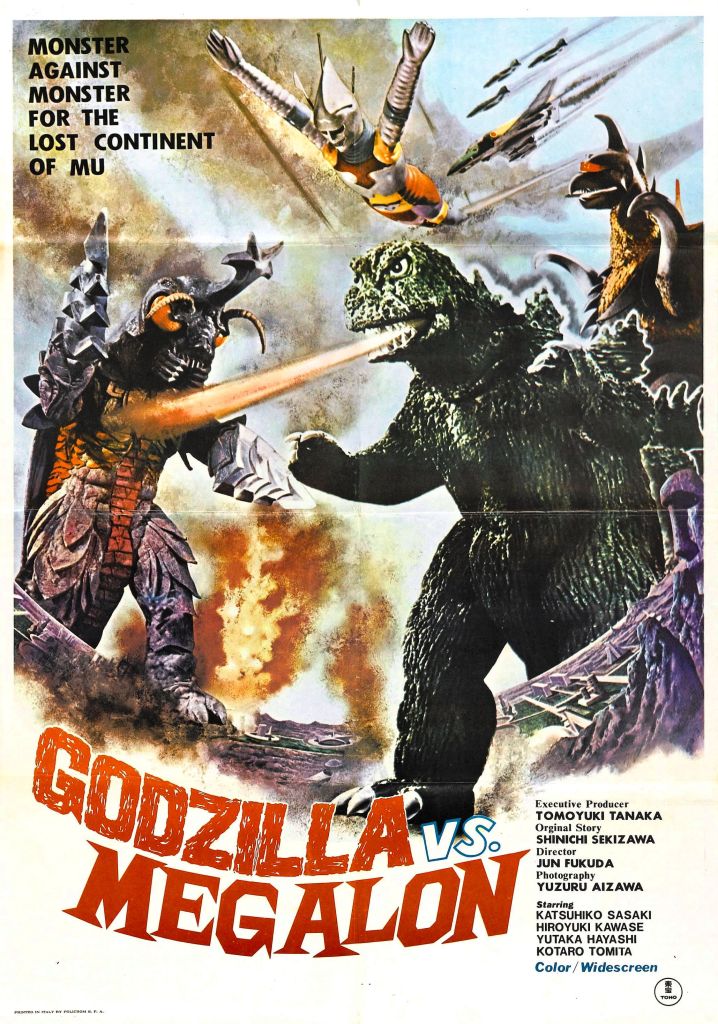
godzilla-vs-megalon-japanese-posterEven the poster is lame.

The trajectory of the Godzilla franchise has never been a straight line. Sometimes these movies are real home runs… Other times Jet Jaguar shows up. Now, I don’t want to blame everything on Jet Jaguar, but 100% of the movies he shows up in suck. Anyway, moving on; one year after Godzilla VS. Gigan, we have Godzilla VS Megalon, another kinda sorta almost recycled Godzilla film, which is still much better than the full on totally definitely recycled Godzilla films we often see. This time, the aliens who use a monster to destroy us aren’t aliens, they’re humans, from the Earth’s core… So, kinda sorta new, but not really. This movie is pretty mediocre, and that’s probably being generous…

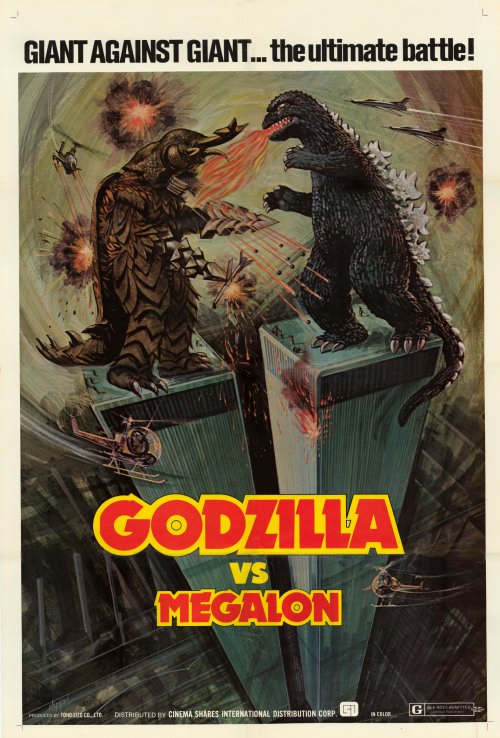
 Godzilla-Vs-Megalon-PosterTHAT’S a poster.

THE PLOT~ The people of Earth have begun conducting all their nuclear bomb tests underground. They think this is totally no big deal, but unbeknownst to them, all these subterranean H-Bombs are really pissing off the people of Seatopia, a lost, Atlantis style civilization, which exists beneath the Earth’s crust. (Also, Seatopia looks like a “Ancient civilization” themed Las Vegas casino, and their leader is an aging swinger in a toga.) Seatopia has had enough of this surface people bullshit, so they launch their defender, Megalon, which is basically a giant humanoid cockroach with drill hands that can spit fire bombs. “That outta take care of it,” they think.

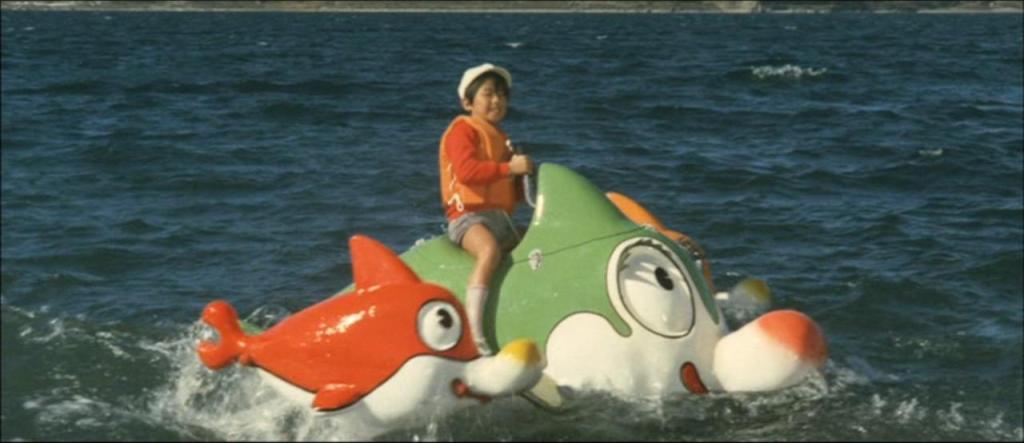
Meanwhile, up on the surface, we have our three human characters, Goro (Apparently before growing a pony tail and two extra arms) his constantly present, loyal, male companion Hiroshi (are these dudes a couple?) and their young child Rokuro, who they probably adopted together. When we meet these three, Goro and Hiroshi have brought Rokuro to a nearby lake for a nice afternoon of recreation, and Rokuro is out on the lake piloting what can only be called some sort of Aquatic Goof-Mobile.

gvmboat

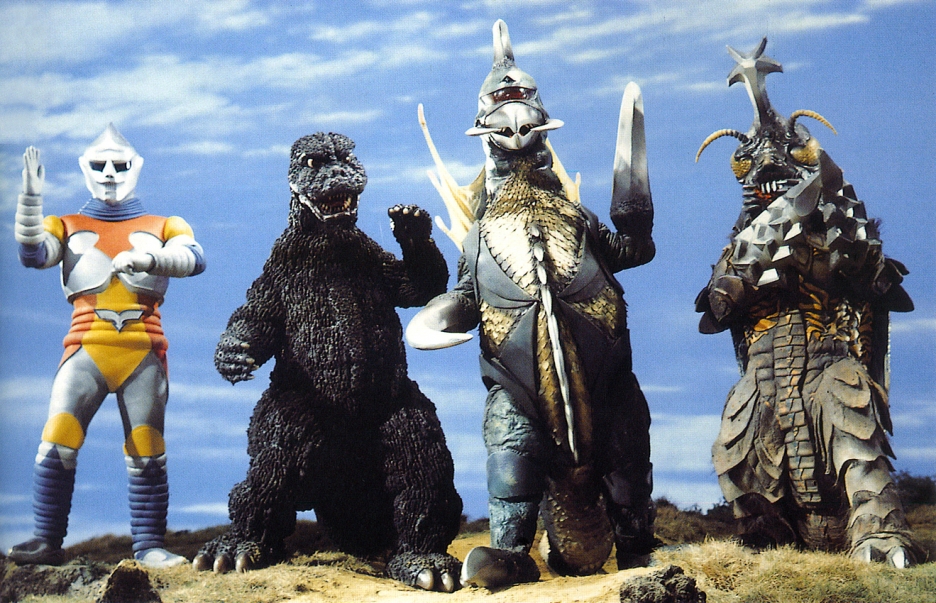
Just then, a fissure opens in the lake bed, creating a whirling maelstrom of danger and death. Perhaps this was caused by Seatopia, the subterranean bomb tests, or perhaps the lake was just tired of something so stupid looking as Rokuro’s Goof-Mobile splashing about on it’s surface and chose to commit suicide. Regardless, just when it looks like his goose is cooked, Rokuro is saved by Goro and Hiroshi, who employ the use of a Liferope Gun that they had with them. LIFEROPE GUN!? What kind of technology is Japan holding out on us? They gave us Playstation, but not the Liferope Gun? Bizarre. Not only that, but check it out, Hiroshi and Goro have also built a humanoid robot called Jet Jaguar, presumably for sexual purposes. Jet Jaguar attracts the attention of some secret agents from Seatopia who are concerned that the robot might thwart their Megalon related plans. They must not know that Jet Jaguar is totally lame. Anyway, there are some twists, some turns, Jet Jaguar is highjacked by these spies briefly, but then escapes their control and somehow gains sentience. He then zooms off to Monster Island to ask Godzilla for help clobbering Megalon, and Godzilla happily agrees because by this point he has completely turned the corner from menace to hero. Anticipating Godzilla’s involvement, Seatopia sends for Gigan’s help, because they apparently work with whatever cosmic temp agency manages him, but they couldn’t afford Ghidorah. Jet Jaguar grows to kaiju size (he can do that, I guess), and the four players beat the shit out of each other for the rest of the movie. It’s not that awesome…

Monster role call!

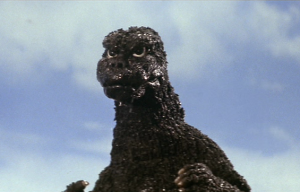
  • 936full-godzilla-vs_-megalon-photoGODZILLA- Just a big ol’ softy. In this one, Godzilla’s head has been redesigned, 713875-vlcsnap_2010_10_31_12h22m27s8his eyes are much larger, and more frontal, which gives him a more humanoid and friendly appearance. Godzilla also observes different human customs, such as the shaking of hands, and feeling insulted when Megalon taunts him with his weird monster butt-slap dance. Things were getting a little Gamera by this point.
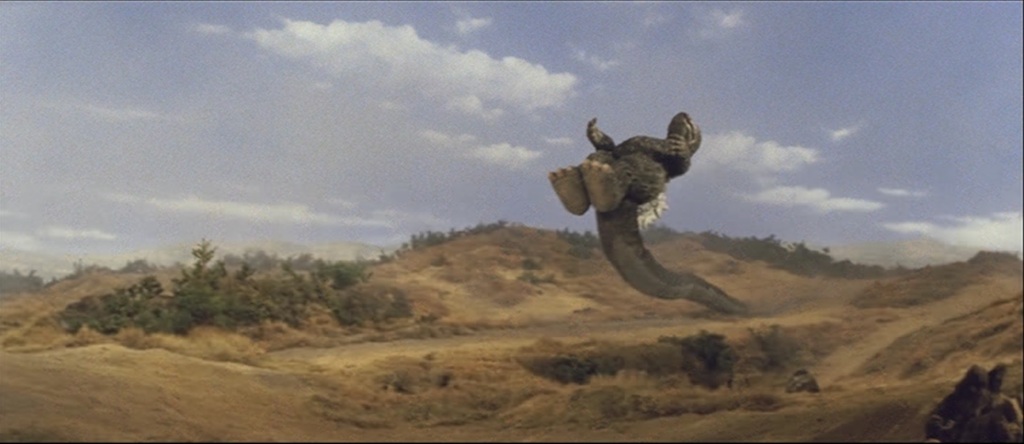
  • JET JAGUAR– A giant piece of garbage.
  • MEGALON– A giant bug.
  • GIGAN- Hey! Gigan’s back!Godzilla-Vs-Megalon-1973

So, yeah… The movie has like, several car chases in it, which is new. There’s also a lot more human on human violence, some of which is kind of goofy. The whole film is much more light and silly than recent entries, and this is the movie where Godzilla does his much despised flying missile kick, a fighting move so ridiculous it was immortalized in the opening of Mystery Science Theater 3000, a program designed to mock cinematic insolence. In fact, Godzilla VS Megalon, as a whole, was riffed left, right and center by MST3K in 1991.

godzilla-vs-megalon-3

GvM is a lull, an awkward misstep between the introduction of the relevant and much loved Gigan in the previous film, and the introduction of the relevant and much loved Mecha Godzilla in the sequel the following year. It’s a fumble, but it’s not super terrible. Really, GvM isn’t much of anything.

C-

GZ backGZ next

Godzilla Versus Gigan!

Godzilla VS Gigan ~ 1972, Jun Fukuda – Japan

Godzilla_vs_Gigan_1972

After the radical change of pace that was Godzilla VS Hedorah we are again back in step with more traditional Toho fare on Godzilla VS Gigan, yet another recycled alien invasion/Godzilla film, directed by Jun Fukuda. Godzilla VS Gigan reuses, for the two billionth time, several plot devices introduced to the franchise way back in 1964’s Ghidorah: The Three Headed Monster, but Fukuda manages to breathe a little bit of life into the picture with his zesty directing and keeps it feeling fresh enough… But just barely.

THE PLOT~ Gengo is a struggling, out of work cartoonist (Preaching to the choir, buddy) with a resourceful nature and a plucky thirst for adventure. While at a job interview (Wait, what?! You serious?!) Gengo becomes suspicious of his would be employers, World Children’s Land, who are currently building a theme park intended to promote world peace and also giant, horrible monsters who smash and kill people. Gengo, falls in with a few other characters interested in exposing whatever conspiracy World Children’s Land has brewing, and together they uncover the truth. You’re never gonna believe this, guys, but the people running World Children’s Land are actually a bunch of body snatching aliens. Thin ice, Toho, you’re really pushing it. Anyway, these aliens, who are actually giant cockroaches wearing human holograms, intend to destroy mankind, and also Godzilla, and their plans to accomplish this involve two space monsters, whom they control. Gengo and his pals plan to put a stop to this astro-roach bullshit, and that’s the movie.

Let’s do a Monster Roll Call.

  1. GodzillaScreen Shot 2012-09-20 at 10.49.53 AMOnce a towering, insurmountable force for death and destruction destined to blanket the Earth in grim darkness, fire and blood, Godzilla is now totally cool and nice, you guys. Not only is he no longer a bad guy, but in Godzilla VS Gigan, he’s a damn underdog. Most Godzilla films portray him as an unstoppable, scaly juggernaut, the unbeatable conclusion to any conflict, but in GVG it kinda seems like his monstrous snout has finally bit off more than it can chew. He really takes a lot of abuse this time around, including, at one point, a full on Ghidoriah lightning bolt attack to his dragon balls. Rough. (NOTE: Apparently, this shot is actually recycled footage from Ghidorah: The Three Headed Monster. So, apparently this has happened to Godzilla twice now!)
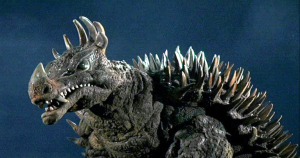
  2. Anguirus21956 Anguirus has also come a long way from being Godzilla’s most hated rival to the sturdy, dependable, four legged BFF we see in GVG. Now he’s like, the “solid dude” of the kaiju kingdom, Anguirus is the monster who would come over to help you move. I mean, he’s a quadruped, with no apparent dragon breath or laser eyes, so his offensive capabilities are pretty much limited to biting and just being spiky, but he’s still out there in the fray, taking his lumps and doing what he can to back up his bros. If Godzilla seems like the underdog in this battle, Anguirus is straight outclassed, and you might find yourself worried about the little guy. I know I was!
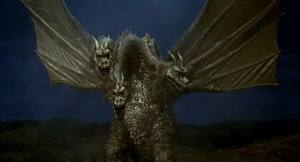
  3. King GhidorahShowa_King_GhidorahWhat is Ghidorah the king of, anyway? Pissing me off, that’s what. Anytime aliens pop in, they summon Ghidorah from the cold recesses of space to shriek, fly around, wiggle his three heads and barf lightning at everybody. GVG is no different, which proves just how successful his outer-space Craig’s List ads are.
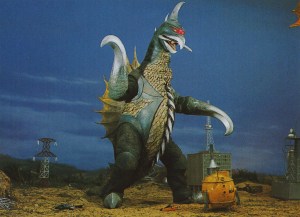
  4. GiganGVG_-_Gigan This guy is the big addition to GVG. Gigan is basically like, the Boba Fett of the Kaiju world. He’s a cypher, he has no purpose and no drive of his own, he’s here to do his job; kill monsters and bust shit up. He’s like a giant monster hit man, hired on by aliens to dish out the death, because truly, that is what he was made to do. This damn thing has no hope of ever living a normal life, and that is by design. Every limb he has ends in a straight up blade, his face alone has four different slicers poking out, and his fucking belly has a fully functioning buzz saw embedded in it. The only means of manipulating an object that Gigan has is to slice the hell out of it, even just picking something up is out of the question unless it can also be impaled in the process. He is super cool, though.
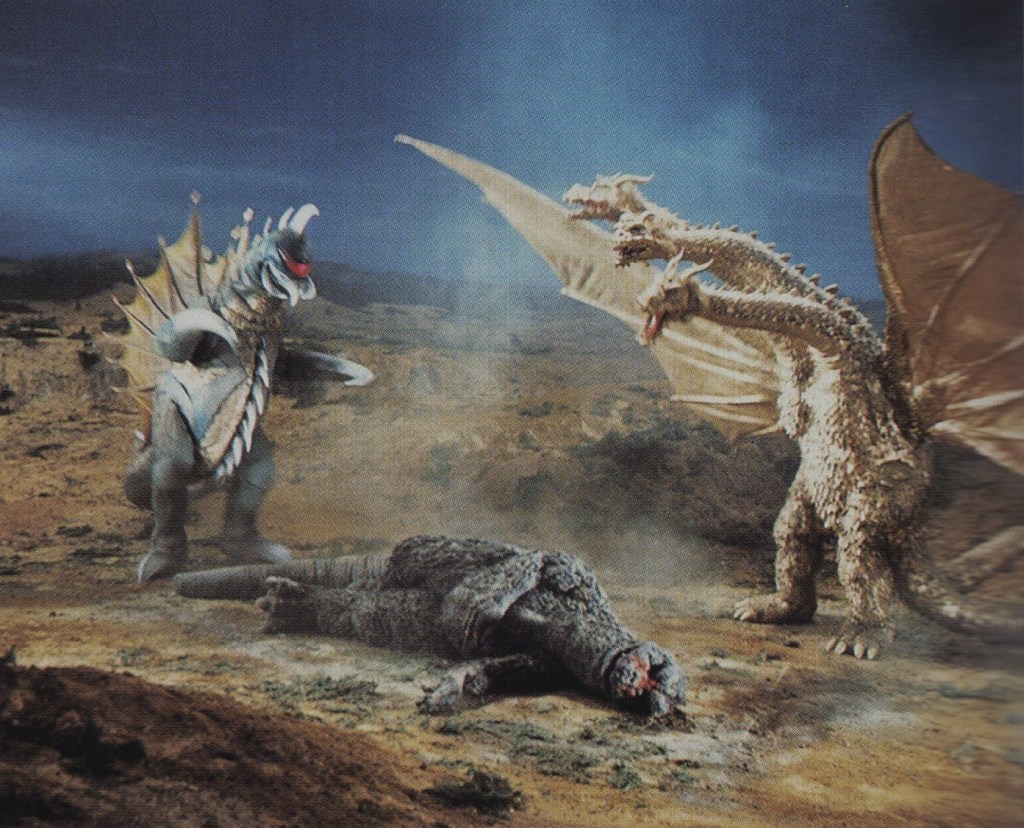
The big monster brawl at the end of the picture actually stretches on for quite a bit of screen time, but it’s excellent. Actually, it might be the best fight in one of these movies yet, certainly it owes more to the big throw down between Godzilla and Hedorah than what was seen in Ishiro Honda’s more reserved, classic feeling Godzilla pictures. Fukuda’s dynamic use of camera works wonders here, the fight feels epic, dirty, painful, frantic, desperate, and mean. Ghidorah and Gigan have the run of the place for most of it, and they really kick the shit out of our boys. Godzilla spends some time down for the count, with Gigan and Ghidorah almost toying with him, beating him mercilessly as he is unable to even regain his composure. Anguirus tries like hell to save Godzilla and take these mercenary dragons down, but he’s utterly outmatched, and thus, is subjected to a series of violent beat downs the likes of which he has not known in centuries. There’s actually a bit of monster blood spurting and dripping in this one, and it really ups the ante and gives this conflict a greater sense of urgency. These guys are really getting hurt!

GVG_-_Godzilla_is_Down_Before_Gigan_and_King_Ghidorah

As usual, a crucial part of the human plan to turn the tide is to defeat the aliens and free any monsters that might be under extra terrestrial control. In order to achieve this, Gengo and his pals launch the most harebrained scheme I’ve ever seen; they literally load a bunch of boxes of dynamite into the elevator of the alien control tower, and then drape a black and white poster with cartoon drawings of themselves in front of the boxes, hoping that this super intelligent race of aliens 1) won’t notice them loading up their elevator with boxes of explosives and 2) won’t know the difference between living breathing humans and black and white cartoons, and will therefore open fire, detonating the explosives and destroying Martian H.Q. It totally works. If your alien race is dumb enough to fall for that, welcome to the Darwin Awards, you do not deserve to continue your intergalactic imperialism.

As said before, this is mostly another “been there, done that” Godzilla film, but Toho manages to squeak by thanks to Fukuda’s talents and in the end we have yet another enjoyable entry in the franchise. It’s more than a little maddening to know that they really see no issue with repeating essentially the same plot over and over and over again, but whatever. I still liked it. Everything else works and even the human characters are pretty likable, except for Gengo. This a-hole turns down jobs and then models a cartoon monster after his attractive and supportive girlfriend who just so happens to have a black belt in an unnamed field of the Martial Arts. Dude- screw you, man. On behalf of unemployed cartoonists everywhere, I hope you are eaten by Rodan.

B

GZ backGZ next

Godzilla VS Hedorah!

Godzilla VS. Hedorah (AKA Godzilla VS The Smog Monster) ~ 1971, Yoshimitsu Banno – Japan

godzilla_vs_hedorah_poster_01

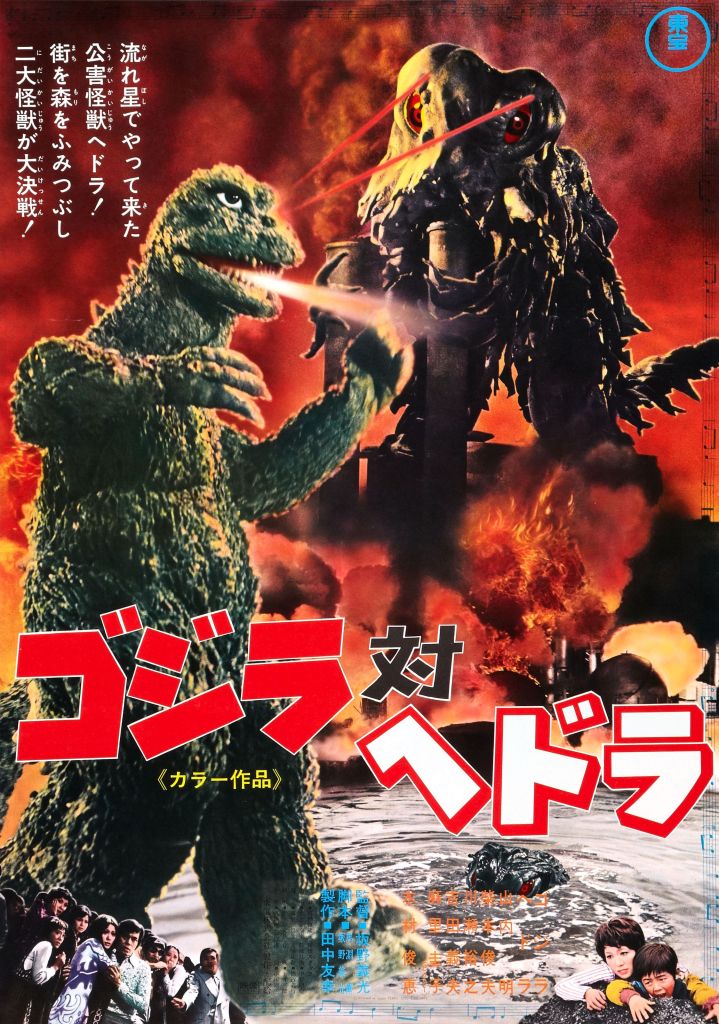
I’m going a little off the rez with this one, because I’ve learned that common G-Fan consensus is that this is a lesser, or even one of the worst of the Showa era Godzilla flicks, and I totally love this movie.

Yes, I’ll admit that it’s goofy, but it was only a few movies ago that Godzilla did a damn victory dance on Planet X. Is this really that much goofier? That was a real low point. And anyway, Godzilla VS Hedorah is also notably darker than it’s recent predecessors, and it makes up for its various short comings by having the most fascinating composition seen in a Godzilla film up to that point, with the exception of the original 1954 film. This is the first Godzilla movie to actively campaign from a new perspective, the perspective of Japan’s 1960’s/70’s youth culture, which is exciting. It’s kinda like younger generation managed to wrestle the megaphone away from their parents and, for the first time, finally had a chance to make their own statement. I totally think it holds up, Godzilla VS Hedorah proves that there is enough room within the Godzilla metaphor that it can mean more than one idea and carry relevance from a broad range of individual perspectives. If Jun Fukuda’s turn in the directors chair felt like a breath of fresh air back in Ebirah: Horror of the Deep, Yoshimitsu Banno here feels like a whirling hurricane of fresh air, heaving your home off it’s foundation and smashing your car windshield.

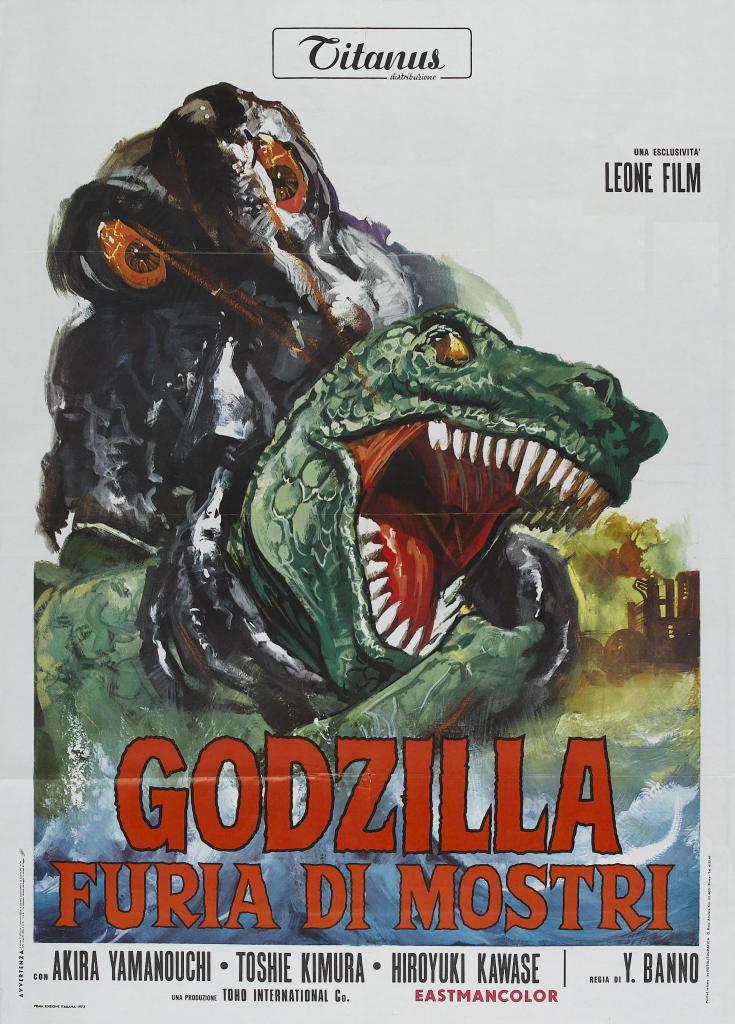
godzilla-vs-the-smog-monster-italian-poster

THE PLOT~ Japan has become horribly, horribly polluted. Like, incredibly polluted. It’s pretty over the top. From within this bog of toxic muck and rotting trash, we have the birth of a new organism, totally unlike any other on Earth; Hedorah, a big tadpole made out of slime and garbage that thrives off pollutants and likes to sink boats. Hedorah makes a big stink doing just that, and Japanese scientist Dr. Yano sets out to study the creature, because he is a scientist, and monster studying is the only steady work a scientist can get in 1970’s Japan.

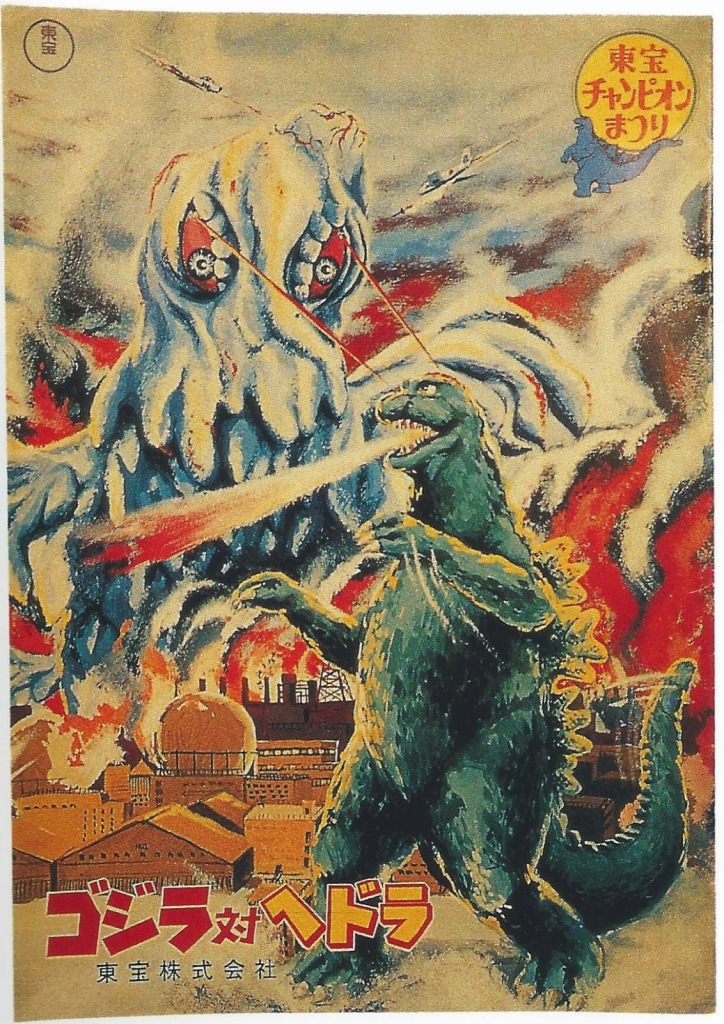
Godzilla vs Hedorah (Japan, theatre program, Style B)

More central to the story is Dr. Yano’s son, Ken, who is actually our main character. We see the film from his perspective. Ken, like many Japanese children, has a fascination with Godzilla, who by this time had become less of an atomic, dinosauric bogeyman and more of a weird, semi-anthropomorphized antihero. Ken believes that Godzilla will save mankind from the Hedorah’s deadly toxic rampage. And Godzilla totally does.

When we meet KeGodzilla vs Hedorahn, he’s playing with Godzilla toys in his backyard. Throughout the film he claims to have dreams and premonitions of Godzilla rising up out of the sea to rescue mankind from Hedorah, who has evolved into a biped with the ability to fly, and has decimated Tokyo, leaving many dead. The film is presented in a strange, almost dreamlike manner, inter-cutting jazzy 70’s split-screen techniques, frightening hallucination/dream sequences, and even occasional short animated sequences, which really lends credibility to the idea that this film could actually just be Ken’s fantasy. Perhaps we never really leave the backyard and Ken’s clunky, plastic monster dolls are playing out the events of Godzilla VS Hedorah for us. While the movie certainly presents itself as being cannon, there is enough here to justify the “child’s fantasy” idea, and the movie is open ended enough, if you want it to be. Several important monster related plot points are triggered by Ken’s “visions”, and these sometimes carry an odd imaginative feel, such as when Ken claims to spot Godzilla lurking unseen by anyone else amongst the city’s skyline while riding a roller coaster.
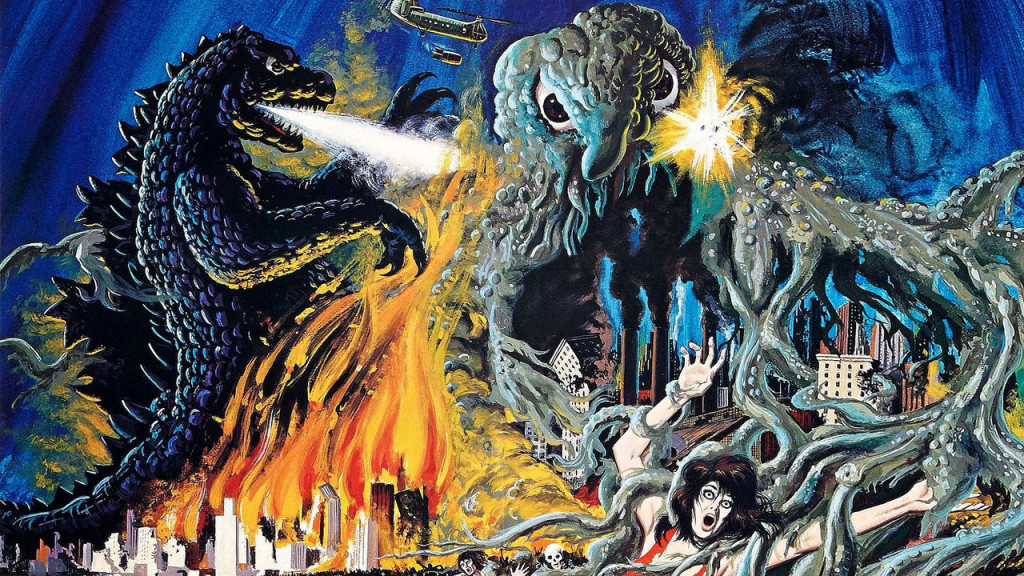
Godzilla_vs._Hedorah_2_-_Cartoon_Final_HedorahAnimation was weird in the 70’s.

Another important character in the film is Yukio. Yukio represents the more active, optimistic youth culture of the Japanese 70’s. He and his peers are eager to try and wrestle the fate of Japan out of the hands of their elders, who have apparently mismanaged it to the point that a damn trash monster was born. Yukio organizes a youth demonstration to take place atop Mt. Fuji when the fate of Japan is at it’s most bleak, and this sequence is especially painterly, and also telling of the film’s thesis statement. While Yukio and his cohorts dance merrily to some swinging, funky 70’s jams in the face of certain Smog Monster related doom, strange, aged figures sit in silence hiding amongst the tall grass just outside the light of the bonfires. These figures are motionless, and drained of color, they merely watch from their hiding places as the young people take the stage. While the appearance of these figures isn’t explained, I think the movie is fairly open about it’s dual-message intent. One could argue that they are merely the elderly locals, watching with curiosity the antics of these teens from the city. They could also quite likely be literal ghosts, mournful at their own shortcomings in securing a bright future for their country, and eager to see how this new generation will handle their nation’s new challenges. The actual truth behind what these figures are is entirely inconsequential because the film’s thesis remains the unchanged by a definitive answer. Whichever they are, they serve the same purpose, and I feel convinced that leaving things like this somewhat open for interpretation is more Banno’s style anyway. I’d love to hear what he had to say about them.

Ken being our lens through which we view the world in Godzilla Versus Hedorah is a conscious and powerful story telling device even beyond giving the movie the plausible claim to being a child’s fantasy. It let’s us understand the severity of the situation in a way that couldn’t carry the same weight from another point of view. For Ken, the outcome of this story is even more crucial, because as a child, Ken represents the future. In fact, he and Yukio form a two headed youth culture monster with Yukoo representing the young adults of today who are now arresting control of the situation from their woefully inadequate predecessors, and Ken representing the youth of tomorrow, themselves still powerless to do anything but hope. This was this new generations chance to say something, and through these two, Godzilla takes on a new meaning, shedding his role as a grim specter of atomic war and instead becoming a figurehead for socially motivated change. He burns up the old with his radioactive breath and paves the way for a new age of improved, socially conscious adults to build a world reflective of their values. In this film, Godzilla means, change, improvement, and rebirth, and that’s a testament to his validity as a cultural phenomena. Some might argue that this is throwing out the component of Gojira that worked best, but I would point that even religious figures can take up new characteristics reflective of their eras. All this lends more legitimacy to Godzilla as an idea, not less, because it proves that he has become a broader metaphor and can represent a new, yet equally crucial idea for each generation. And anyway, by this point, I think we had already strayed so far from his nuclear horror film roots that the integrity of this franchise was more than capable of handling this additional change. Again, Godzilla, by this time, had become a bigger cultural phenomena than Gojira could have predicted, and it now belonged to the entire world. The perspective of one nation, locked in one moment in history, could no longer contain this figure, he had made the leap from a plot device, to a folk character, something few intellectual properties can hope to achieve.

dD7KWrsuChQfz5JY4YFEu6iWFpE

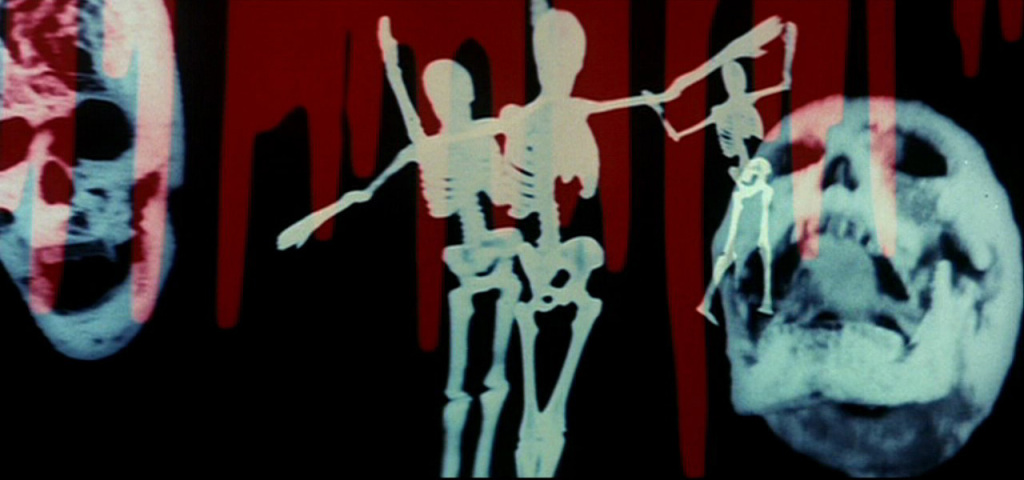
So, while Godzilla VS Hedorah is in some ways the most childish entry yet, it’s also the darkest Godzilla film since his original appearance. Banno and the youth of 1971 want you to know the highs, but they also want those highs to mean something, so you’re going to also become very well acquainted with the lows. The movie uses very dark, loaded imagery, prolonged photography of thick, slime like sludge dotted with garbage coating the sea, black skies, thick, curling smoke, a disintegrating mannequin floating in black oil, a broken clock drifting in gunk. At one point we even see a live, crying, human baby, buried up to it’s shoulders in toxic sludge. These are heavy handed images, but the vibrant, exuberant culture that informs the perspective of Godzilla VS Hedorah really want you to understand and believe that at this time, in their mind, there was no more crucial battle to be fought, and the movie wants you to feel convinced that this is our darkest hour. The deaths in this movie are numerous, and we see them in no uncertain terms, human skeletons, their flesh dissolved by Hedorah’s acidic omissions, are a common and gruesome sight. The aforementioned final show down between Godzilla and Hedorah atop Mt Fuji is filmed so stylish and bleak that it looks like the last shot from Fulci’s The Beyond. The movie doesn’t hold back when it comes to the grim, or the silly.  How much more childlike does it get?

Godzilla_Vs_Hedorah_man_Like_Skeletons

Whoa, did we get lost and wander onto Hausu?!?

Well, a lot more child like; this is the movie in which Godzilla damn flies. This did not go over well amongst kaiju fans, and with good reason, it’s dumb as hell. He achieves flight this by curling up into the Godzillasaurus fetal position and rocketing off using his dinosaur breath as propulsion. This means, of course, he’s flying backwards, but really, that’s just one problem on a long list with this idea. It’s not good, and it shouldn’t have been in the movie, but honestly, it’s not killing the picture for me. Especially not when I’m already looking at this as most likely being a vivid metaphor or a child’s fantasy. In any case, Godzilla takes on the abilities and characteristics needed of him, which again, harkens back to a more folksy and less self conscious form of story telling, and I can deal with it.

One more thing I want to high light; Godzilla’s incredibly violent “finish him” style execution of Hedorah. So awesome. Apparently, Godzilla really, really hates Hedorah. First, he kills him (we think.) He then proceeds to rip out the creatures eyes with his bare hands. Oh, snap, Hedorah is actually not quite dead, he makes a break for it and tries to fly away! Nope, Godzilla’s not having it, he chases him down, beats his ass a little, drags him right back, zaps the life out of him a little more, and then proceeds to desecrate the shit out of Hedorah’s lifeless corpse, a process which includes ripping it open, tearing chunks off and scattering them wildly all about, stomping on him, frying the individual pieces, and frantically looking around to make sure that there aren’t any extra pieces of him which need additional murdering. I mean, Godzilla makes absolutely sure. In every slasher film where they just assume the killer is dead and walk away, what they needed to do was take a page out of Godzilla’s Handbook; specifically, his Hedorah Policy, cuz damn is it thorough.

Banno was no young buck when this film came out, based on the information I was able to dredge up he was about 40 when he directed this picture, but that’s still twenty years younger than Ishiro Honda, the director of most Godzilla flicks up to that point, and clearly, Banno had a connection to the ideals of Japans youth culture that Honda did not. His radically new perspective is plainly felt in this film, and I think he did a great job with it.

In the end, judgement has been passed on this film long ago, and it wasn’t favorable. However, now there is an oportunity for a new generation to look at it with fresh eyes and make up their minds for themselves, and chances are, they’re going to hate it for all new, all different reasons. I actually think this is a pretty great entry in the series, and I love what Banno did with the ideas the franchise offered him.

B+

GZ backGZ next

ALL MONSTERS ATTACK!

All Monsters Attack A.K.A. Godzilla’s Revenge~ 1969, Ishiro Honda -Japan

all monsters attack

I watched this movie probably 135 times as a child. That makes it hard for me to declare outright that All Monsters Attack is a total piece of crap, even if part of me does want to say that… But that would be dishonest, after all, the film is intentionally geared for a young audience, and I seemed to like it just fine when I was a kid. I can say this, though; for adults, it’s rough. Especially the English dub. Brutal.

The movie focuses on Ichiro, a little kid who nobody likes, least of all the you, the viewer. Ichiro bumbles around sucking at all things, and periodically falls asleep, launching his numerous dream sequences, all of which take place on Monster Island, eternal battleground of giant friggin’ beasts, and therefore the least safe place in the world- but it is here that Ichiro pals around with Minilla, Godzilla’s doofy and equally unworthy son, and slowly learns to stand up for himself and be less of a little bitch. Most of the movie is either Ichiro in the real world, which is super, super depressing, Ichiro on Monster Island, which is goofy, or scenes of Godzilla kicking thing’s asses, which is awesome.

And really, that’s about it for All Monsters Attack, plot wise. The English dub is excruciating, Ichiro sounds like a screeching, annoying little nerd, and that’s really what he is. He had to learn to not suck via dream sequence life lessons, but I would think the same effect could have been achieved if someone had just shaken him and screamed “NOBODY GIVES A FUCK ABOUT YOUR SHIT, KID, QUIT SUCKING!” right into his face.

I also feel the theme song at the beginning is worth mentioning. Even as a child I thought it was weird, it’s this strange hot jazz/angry funk acid nightmare, listen to it here.

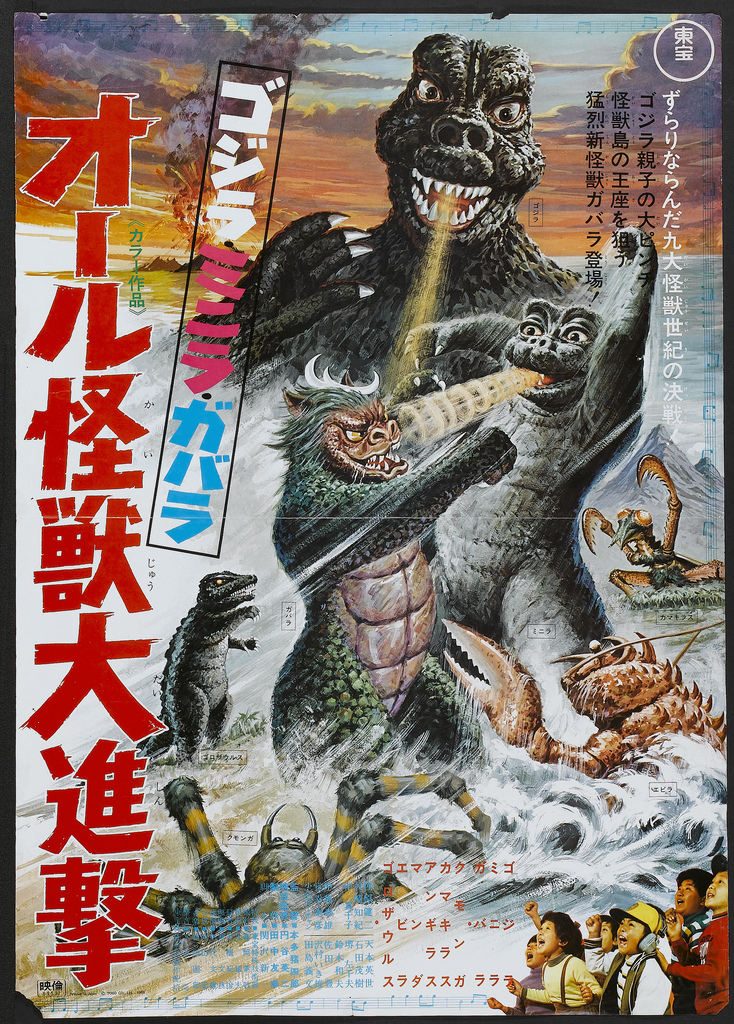
Godzillas-Revenge-Poster

The movie is too uneven, even as a kid’s film. The “real world” sequences are bleak and depressing, which I can remember is how I generally felt about them as a child, even if I could not yet articulate that. Meanwhile, the frequently fast-fowarded to Monster Island sequences delivered the goods, because they packed in like, so many damn monsters. That was probably what made this movie a regular in my childhood VHS rotation, high monster count.

One of the lesser Toho Godzilla films, and possibly the worst Showa outting for Big G..

C-

GZ backGZ next

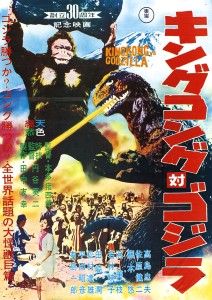
KING KONG VERSUS GODZILLA

King Kong Versus Godzilla~ 1962, Ishiro Honda – Japan (Later reedited for American release)

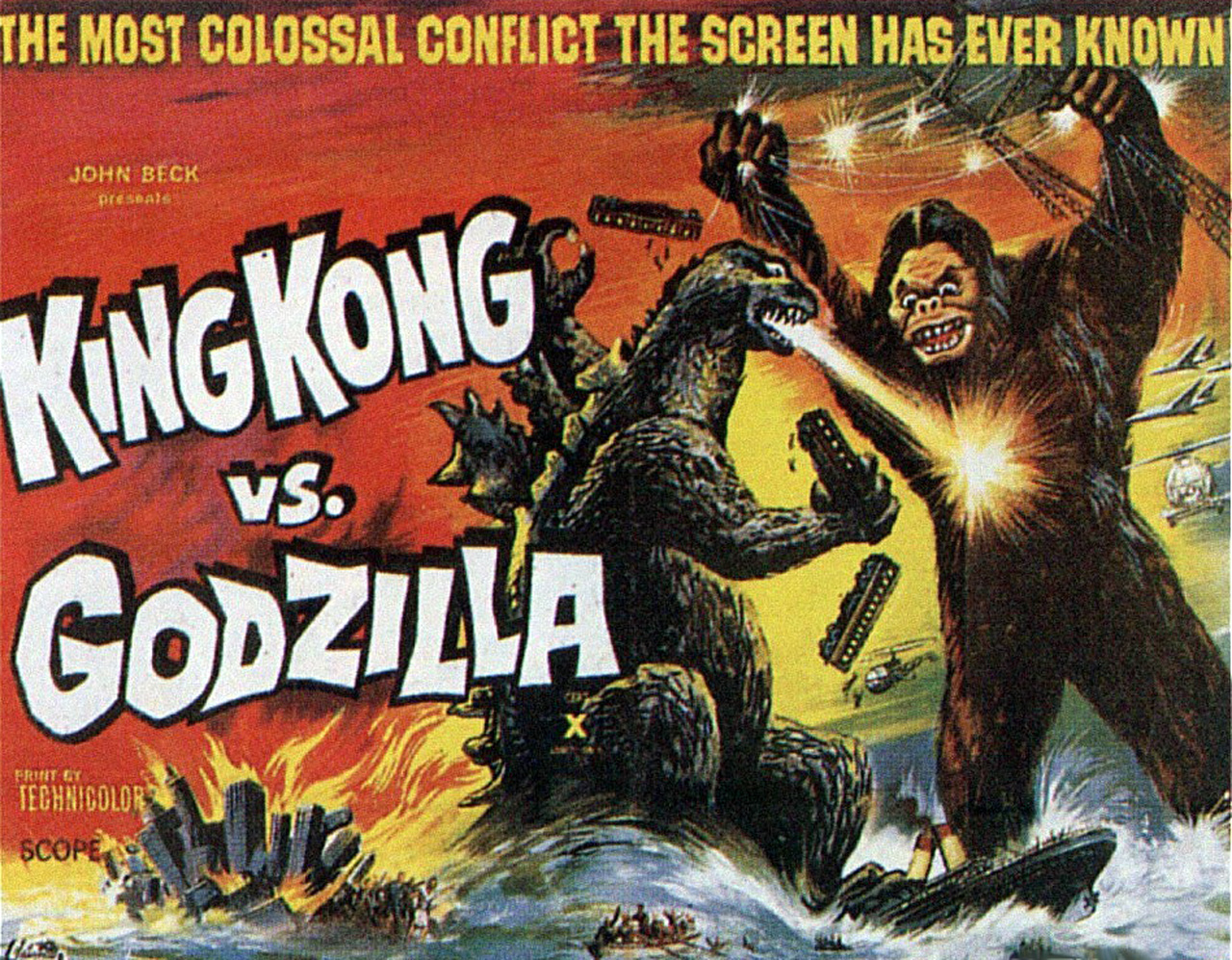
king-kong-vs-godzilla-1

THE PLOT: Scientists discover a mysterious berry on a remote island which can totally get you high.

kong high

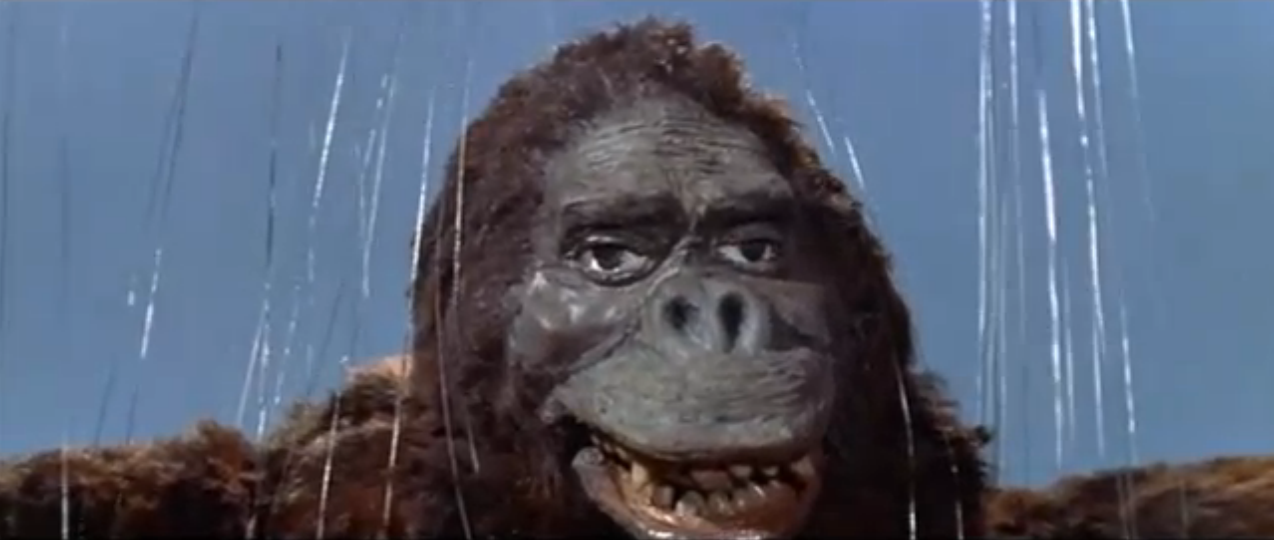
This is King Kong, and he loves those berries.

Immediately, the race is on to collect these psychedelic berries, mash them into juice and sell them somehow. Coincidentally, the island these berries are found on is also home to King Kong, who some scientists theorize could have possibly reached his large size through repeated ingestion of these magical krunk berries, because there is ample evidence to show that Kong is a habitual berry user. So, while on the island, the decision is made to capture Kong, too, why the hell not? Meanwhile, Godzilla busts out of his iceberg prison from Godzilla Raids again, and he’s pissed about it. In the end, the decision is made to pit Godzilla’s “tail swipes and dragon breath” based fighting style against King Kong’s fighting technique, which, as everyone knows, is entirely predicated upon the availability of boulders. Having giant monster trouble? For Japan, the answer is always “Add another monster.”

film_shorts_2

This will work itself out.

Like all early Godzilla films, this move faced re-editing and the filming of additional “White people” scenes for American distribution. These scenes, I’m convinced, do not help, because they never, ever do. Ever. The white person version is the only one I’ve seen, though, so I guess I don’t know that for a fact.

098d6734bb41acacbfac3be58f3b113c

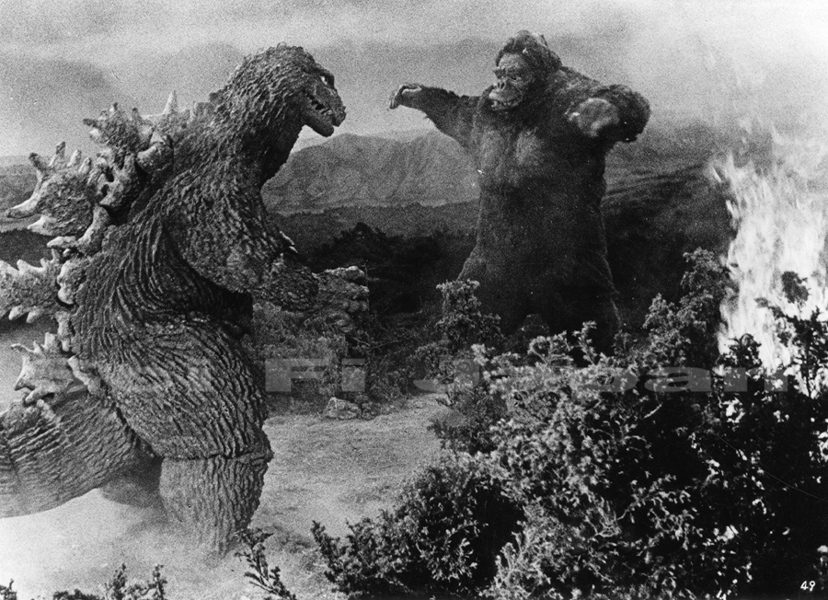
So, the movie isn’t very good. The effects are surprisingly cheap, and the suits look terrible, especially King Kong and his sometimes elongated monkey arms. The monster scenes aren’t exciting, and the humans are also predictably disinteresting. The film is noteworthy, but only because these really are the two most famous giant monsters ever, so pitting them against one another is a big deal. The movie was also really, really successful. And wacky. This is a much sillier film than any preceding Godzilla movies, all that gloom and terror from Gojira has been traded for zany antics of near Abbot and Costello levels. I’m serious, this shit is straight goofy .

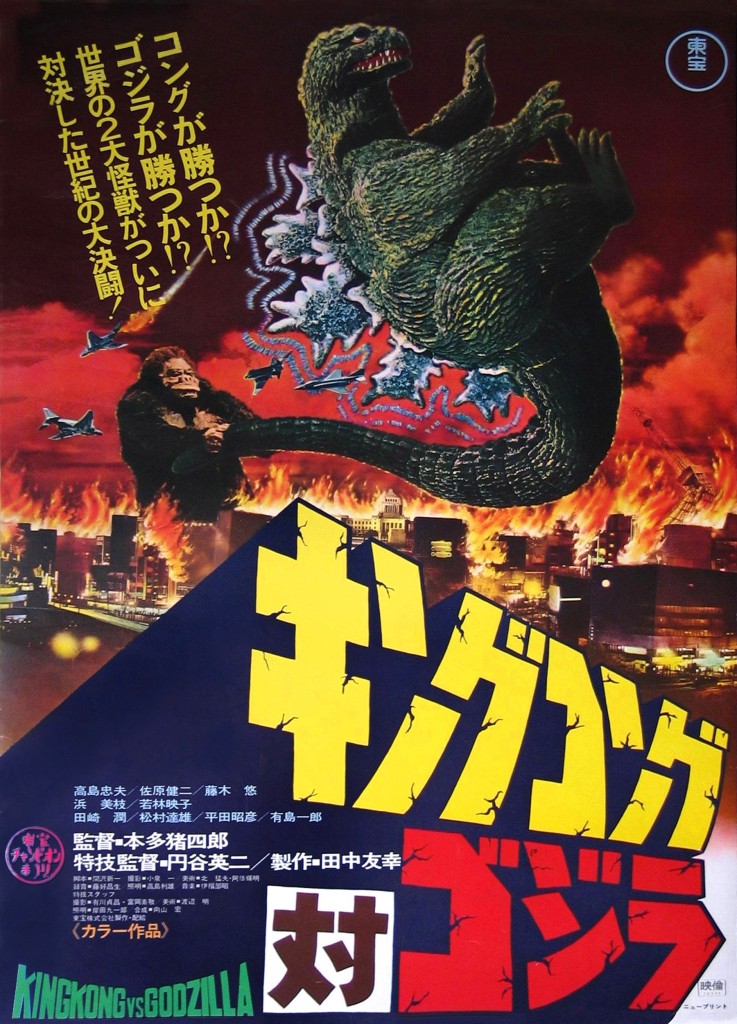
king_kong_vs_godzilla_poster_01

Really quick, I want to get back to Kong’s berry usage, because it’s pretty hilarious. The way they deal with Kong problems in this movie is just to present him with the opportunity to get wasted on berries, which he always immediately accepts without hesitation, and then he just passes out and they can chain him up or drag him onto a boat or kill him or whatever they need to do, no problem. This dependable “off-switch” for Kong makes him much more manageable than Godzilla, who has no known substance abuse problems. In this way, Kong becomes our de-facto “good guy,” because he’s controlable.

Another reason the movie is noteworthy? It’s full of what appears to be Asians in blackface, imitating… South Americans? Africans? It’s hard to tell what they were shooting for, but those definitely look like Asian people painted dark, pretending to be non-Asian people. They do the same thing in Mothra.. I’m not sure how to comprehend that kind of racism, but here it is, for future generations to ponder.

C+

GZ backGZ next

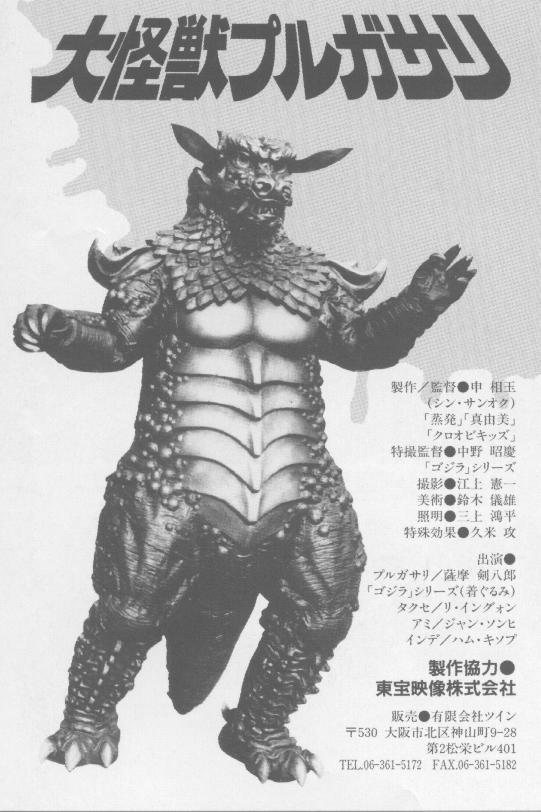
PULGASARI!!!!

Pulgasari~ 1985, Chong Gon Jo and Sang-Ok Shin

pulgasari-card2

In the case of Pulgasari, nothing that happens on film is as important as what happened behind the camera. For reals, you guys.

Pulgasari is a product of North Korea, produced by, and made under the watchful, giant glasses of Kim Jong-Il, then son of fascist dictator Kim-Il Sung. The film’s director, Sang-Ok Shin was a South Korean director who Kim Jong-Il deliberately arranged to be kidnapped and brought back to North Korea with the express purpose of forcing him to craft propaganda films. It’s a set up more than worthy of a film itself, and it really happened.

One of the films brought about through this insane, childish union of sheltered, detestable puppet master and horribly victimized kidnapee is Pulgasari; a confused bit of communist propaganda packaged as a quasi-Godzilla imitation.

As much as the desire to hate this movie because of it’s connection to Kim Jong-Il might motivate critical bias, the truth is that Shin’s directorial talent shines and the film is actually pretty good, and certainly fascinating due to it’s history. It’s rare that a blatant violation of human rights results in a corny monster movie, but this time we got lucky.

THE PLOT- Korea- Villagers toil in fruitless labor, slowly starving to death as their leach like government sucks them dry of resources without the faintest regard for their quality of life. (It’s difficult for me to place what era Pulgasari takes place in. They have no electricity, no medicine, no science and no technology to speak of, and it’s North Korea… So… 1998? I imagine that, throughout Pulgasari, there are people on the other side of the North/South border checking their E-mail.) As the people are slowly beaten down by their corrupt monarchy, a dying, imprisoned blacksmith fashions a tiny golem like figure of a monster out of mud and rice. With his dying breath, he prays to the gods to bring life to his creation, and then they totally do. As rebellion amongst the peasants leads to all out revolution, this small monster begins to devour metal, especially iron, growing exponentially in size and power as he does so. Soon, the all-but invincible beast is discovered and named Pulgasari, and the villagers use his might against their oppressors, eventually leading them to victory.

And for seven or eight minutes, everything is awesome, until the peasants realize that they were only able to achieve this feat due to their use of Pulgasari, whose voracious hunger for precious resources is ultimately unsustainable. Knowing that they lack the ability to satisfy his enormous hunger, the people conclude that ultimately, this responsibility would force them to invade foreign nations, and eventually this would lead to the fall of mankind altogether. Through tragic sacrifice, the Pulgasari is destroyed.

SO, WHAT’S GOING ON HERE- It’s a funny thing, Pulgasari is blatant communist propaganda, with Pulgasari himself serving as a stand in for Capitalism. The message is clear- Capitalism is a destructive force that will motivate societies to war and battle over resources and only by throwing off the shackles of this burden can we hope to achieve global unity and peace… But that message only really comes into focus at the very end of the picture. For the lion’s share of Pulgasari‘s run time, the movie really looks like a strong piece of anti-fascist sentiment, incredibly strange, given the overtly fascist nature of the powers responsible for creating Pulgasari. It really does take a government as obtuse as North Korea’s to use their fascist powers to create anti-fascist propaganda and have no idea why that’s ridiculous. Must be nice, simply ordering a multi-generation execution of anyone who points out the obvious.

So, as a piece of propaganda, the film is successful, but not exactly in the way Kim Jong-Il probably wanted… Or at least, maybe not in the way he would have wanted if the intellectual mechanism needed for him to second guess even his most basic of thoughts hadn’t withered and disappeared from his brain after a lifetime of being surrounded by terrified Yes-Men. I have no doubt this his biding was done to the letter, I just think that he could have realized that the implication against his own regime was clear if he could have thought about it a little more critically. I guess maybe someone could have helped to point that out during the writing process if execution wasn’t a 100% certainty attached to literally any form of criticism whatsoever.

But as a movie, it’s enjoyable, and fairly solid. The rear projection effects look like garbage, but the monster suit is more than passable, and Kim Jong-Il’s absolute control over his subjects and complete disregard for their safety helped net him some pretty impressive sweeping battlefield shots. One criticism, however- I was shocked to learn this movie was shot in the mid-eighties. It looks on par with Toho productions of the early sixties. I would have expected more cutting edge work from a hostage with a gun to his head.

Pulgasari is, strangely, an enjoyable experience, and the propaganda is blatant enough so as to fail at being effectively subversive. I’d say the circumstances around it make it pretty relevant, and it’s not even terrible. I recommend it to kaiju fans, and would say that it’s required viewing for fans of Mondo Macabro style bizarre world cinema.

B-