Godzilla Versus Gigan!

Godzilla VS Gigan ~ 1972, Jun Fukuda – Japan

Godzilla_vs_Gigan_1972

After the radical change of pace that was Godzilla VS Hedorah we are again back in step with more traditional Toho fare on Godzilla VS Gigan, yet another recycled alien invasion/Godzilla film, directed by Jun Fukuda. Godzilla VS Gigan reuses, for the two billionth time, several plot devices introduced to the franchise way back in 1964’s Ghidorah: The Three Headed Monster, but Fukuda manages to breathe a little bit of life into the picture with his zesty directing and keeps it feeling fresh enough… But just barely.

THE PLOT~ Gengo is a struggling, out of work cartoonist (Preaching to the choir, buddy) with a resourceful nature and a plucky thirst for adventure. While at a job interview (Wait, what?! You serious?!) Gengo becomes suspicious of his would be employers, World Children’s Land, who are currently building a theme park intended to promote world peace and also giant, horrible monsters who smash and kill people. Gengo, falls in with a few other characters interested in exposing whatever conspiracy World Children’s Land has brewing, and together they uncover the truth. You’re never gonna believe this, guys, but the people running World Children’s Land are actually a bunch of body snatching aliens. Thin ice, Toho, you’re really pushing it. Anyway, these aliens, who are actually giant cockroaches wearing human holograms, intend to destroy mankind, and also Godzilla, and their plans to accomplish this involve two space monsters, whom they control. Gengo and his pals plan to put a stop to this astro-roach bullshit, and that’s the movie.

Let’s do a Monster Roll Call.

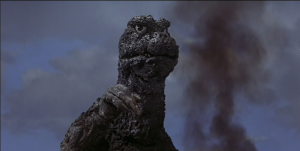
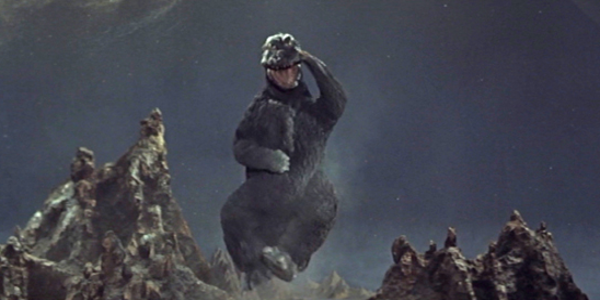
  1. GodzillaScreen Shot 2012-09-20 at 10.49.53 AMOnce a towering, insurmountable force for death and destruction destined to blanket the Earth in grim darkness, fire and blood, Godzilla is now totally cool and nice, you guys. Not only is he no longer a bad guy, but in Godzilla VS Gigan, he’s a damn underdog. Most Godzilla films portray him as an unstoppable, scaly juggernaut, the unbeatable conclusion to any conflict, but in GVG it kinda seems like his monstrous snout has finally bit off more than it can chew. He really takes a lot of abuse this time around, including, at one point, a full on Ghidoriah lightning bolt attack to his dragon balls. Rough. (NOTE: Apparently, this shot is actually recycled footage from Ghidorah: The Three Headed Monster. So, apparently this has happened to Godzilla twice now!)
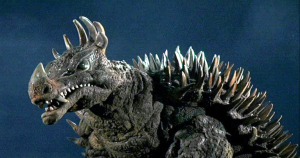
  2. Anguirus21956 Anguirus has also come a long way from being Godzilla’s most hated rival to the sturdy, dependable, four legged BFF we see in GVG. Now he’s like, the “solid dude” of the kaiju kingdom, Anguirus is the monster who would come over to help you move. I mean, he’s a quadruped, with no apparent dragon breath or laser eyes, so his offensive capabilities are pretty much limited to biting and just being spiky, but he’s still out there in the fray, taking his lumps and doing what he can to back up his bros. If Godzilla seems like the underdog in this battle, Anguirus is straight outclassed, and you might find yourself worried about the little guy. I know I was!
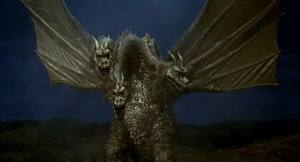
  3. King GhidorahShowa_King_GhidorahWhat is Ghidorah the king of, anyway? Pissing me off, that’s what. Anytime aliens pop in, they summon Ghidorah from the cold recesses of space to shriek, fly around, wiggle his three heads and barf lightning at everybody. GVG is no different, which proves just how successful his outer-space Craig’s List ads are.
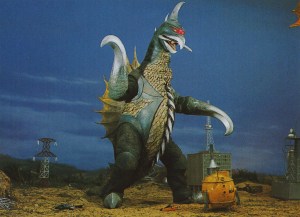
  4. GiganGVG_-_Gigan This guy is the big addition to GVG. Gigan is basically like, the Boba Fett of the Kaiju world. He’s a cypher, he has no purpose and no drive of his own, he’s here to do his job; kill monsters and bust shit up. He’s like a giant monster hit man, hired on by aliens to dish out the death, because truly, that is what he was made to do. This damn thing has no hope of ever living a normal life, and that is by design. Every limb he has ends in a straight up blade, his face alone has four different slicers poking out, and his fucking belly has a fully functioning buzz saw embedded in it. The only means of manipulating an object that Gigan has is to slice the hell out of it, even just picking something up is out of the question unless it can also be impaled in the process. He is super cool, though.

The big monster brawl at the end of the picture actually stretches on for quite a bit of screen time, but it’s excellent. Actually, it might be the best fight in one of these movies yet, certainly it owes more to the big throw down between Godzilla and Hedorah than what was seen in Ishiro Honda’s more reserved, classic feeling Godzilla pictures. Fukuda’s dynamic use of camera works wonders here, the fight feels epic, dirty, painful, frantic, desperate, and mean. Ghidorah and Gigan have the run of the place for most of it, and they really kick the shit out of our boys. Godzilla spends some time down for the count, with Gigan and Ghidorah almost toying with him, beating him mercilessly as he is unable to even regain his composure. Anguirus tries like hell to save Godzilla and take these mercenary dragons down, but he’s utterly outmatched, and thus, is subjected to a series of violent beat downs the likes of which he has not known in centuries. There’s actually a bit of monster blood spurting and dripping in this one, and it really ups the ante and gives this conflict a greater sense of urgency. These guys are really getting hurt!
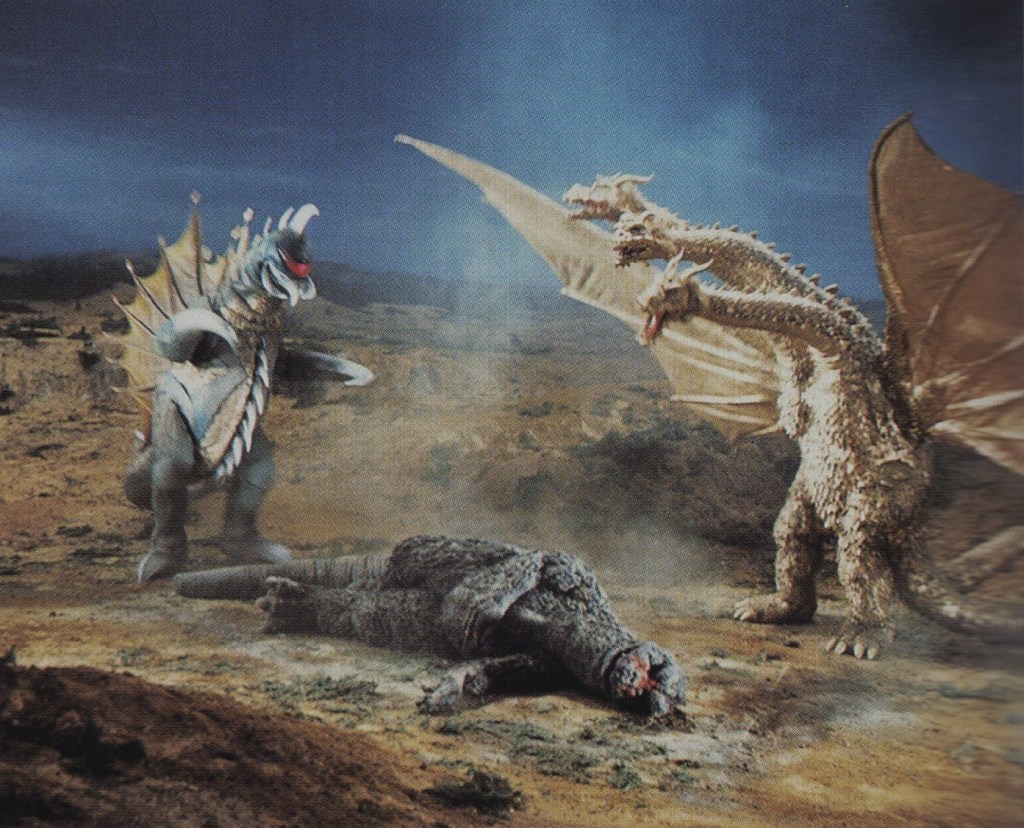
GVG_-_Godzilla_is_Down_Before_Gigan_and_King_Ghidorah

As usual, a crucial part of the human plan to turn the tide is to defeat the aliens and free any monsters that might be under extra terrestrial control. In order to achieve this, Gengo and his pals launch the most harebrained scheme I’ve ever seen; they literally load a bunch of boxes of dynamite into the elevator of the alien control tower, and then drape a black and white poster with cartoon drawings of themselves in front of the boxes, hoping that this super intelligent race of aliens 1) won’t notice them loading up their elevator with boxes of explosives and 2) won’t know the difference between living breathing humans and black and white cartoons, and will therefore open fire, detonating the explosives and destroying Martian H.Q. It totally works. If your alien race is dumb enough to fall for that, welcome to the Darwin Awards, you do not deserve to continue your intergalactic imperialism.

As said before, this is mostly another “been there, done that” Godzilla film, but Toho manages to squeak by thanks to Fukuda’s talents and in the end we have yet another enjoyable entry in the franchise. It’s more than a little maddening to know that they really see no issue with repeating essentially the same plot over and over and over again, but whatever. I still liked it. Everything else works and even the human characters are pretty likable, except for Gengo. This a-hole turns down jobs and then models a cartoon monster after his attractive and supportive girlfriend who just so happens to have a black belt in an unnamed field of the Martial Arts. Dude- screw you, man. On behalf of unemployed cartoonists everywhere, I hope you are eaten by Rodan.

B
GZ backGZ next

Godzilla VS Hedorah!

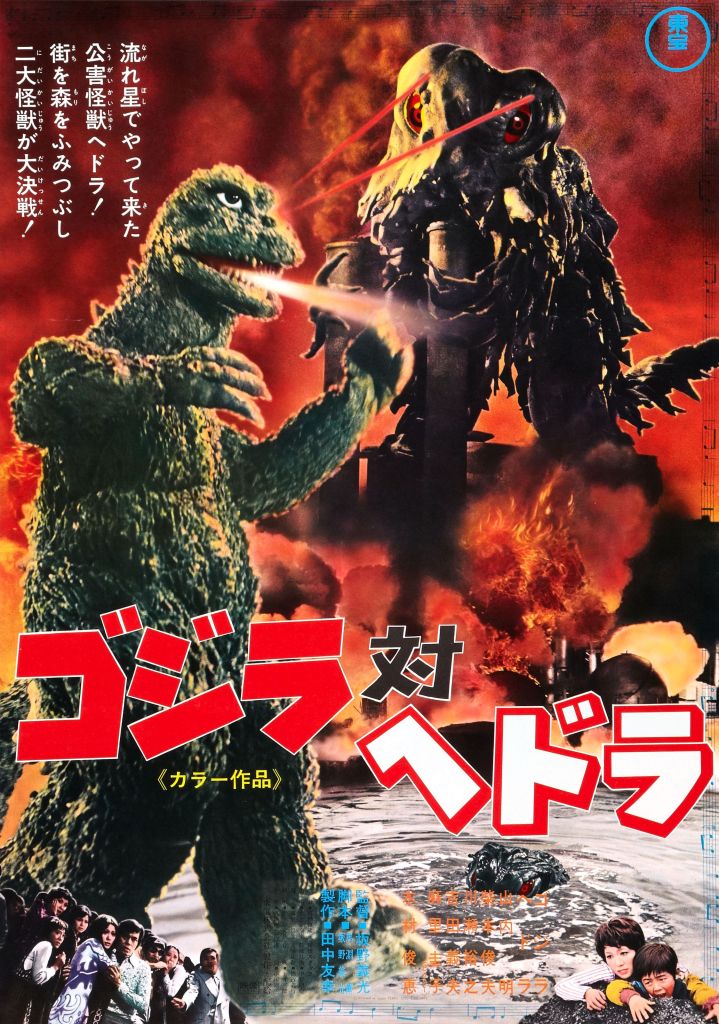
Godzilla VS. Hedorah (AKA Godzilla VS The Smog Monster) ~ 1971, Yoshimitsu Banno – Japan

godzilla_vs_hedorah_poster_01

I’m going a little off the rez with this one, because I’ve learned that common G-Fan consensus is that this is a lesser, or even one of the worst of the Showa era Godzilla flicks, and I totally love this movie.

Yes, I’ll admit that it’s goofy, but it was only a few movies ago that Godzilla did a damn victory dance on Planet X. Is this really that much goofier? That was a real low point. And anyway, Godzilla VS Hedorah is also notably darker than it’s recent predecessors, and it makes up for its various short comings by having the most fascinating composition seen in a Godzilla film up to that point, with the exception of the original 1954 film. This is the first Godzilla movie to actively campaign from a new perspective, the perspective of Japan’s 1960’s/70’s youth culture, which is exciting. It’s kinda like younger generation managed to wrestle the megaphone away from their parents and, for the first time, finally had a chance to make their own statement. I totally think it holds up, Godzilla VS Hedorah proves that there is enough room within the Godzilla metaphor that it can mean more than one idea and carry relevance from a broad range of individual perspectives. If Jun Fukuda’s turn in the directors chair felt like a breath of fresh air back in Ebirah: Horror of the Deep, Yoshimitsu Banno here feels like a whirling hurricane of fresh air, heaving your home off it’s foundation and smashing your car windshield.

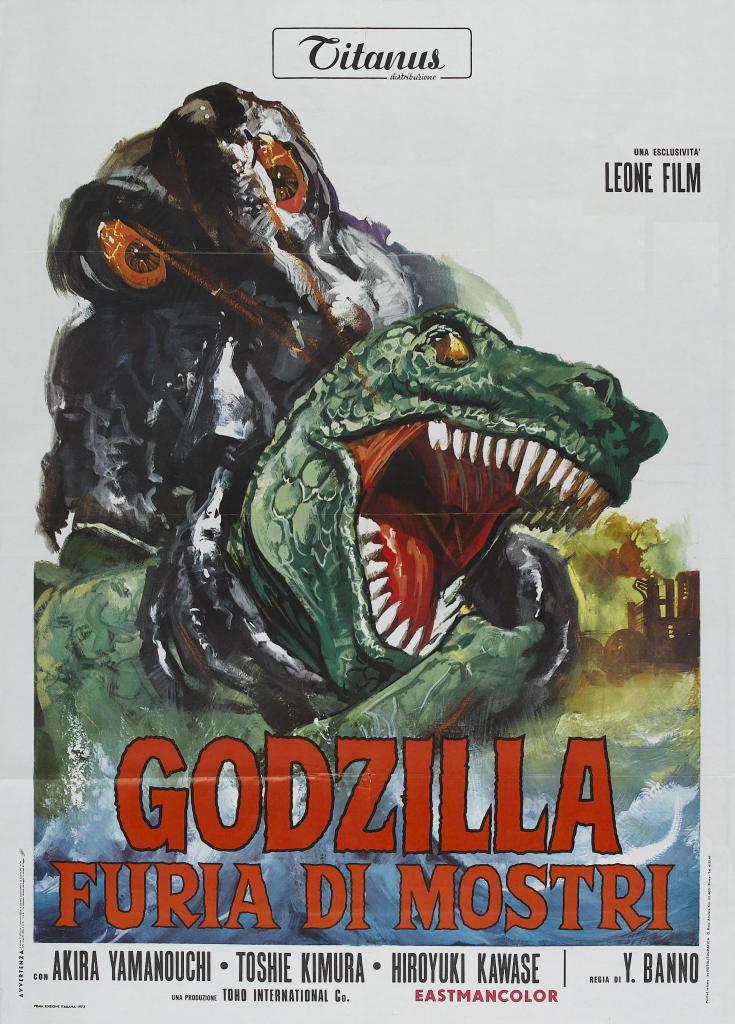
godzilla-vs-the-smog-monster-italian-poster

THE PLOT~ Japan has become horribly, horribly polluted. Like, incredibly polluted. It’s pretty over the top. From within this bog of toxic muck and rotting trash, we have the birth of a new organism, totally unlike any other on Earth; Hedorah, a big tadpole made out of slime and garbage that thrives off pollutants and likes to sink boats. Hedorah makes a big stink doing just that, and Japanese scientist Dr. Yano sets out to study the creature, because he is a scientist, and monster studying is the only steady work a scientist can get in 1970’s Japan.

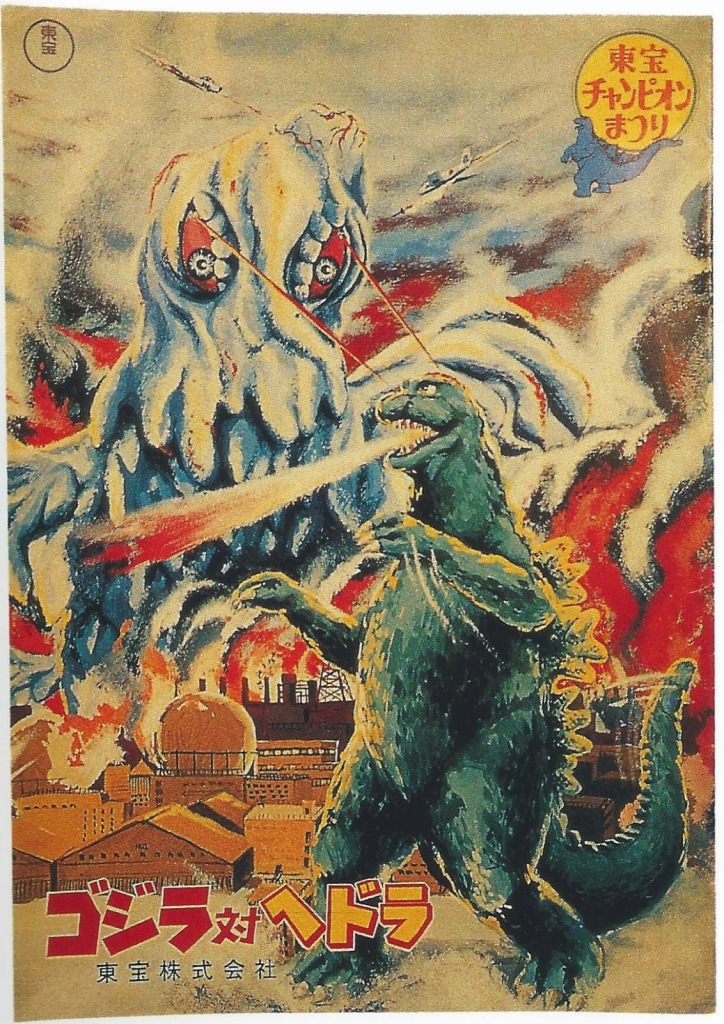
Godzilla vs Hedorah (Japan, theatre program, Style B)

More central to the story is Dr. Yano’s son, Ken, who is actually our main character. We see the film from his perspective. Ken, like many Japanese children, has a fascination with Godzilla, who by this time had become less of an atomic, dinosauric bogeyman and more of a weird, semi-anthropomorphized antihero. Ken believes that Godzilla will save mankind from the Hedorah’s deadly toxic rampage. And Godzilla totally does.

When we meet KeGodzilla vs Hedorahn, he’s playing with Godzilla toys in his backyard. Throughout the film he claims to have dreams and premonitions of Godzilla rising up out of the sea to rescue mankind from Hedorah, who has evolved into a biped with the ability to fly, and has decimated Tokyo, leaving many dead. The film is presented in a strange, almost dreamlike manner, inter-cutting jazzy 70’s split-screen techniques, frightening hallucination/dream sequences, and even occasional short animated sequences, which really lends credibility to the idea that this film could actually just be Ken’s fantasy. Perhaps we never really leave the backyard and Ken’s clunky, plastic monster dolls are playing out the events of Godzilla VS Hedorah for us. While the movie certainly presents itself as being cannon, there is enough here to justify the “child’s fantasy” idea, and the movie is open ended enough, if you want it to be. Several important monster related plot points are triggered by Ken’s “visions”, and these sometimes carry an odd imaginative feel, such as when Ken claims to spot Godzilla lurking unseen by anyone else amongst the city’s skyline while riding a roller coaster.
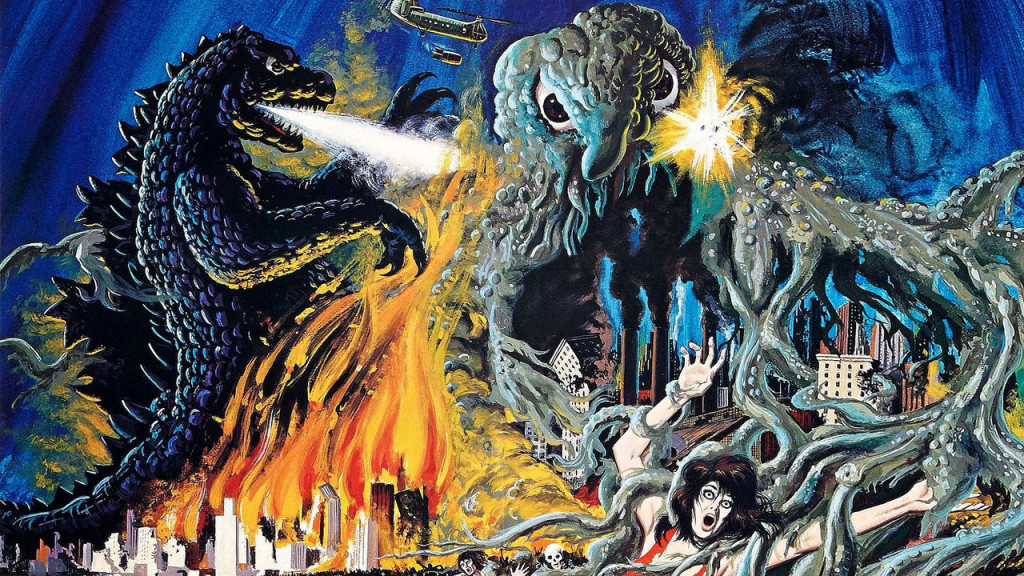
Godzilla_vs._Hedorah_2_-_Cartoon_Final_HedorahAnimation was weird in the 70’s.

Another important character in the film is Yukio. Yukio represents the more active, optimistic youth culture of the Japanese 70’s. He and his peers are eager to try and wrestle the fate of Japan out of the hands of their elders, who have apparently mismanaged it to the point that a damn trash monster was born. Yukio organizes a youth demonstration to take place atop Mt. Fuji when the fate of Japan is at it’s most bleak, and this sequence is especially painterly, and also telling of the film’s thesis statement. While Yukio and his cohorts dance merrily to some swinging, funky 70’s jams in the face of certain Smog Monster related doom, strange, aged figures sit in silence hiding amongst the tall grass just outside the light of the bonfires. These figures are motionless, and drained of color, they merely watch from their hiding places as the young people take the stage. While the appearance of these figures isn’t explained, I think the movie is fairly open about it’s dual-message intent. One could argue that they are merely the elderly locals, watching with curiosity the antics of these teens from the city. They could also quite likely be literal ghosts, mournful at their own shortcomings in securing a bright future for their country, and eager to see how this new generation will handle their nation’s new challenges. The actual truth behind what these figures are is entirely inconsequential because the film’s thesis remains the unchanged by a definitive answer. Whichever they are, they serve the same purpose, and I feel convinced that leaving things like this somewhat open for interpretation is more Banno’s style anyway. I’d love to hear what he had to say about them.

Ken being our lens through which we view the world in Godzilla Versus Hedorah is a conscious and powerful story telling device even beyond giving the movie the plausible claim to being a child’s fantasy. It let’s us understand the severity of the situation in a way that couldn’t carry the same weight from another point of view. For Ken, the outcome of this story is even more crucial, because as a child, Ken represents the future. In fact, he and Yukio form a two headed youth culture monster with Yukoo representing the young adults of today who are now arresting control of the situation from their woefully inadequate predecessors, and Ken representing the youth of tomorrow, themselves still powerless to do anything but hope. This was this new generations chance to say something, and through these two, Godzilla takes on a new meaning, shedding his role as a grim specter of atomic war and instead becoming a figurehead for socially motivated change. He burns up the old with his radioactive breath and paves the way for a new age of improved, socially conscious adults to build a world reflective of their values. In this film, Godzilla means, change, improvement, and rebirth, and that’s a testament to his validity as a cultural phenomena. Some might argue that this is throwing out the component of Gojira that worked best, but I would point that even religious figures can take up new characteristics reflective of their eras. All this lends more legitimacy to Godzilla as an idea, not less, because it proves that he has become a broader metaphor and can represent a new, yet equally crucial idea for each generation. And anyway, by this point, I think we had already strayed so far from his nuclear horror film roots that the integrity of this franchise was more than capable of handling this additional change. Again, Godzilla, by this time, had become a bigger cultural phenomena than Gojira could have predicted, and it now belonged to the entire world. The perspective of one nation, locked in one moment in history, could no longer contain this figure, he had made the leap from a plot device, to a folk character, something few intellectual properties can hope to achieve.

dD7KWrsuChQfz5JY4YFEu6iWFpE

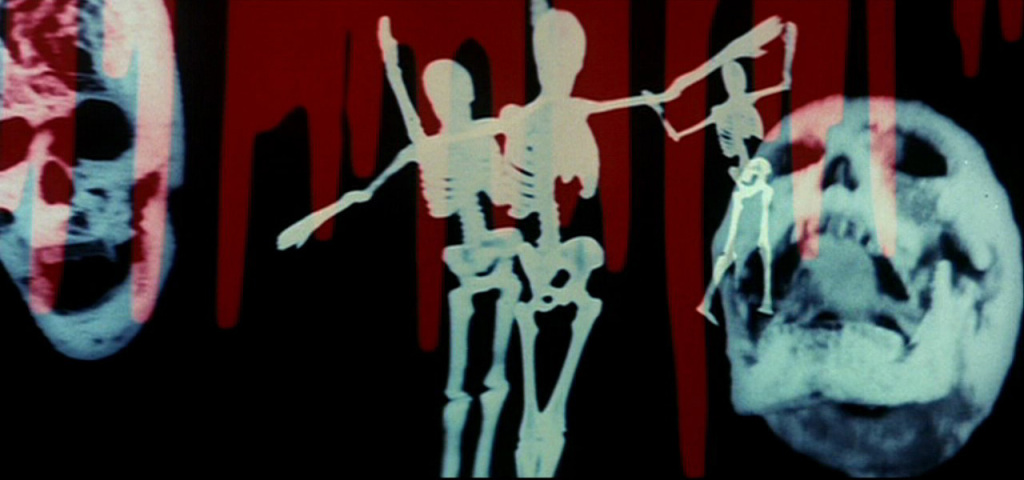
So, while Godzilla VS Hedorah is in some ways the most childish entry yet, it’s also the darkest Godzilla film since his original appearance. Banno and the youth of 1971 want you to know the highs, but they also want those highs to mean something, so you’re going to also become very well acquainted with the lows. The movie uses very dark, loaded imagery, prolonged photography of thick, slime like sludge dotted with garbage coating the sea, black skies, thick, curling smoke, a disintegrating mannequin floating in black oil, a broken clock drifting in gunk. At one point we even see a live, crying, human baby, buried up to it’s shoulders in toxic sludge. These are heavy handed images, but the vibrant, exuberant culture that informs the perspective of Godzilla VS Hedorah really want you to understand and believe that at this time, in their mind, there was no more crucial battle to be fought, and the movie wants you to feel convinced that this is our darkest hour. The deaths in this movie are numerous, and we see them in no uncertain terms, human skeletons, their flesh dissolved by Hedorah’s acidic omissions, are a common and gruesome sight. The aforementioned final show down between Godzilla and Hedorah atop Mt Fuji is filmed so stylish and bleak that it looks like the last shot from Fulci’s The Beyond. The movie doesn’t hold back when it comes to the grim, or the silly.  How much more childlike does it get?

Godzilla_Vs_Hedorah_man_Like_Skeletons

Whoa, did we get lost and wander onto Hausu?!?

Well, a lot more child like; this is the movie in which Godzilla damn flies. This did not go over well amongst kaiju fans, and with good reason, it’s dumb as hell. He achieves flight this by curling up into the Godzillasaurus fetal position and rocketing off using his dinosaur breath as propulsion. This means, of course, he’s flying backwards, but really, that’s just one problem on a long list with this idea. It’s not good, and it shouldn’t have been in the movie, but honestly, it’s not killing the picture for me. Especially not when I’m already looking at this as most likely being a vivid metaphor or a child’s fantasy. In any case, Godzilla takes on the abilities and characteristics needed of him, which again, harkens back to a more folksy and less self conscious form of story telling, and I can deal with it.

One more thing I want to high light; Godzilla’s incredibly violent “finish him” style execution of Hedorah. So awesome. Apparently, Godzilla really, really hates Hedorah. First, he kills him (we think.) He then proceeds to rip out the creatures eyes with his bare hands. Oh, snap, Hedorah is actually not quite dead, he makes a break for it and tries to fly away! Nope, Godzilla’s not having it, he chases him down, beats his ass a little, drags him right back, zaps the life out of him a little more, and then proceeds to desecrate the shit out of Hedorah’s lifeless corpse, a process which includes ripping it open, tearing chunks off and scattering them wildly all about, stomping on him, frying the individual pieces, and frantically looking around to make sure that there aren’t any extra pieces of him which need additional murdering. I mean, Godzilla makes absolutely sure. In every slasher film where they just assume the killer is dead and walk away, what they needed to do was take a page out of Godzilla’s Handbook; specifically, his Hedorah Policy, cuz damn is it thorough.

Banno was no young buck when this film came out, based on the information I was able to dredge up he was about 40 when he directed this picture, but that’s still twenty years younger than Ishiro Honda, the director of most Godzilla flicks up to that point, and clearly, Banno had a connection to the ideals of Japans youth culture that Honda did not. His radically new perspective is plainly felt in this film, and I think he did a great job with it.

In the end, judgement has been passed on this film long ago, and it wasn’t favorable. However, now there is an oportunity for a new generation to look at it with fresh eyes and make up their minds for themselves, and chances are, they’re going to hate it for all new, all different reasons. I actually think this is a pretty great entry in the series, and I love what Banno did with the ideas the franchise offered him.

B+

GZ backGZ next

SPACE AMOEBA!

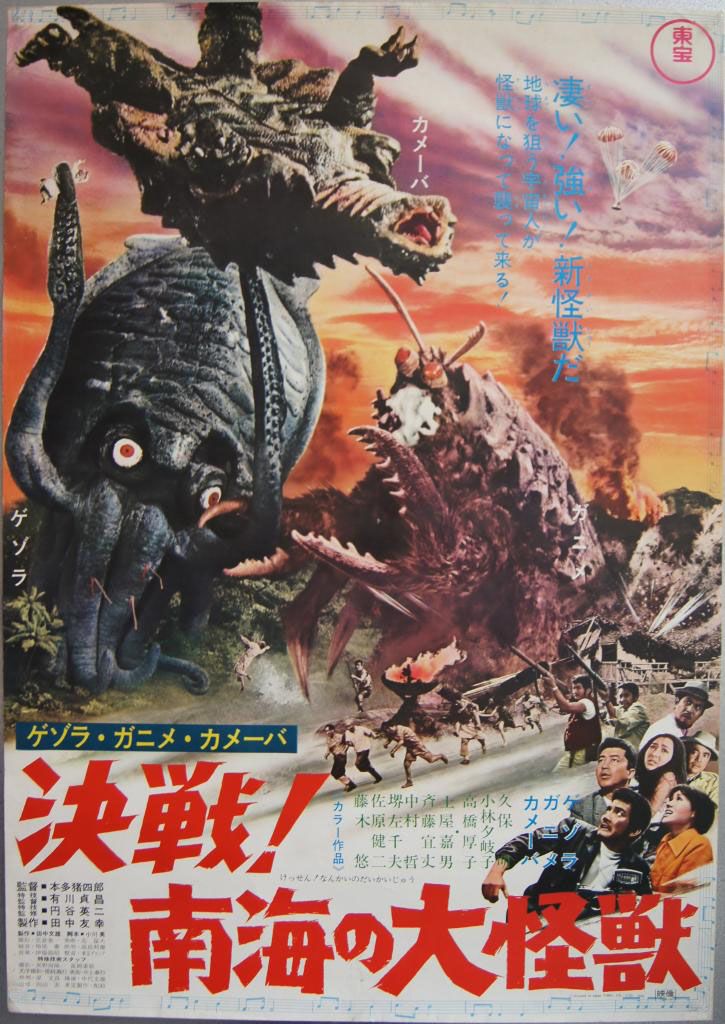
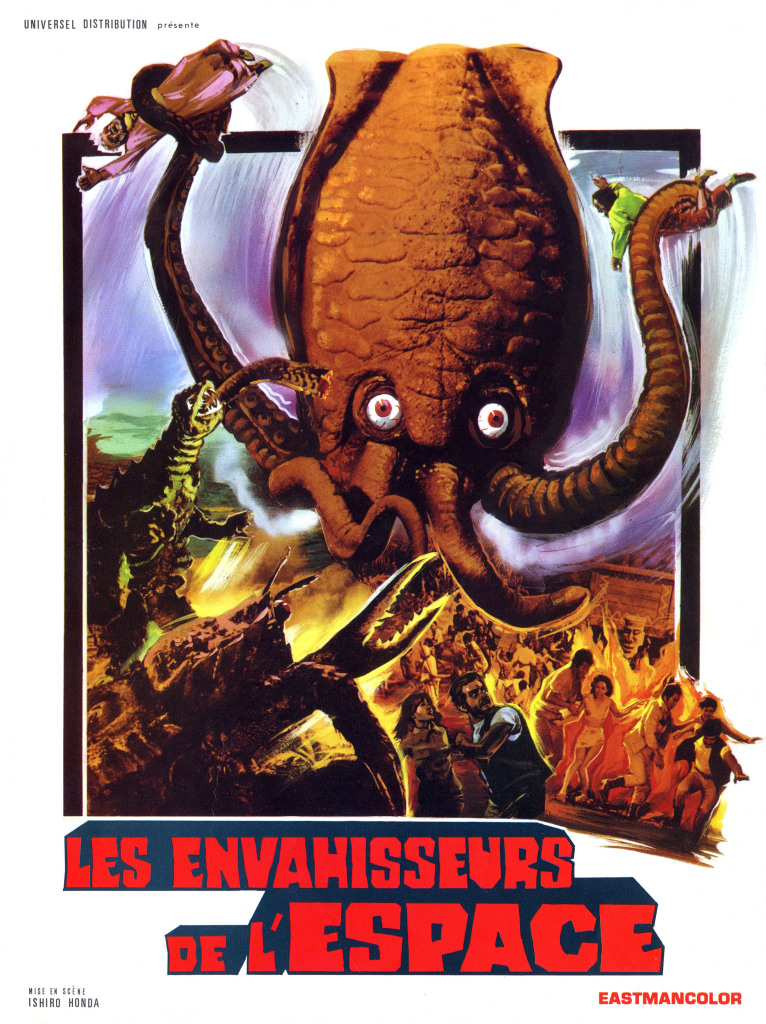
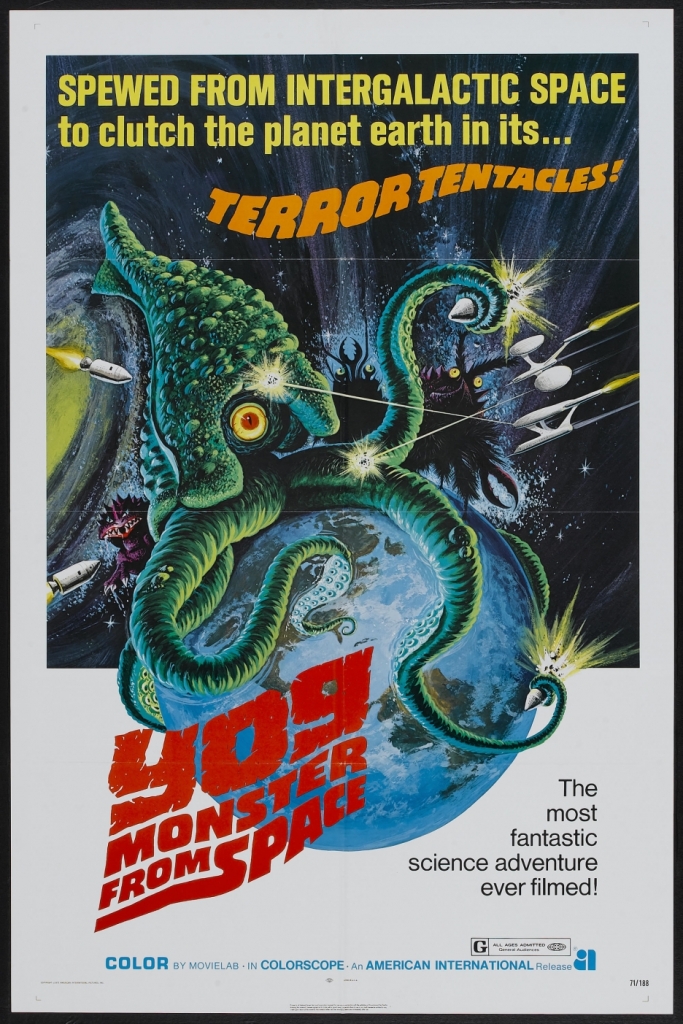
Space Amoeba (AKA: Yog: Monster From Space, AKA Gezora, Ganime, Kameba: Kessen! Nankai no daikaijû) 1970, Ishiro Honda – Japan

1649ac51fe479dc767a27db11304f159

In the annals of Kaiju cinema, no one director can claim to have contributed quite as much as Ishiro Honda, the director of like, friggin’ everything. Well, not everything, but he directed a lot. Most of Toho’s real, certifiable kaiju classics come from his body of work, Honda was in the director’s chair for Gojira, Mothra, Rodan, the list goes on and on. However, he also brought us Space Amoeba, which is more or less totally forgettable, so I guess not everything King Midas touches turns to gold.

THE PLOT~ After some alien space glitter hijacks a satellite and crashes it in the ocean, islanders (And some Japanese folks who have come to our island for one reason or another) find themselves terrorized by a series of giant, goofy monsters, which include a squid, two weird crab things, and a spikey turtle. I’m pretty sure the original idea for this story is credited to a five year old kid playing with some toys in the bathtub.

yog_monster_from_space_poster_03

Although these enormous beasts are indeed a serious threat to our stable of who-cares-characters, we are delighted to learn that each one possesses it’s own unique weakness- for instance, Gezora, the squid type dude, is vulnerable to fire, and Ganime, the crab guy, is vulnerable to having both of it’s eyeballs shot off and then being thrown off of a cliff onto sharp, jagged rocks before suffering horrible injuries brought on by explosive blasts. That’s a good one to remember. We also learn that all the monsters, and indeed, the aliens who control them, are vulnerable to high frequency sounds, so our humans cook up a plan to save the world that mostly hinges on pissing off all of the island’s sleeping fruit bats- but hold up! Someone has been sneaking around and killing all of the bats somehow! Yes, apparently there is a traitor in our midst- Obata, who was kind of already the bad guy since we learned earlier that his entire purpose for tagging along on this island adventure was one of industrial espionage, has apparently been possessed by space glitter also, thereby making him double the traitor. And to think I thought he was just your typical sneaky dude in a flashy white suit with a super dope Satan goatee.

Anyway. The movie ends, as every movie should, with a giant crab wrestling a giant turtle until they both topple over into an active volcano, leaving our cast of good guys to instantly be rescued by a Japanese fishing boat, roll credits.

It’s not amazing. It’s fine, and it’s entertaining enough, but a classic this is not. I’ve read that apparently lots of Westerners have a warm place in their hearts for this film after seeing it in drive-ins or on TV under the name YOG: The Monster From Space, but without the aid of nostalgia to warm your heart, Space Amoeba isn’t going to rise above the rabble. There’s also not much to it, thematically; there’s some stuff in here about respecting indigenous cultures and the exploitation of humans and resources, but as usual, it’s a mixed message, and they sort of touch on the idea of combatting your inner-demons, but for the most part, this is just a straight up B-movie that offers little for your mind to digest beyond giant monsters and a tropical settling.

936full-space-amoeba-(aka-yog--monster-from-space)-poster

The monsters aren’t too bad, though, I especially enjoy seeing Gezora lumbering about on land, for some reason, although Ganimes and Kamoebas (the turtle dude) could have been cooler. The legacy of Space Amoeba isn’t a proud one, these monsters didn’t really go anywhere after this. Off the top of my head, I’m pretty sure I killed Gezora about a million times on the Godzilla Nintendo game, and Kamoebas has a cameo in Godzilla: Tokyo SOS, but he’s a corpse already when he shows up, so all in all the class of Space Amoeba remains under-utilized and relatively forgotten by today’s movie buff. It’s also not easy to get a copy on home video, so that doesn’t help.

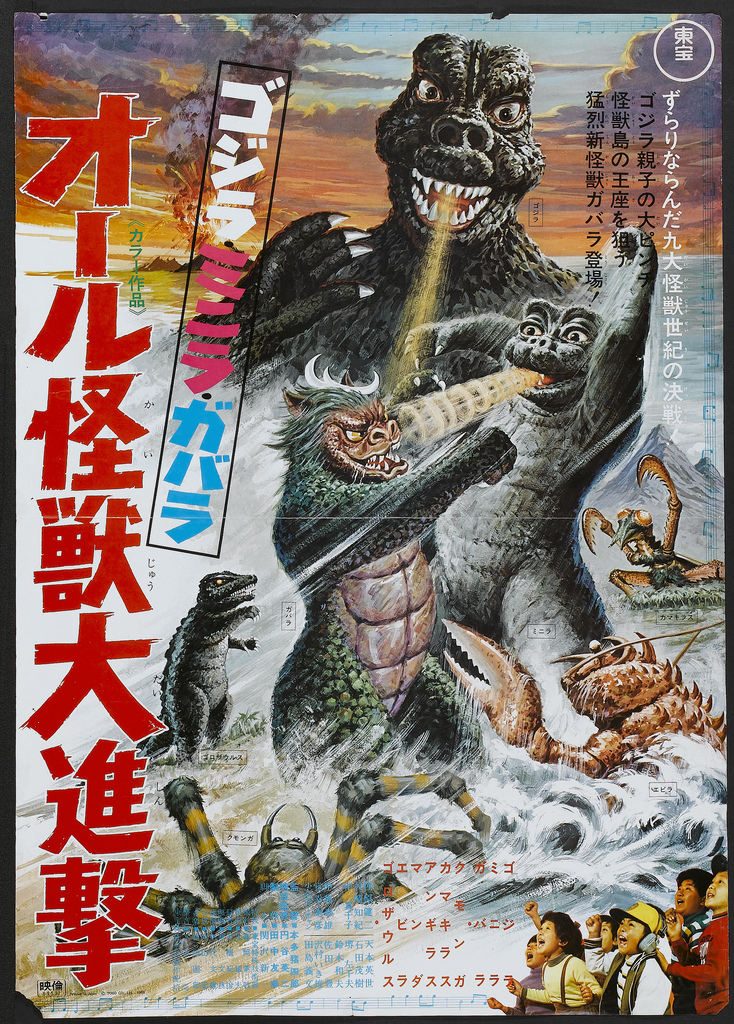
piccit_space_amoeba_1971_2043x2909_1446595838 Space Amoeba feels a little cheap, too, almost like they had a few extra reels of film and a bunch of unused monster suits so they decided to squeeze out one more movie before going back to the producers for more funds. I think this one might be for completest only, it’s too difficult to obtain to warrant a viewing for casual Zilla fans.
C

GZ backGZ next

ALL MONSTERS ATTACK!

All Monsters Attack A.K.A. Godzilla’s Revenge~ 1969, Ishiro Honda -Japan

all monsters attack

I watched this movie probably 135 times as a child. That makes it hard for me to declare outright that All Monsters Attack is a total piece of crap, even if part of me does want to say that… But that would be dishonest, after all, the film is intentionally geared for a young audience, and I seemed to like it just fine when I was a kid. I can say this, though; for adults, it’s rough. Especially the English dub. Brutal.

The movie focuses on Ichiro, a little kid who nobody likes, least of all the you, the viewer. Ichiro bumbles around sucking at all things, and periodically falls asleep, launching his numerous dream sequences, all of which take place on Monster Island, eternal battleground of giant friggin’ beasts, and therefore the least safe place in the world- but it is here that Ichiro pals around with Minilla, Godzilla’s doofy and equally unworthy son, and slowly learns to stand up for himself and be less of a little bitch. Most of the movie is either Ichiro in the real world, which is super, super depressing, Ichiro on Monster Island, which is goofy, or scenes of Godzilla kicking thing’s asses, which is awesome.

And really, that’s about it for All Monsters Attack, plot wise. The English dub is excruciating, Ichiro sounds like a screeching, annoying little nerd, and that’s really what he is. He had to learn to not suck via dream sequence life lessons, but I would think the same effect could have been achieved if someone had just shaken him and screamed “NOBODY GIVES A FUCK ABOUT YOUR SHIT, KID, QUIT SUCKING!” right into his face.

I also feel the theme song at the beginning is worth mentioning. Even as a child I thought it was weird, it’s this strange hot jazz/angry funk acid nightmare, listen to it here.

Godzillas-Revenge-Poster

The movie is too uneven, even as a kid’s film. The “real world” sequences are bleak and depressing, which I can remember is how I generally felt about them as a child, even if I could not yet articulate that. Meanwhile, the frequently fast-fowarded to Monster Island sequences delivered the goods, because they packed in like, so many damn monsters. That was probably what made this movie a regular in my childhood VHS rotation, high monster count.

One of the lesser Toho Godzilla films, and possibly the worst Showa outting for Big G..

C-

GZ backGZ next

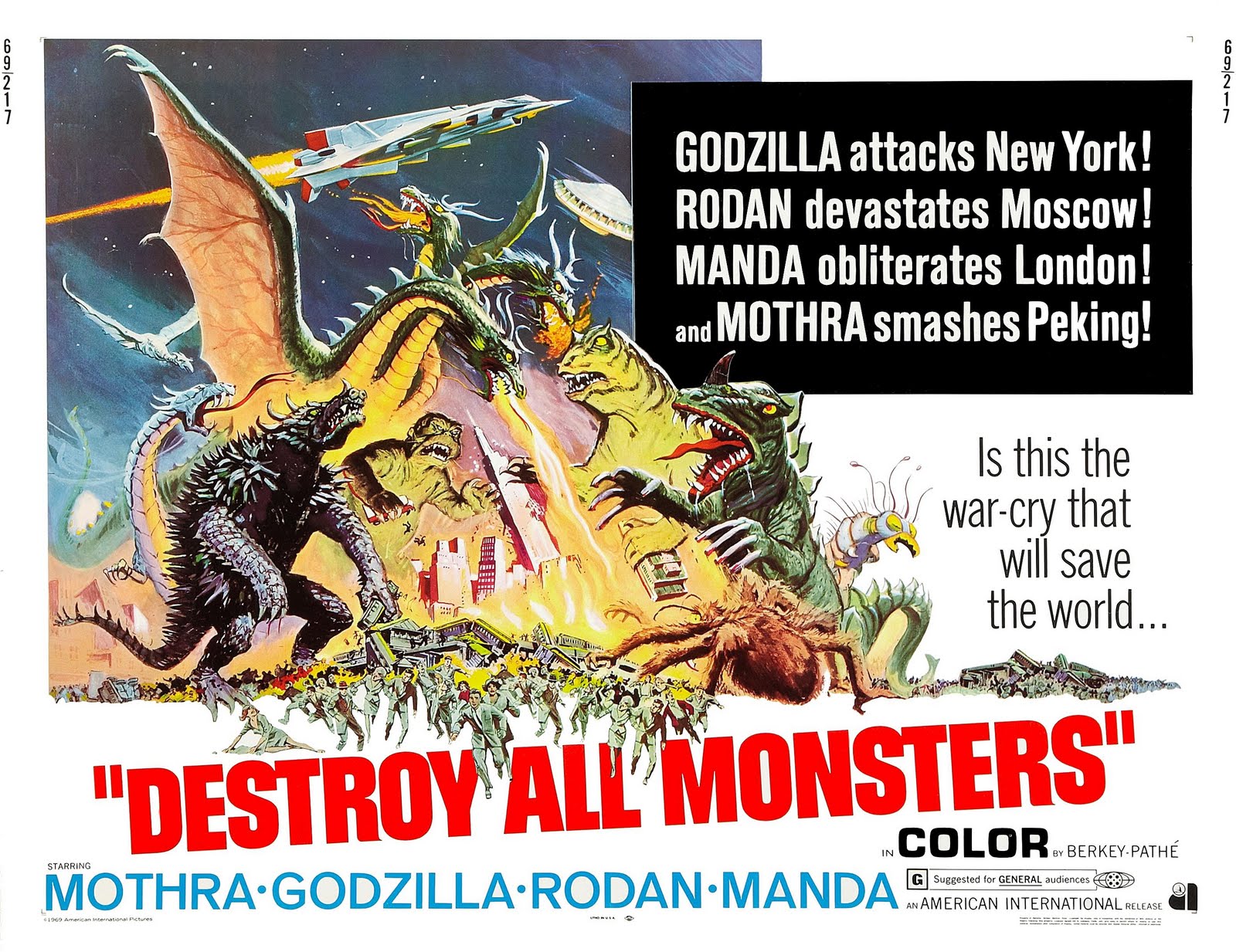
Destroy All Monsters!!!

Destroy All Monsters~ 1968, Ishiro Honda – Japan

Destroy_all_monsters

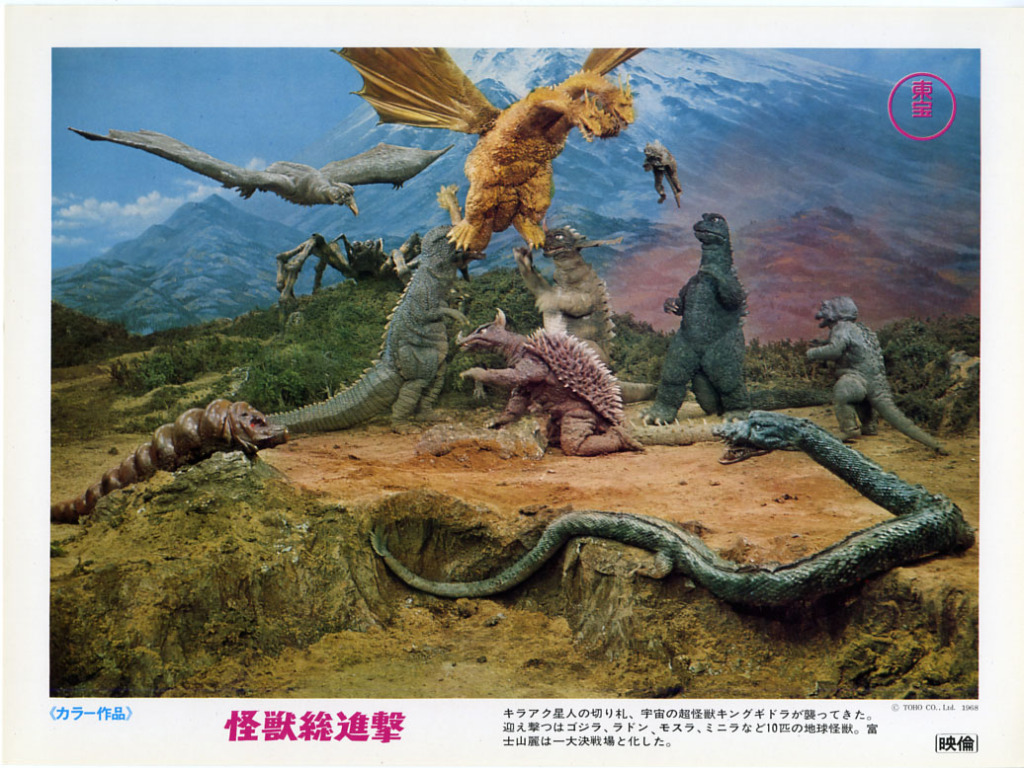
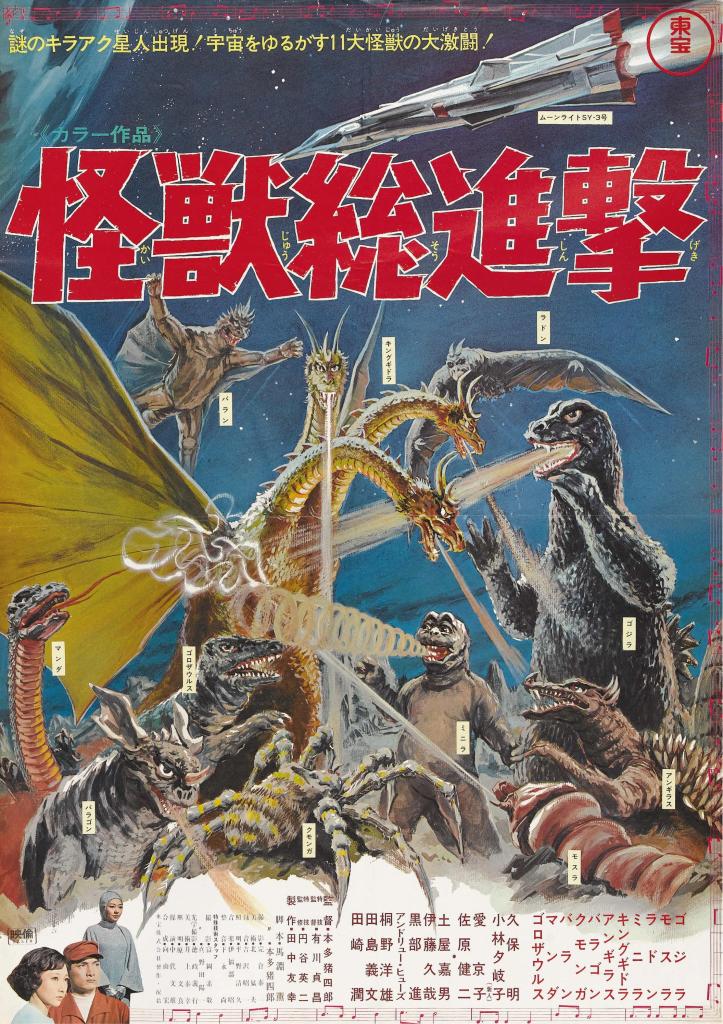
In 1968 Toho released their THIRD Ishiro Honda directed Godzilla film wherein a race of extra-terrestrials take control of Earth’s monsters in an attempt to force a surrender and usher in alien occupation of the planet. Each of these films feature Ghidorah as the ultimate monster challenge posed to Godzilla and co., and in each film, mankind discovers a way to release their monsters from the alien’s control at the eleventh hour and saves the day. To rephrase that, between 1964 and 1968, Toho released five Godzilla films, and three of them had essentially the same story. I’m not saying I dislike this run of films, but how can anyone argue that things were getting alarmingly “been there done that” by this point? This is the Super Street Fighter II of Godzilla films (Making Final Wars the Super Street Fighter II Turbo of the franchise.)

12-DestroyAllMonstersHalf

THE PLOT- Mankind is really kicking ass these days. We’ve managed to put together a pretty sweet international space program, complete with moon bases, and Earth’s monsters are all contained for observation on a tricked out island somewhere in the Pacific. Advanced science has been developed to prevent each of the monsters from ever escaping, and simultaneously we’ve designed a self sufficient Eco-system which can feed the creatures indefinitely while we study them from ultra safe bunkers deep beneath the surface of the island. Yes sir, nothing can go wrong now. Oh, wouldn’t you know it, aliens show up and want to conquer our sweet planet, and they have somehow managed to take control of all of our monsters. Really, really sucks how often this happens.

Long story short, there is some space warfare stuff that goes down, and in the end we manage to free our monsters from alien control and defeat the interloping space people once again. Sound familiar? This also won’t be the last time Toho does this in a movie.

It’s not so bad, though. It’s still a pretty good effort, and the alien/outer space stuff is actually done pretty well, much better than in Invasion Of Astro Monster. The daring human assault on the alien moon bases is an especially exciting and well done sequence for it’s lack of giant monsters, and the film does a good job upping the ante and making this movie feel more global and epic in scope. It does really feel like the very survival of mankind is on the line, and really, that’s the mark of a successful alien invasion film, so kudos on that, Ishiro.

There are also lots, and lots of monsters, and they look good. The big battle at the end where Godzilla leads a monster army against Ghidorah and the alien invaders is pretty cool, and it’s satisfying to see Ghidorah get his ass beat so, so hard by Papa G’s Kaiju Posse.

22143

Overall, Destroy All Monsters does it right, but the problem is that we’ve just tread this ground so many times already. Had it not been diluted by the foul backwash of repetition, this movie would really shine. As it is, it’s still pretty good.

B-

GZ backGZ next


KING KONG ESCAPES!!!

King Kong Escapes – 1967, Ishiro Honda – Japan

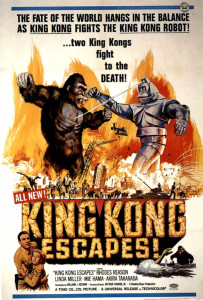
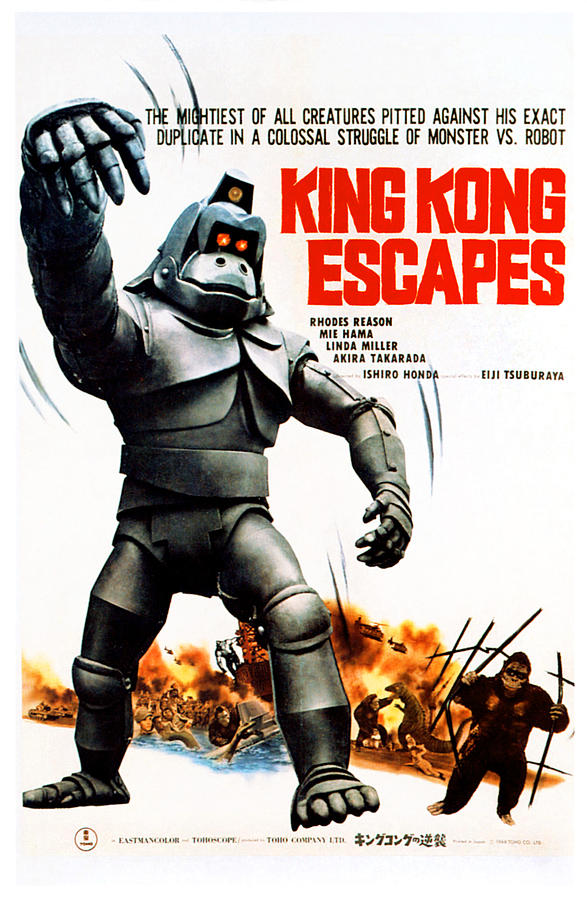
Kingkongescapes

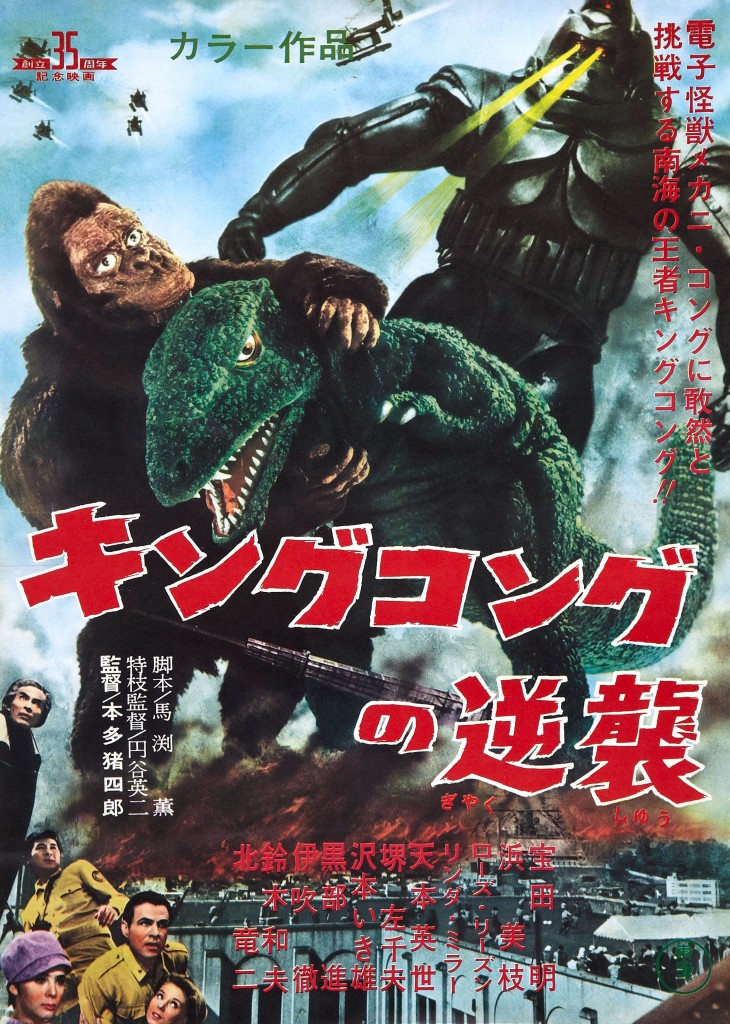
Don’t bother trying to type cast King Kong- this dynamic star of the silver screen will not be limited by the restrictive boundaries of your feeble imagination. No, he’s not all about swatting at biplanes, screaming woman in hand, whilst perched atop the Empire State Building. On the contrary, he does it all! On occasion, he might wrestle a dinosaur, or engage in a deadly battle with an android replication of himself while clinging to an enormous radio tower, screaming woman in hand. I’ve even seen King Kong swim! He’s like a giant, furry chameleon who can be anything you need him to be, and outside of the RKO original, there is no one movie that displays why Kong is so special more than this film, King Kong Escapes, Toho’s giant ape/kaiju romp follow up to it’s cash cow crossover King Kong VS Godzilla. This time they’ve really pulled out all the stops, and the result is one of my favorite kaiju films ever.

THE PLOT~ Deep beneath the icy surface of the North Pole there is a great abundance of a valuable and highly radioactive substance called Element X. Dr. Who (?!?!?), international super-villain of James Bond proportions, wants to mine these resources and sell them to the highest bidder- and he happens to already have an interested party footing the bill for his efforts. Now, retrieving this resource is difficult- humans can’t do it, because of the radiation. Obviously, if we were to try and think of the best method for retrieving radioactive minerals from beneath the icy strata of the North Pole, the very first, and best option would be to make a giant ape do it for you. Everyone knows that nobody digs stuff up out of ice better than giant apes do, that goes without saying, but apparently the giant ape store was sold out, so Dr. Who instead designs a robot which is shaped like a giant ape, because that would definitely be the second option you’d pursue in that situation. Long story short- this ape’s circuits fries from exposure to Element X, and it’s time to formulate Plan C.

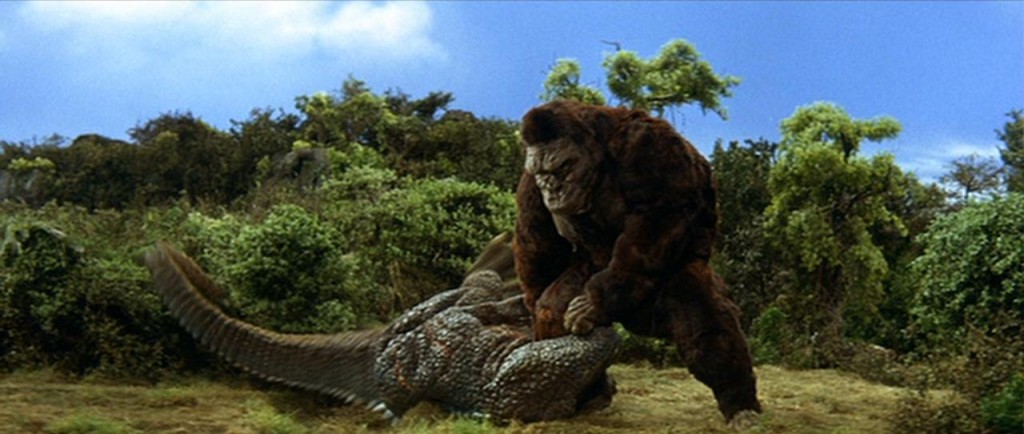
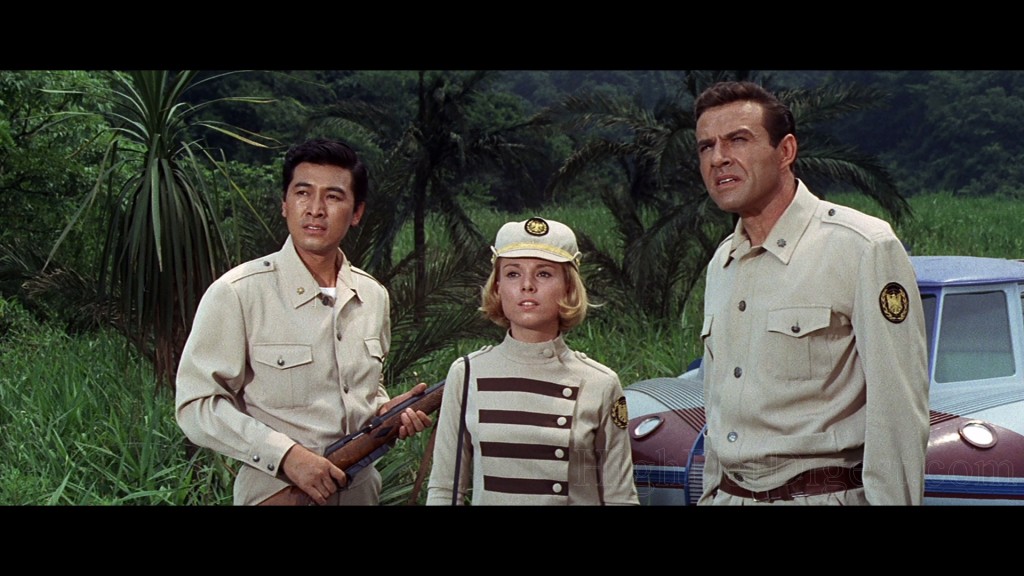
Meanwhile, a U.N. Submarine, carrying our three protagonists (Commander Carl Nelson, Lieutenant Susan Watson, and Commander Jiro Nomura), docks in an inlet off the coast of Mondo Island for repairs, a coincidence which leads to the rediscovery of big ol’ King Kong, who lives on Mondo and spends his days clobbering the hell out of a variety of awesome, dinosaur type monsters.

kkesaurus

He does this all day every day.

Kong, upon seeing Lieutenant Watson, immediately falls in love with her the way only a giant, three hundred foot tall ape can. He certainly has a type, and that type is impossibly small women. For real, he’s friggin’ giant, and she’s tiny even by human standards.

king_kong_escapes_1

Look how little she is! She’s like a hobbit.

The three sail their sub right on back to civilization to spill the beans about Kong, and the news rocks the scientific community, which, I imagine, is made up of at least 80% mad scientists. One of these deranged, and learned men just so happens to be our very own would be Element X distributor, the vile and diabolical Dr. Who, who views the discovery of Kong as a fantastic opportunity to do some more shady shit, because he’s a man with vision and priorities.

KING-KONG-ESCAPES-2

Who has no trouble kidnapping Kong and transporting him to his Top Secret Ice Station Hideout, and he similarly manages to kidnap Nelson, Watson and Nomura without much fuss, thinking that he may be able to use them to control Kong, since everybody knows that big monkey is sweet on Watson. We quickly learn, however, that while Dr. Who must have gotten an A+ in Kidnapping 101, he’s actually really shitty at executing pretty much any other aspect of his evil schemes, and once again everything falls apart on him really bad. How hard is it to force a giant ape to dig up radioactive minerals?! Really hard, I guess. In the end, we wind up back in Japan with Kong and Mecha Kong slugging it out on a giant metal tower of some kind, which is at least nineteen different varieties of awesome simultaneously and I love it so much.

king-kong-escapes-aka-kingukongu-no-everett

There are a few special things that really work in King Kong Escapes, and I want to go over them each individually, list style, as is my preference. Here we go:

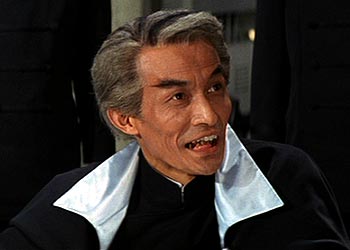
1. Dr. WHO- Oh, hell yes. This ain’t your daddy’s Dr. Who. This guy is your proto-typical comic book super villain, which is just so great. At one point, Who busts a cap in the ass of a Javanese Island Priest just because guns are awesome and this guy was there, so of course it was going to be murder time. Hours later, as this mortally wounded priest lay clutching his chest, moments from death, he describes his killer to Commander Nelson as “An oriental skeleton, a devil, with the eyes of a gutter rat.” Upon hearing this, Nelson knows exactly who we’re talking about. “It must be my old friend, that international Judas; DR. WHO!” That’s an actual line from the movie, dude.

Well, I don’t know about the eyes of a gutter rat, but I kind of get the skeleton bit, Who’s physique is decidedly tall and gaunt, but the first things about him that catch my eye are his eyebrows- which are flamboyantly evil in nature, and his teeth, all of which appear to be at war with one another. Honestly, his mouth is like The Thunderdome- twenty eight teeth enter- one tooth leaves. Note to Dr. Who; instead of focusing on conquering the world or building giant robotic apes, maybe brush your fucking teeth now and again, because your smile looks like a damn orphanage fire.

dr-who-toho Your teeth are gross, dude.

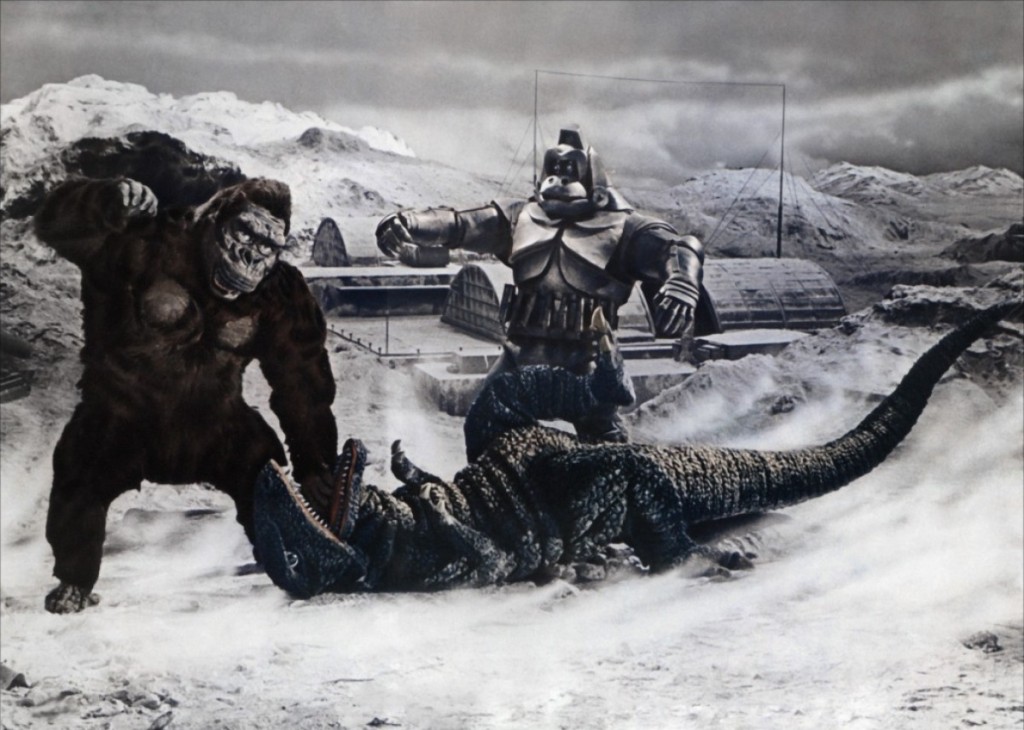
  1. Mecha Kong- Initially, I assumed that Mecha-Kong was just a lame Mecha-Godzilla rip off, after all; Toho ain’t afraid to reuse ideas, we know this. But here’s the catch: Mecha Kong came first! Total mind blow! Mecha Godzilla is the rip off, and NOT the other way around! Behold, the true original giant robot doppelgänger! Mecha-Kong is super cool, too, and I really wish he’d been in the movie more. His battle against Kong at the end of the picture is awesome, but you can never have too much Kong on Kong violence, that’s what I always say.

King_Kong_Escapes_Art_featuring_King_Kong_Mechani-Kong_and_GorosaurusAlso, this scene never actually happens in the movie, and that is inexcusable.
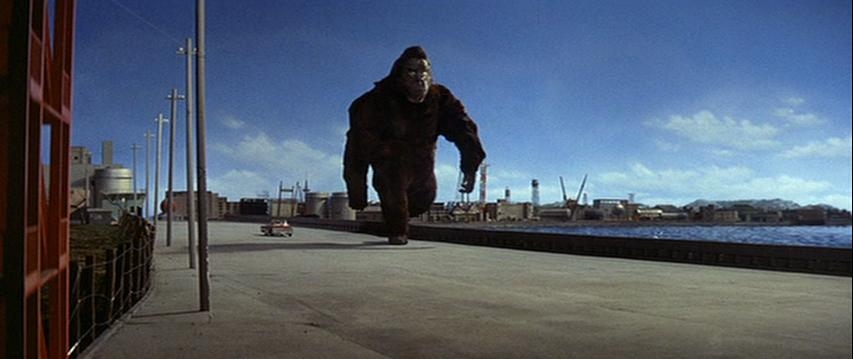
  1. King Kong- This is the best job Toho has done with King Kong by far- Which, sadly, isn’t saying much. Their take on the big hairy galoot back in King Kong Versus Godzilla basically sucked out loud, looked like a sack of shit, and had little to no charm or personality to him at all. This Kong still looks super frumpy, but there’s something so much more endearing about it this time around, and probably that’s a reflection of how much fun the movie is overall, coupled with how refreshing it is to again have a monster with such a soft side for petite, human women. I can relate to that. Toho really establishes Kong as being a “good guy” monster with this movie, and this is long before Godzilla had quite turned the corner into the heroic antics he’d be known for in his later movies, so in a lot of ways, King Kong Escapes is actually leading the trend ahead of Big G, even though the casual observer would likely assume the exact opposite. For me, that gives this movie even more street cred.

968full-king-kong-escapes-screenshot If I were to point out any downsides to King Long Escapes, I guess I could say that perhaps the biggest problem with the film is it’s portrayal of Lieutenant Susan Watson, a whimpering, simple-minded female and potential future bride to a towering Javanese ape monster, who is herself essentially helpless. Toho, on average, was actually markedly less sexist than most studios back in this golden age of monster cinema, but with King Kong Escapes, they certainly muddy their track record. It’s weird, all the Godzilla films are all littered with strong, intelligent female characters, both as protagonists and antagonists, but this movie is a major departure from that progressive attitude. This therefore begs the question; is this 180 specifically meant to be a slam on American women? Watson is, I believe, our first white, American woman to have a major role in one of these films, is her race or nationality the reason she’s been painted in such an unflattering light? Or could it be a result of Toho’s effort to replicate the feel of RKO’s original King Kong film from 1933? We may never know, but either way, Watson is completely helpless, and basically a fool, which is definitely a shame. We’re used to seeing better from Toho.

…But I would call that the one flaw here. King Kong Escapes is otherwise a home run, and probably Toho at it’s wackiest, with the exception of the certifiably insane Frankenstein Conquers the World. There’s a lot to love here, without question. Dr. Who is, for sure, the single greatest human villain in the expanded Godzilla cinematic universe, and he leaves the aliens Godzilla keeps clashing with in the dust. It’s a shame he doesn’t pop up again, or that Toho didn’t lean on this idea more often in it’s giant monster films. Even better, probably because of Toho’s attempts to retrerofit Western ideas from the American Kong franchise into it’s own universe, King Kong Escapes comes across feeling different and distinct from other films under the Toho banner, but not so much that it feels like it doesn’t belong. On my list of Toho favorites, this one lands pretty near to the top.

A

GZ backGZ next


SON OF GODZILLA

Son of Godzilla~ 1967, Jun Fukuda – Japan

son-of-godzilla-movie-poster-1967-1020251389

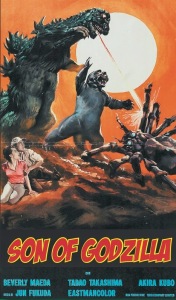
THE PLOT- A group of scientists (And one plucky, interloping journalist) work tirelessly in a Son-of-Godzilla-postertop secret research laboratory located on a remote island. Their experiments, focused on climate control, backfire, heating up the island to near unlivable temperatures, as well as causing a freak mutation in the island’s already pretty giant bugs, this time making them really, really giant. Things couldn’t get any worse, just kidding, of course they can- the giant bugs dig up an egg, which hatches. The hatchling? Apparently Godzilla JR! Eager to buck the absentee father kaiju dinosaur stereotype, Godzilla trods up onto shore for some good old fashioned monster child rearing. Things with our scientists are bad, they all got weird jungle fever, there is increased tension amongst the ranks, and now the island has turned into a full on Kaiju ass-whooping zone, so these are for sure stressful days. Their only hope for salvation comes in the form a mysterious woman found living on the island, and, of course, through Godzilla’s innate skill at clobbering the hell out of anything and everything.
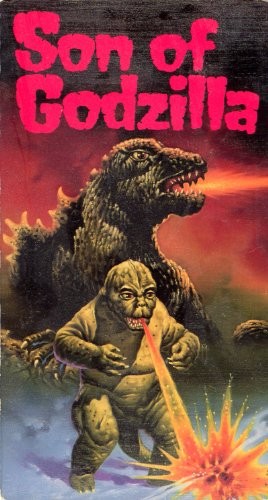
Son of Godzilla is good! It’s a fun one. It looks cheaper, the monster costumes look a little 2585_17620less masterfully crafted than they have in the past, although there is passable use of insect puppetry here. It’s clearly meant to be more of a children’s film than past Godzilla flicks, but it’s not so over the top that adults needs be concerned, and little Godzilla Jr. (I should stop pretending that I don’t know his name- it just wasn’t ever mentioned in this film) doesn’t approach Jar Jar levels of annoyance by any means… At least, not in this movie, he doesn’t.
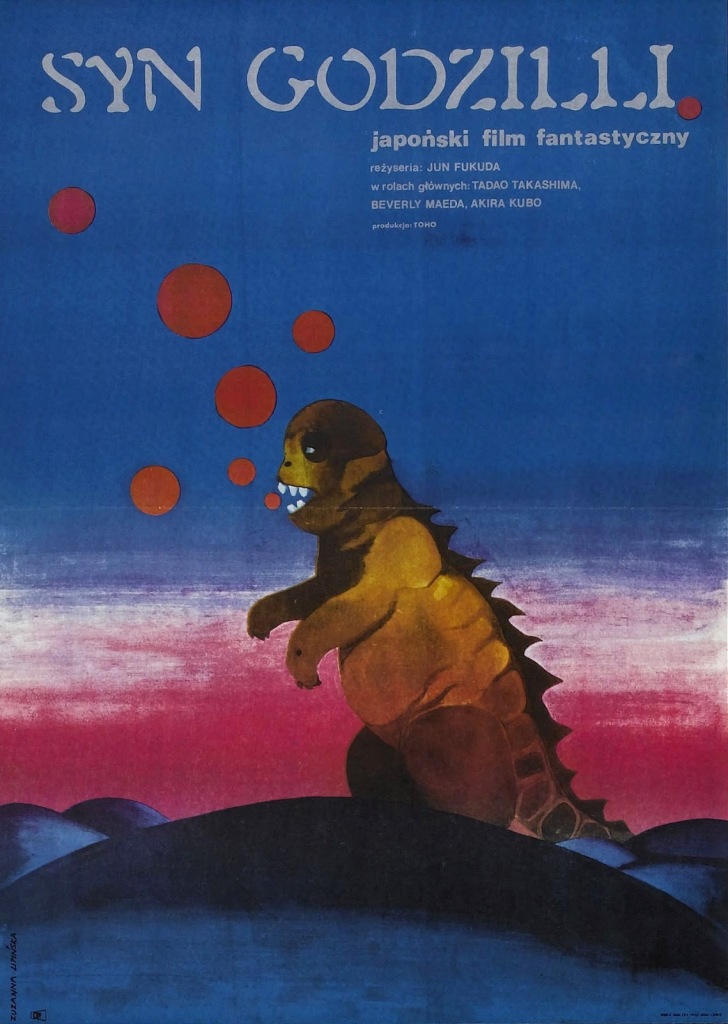
Really, the biggest flaw in Son of Godzilla is that while it is clearly geared for a younger audience, it’s too slow for kids, and it takes way, way too long for the monsters to turn up. When I used to watch these movies as a kid, the human sequences were a brutal chore to endure, I always wanted that monster on the screen right now. For Son of Godzilla, there’s a lot of work leading up the monsters, and possibly not enough payoff.

Regardless, the true test of how well Son of Godzilla performs for a young audience would be to let some kids watch it. From an adult perspective, the film is lighthearted, but still very enjoyable.

Check out these cool posters.
son_of_godzilla_poster_03

B

GZ backGZ next

WAR OF THE GARGANTUAS!

War of the Garganutas – 1966, Ishiro Honda – Japan

warofgs

War of the Gargantuas is a half-hearted sequel to Toho’s wacky ass Giant Frankenstein movie Frankenstein Conquers the World. We pick up where we left off for War of the Garganutas, but we also go ahead and rewrite the past more than a little, because, as you should know by now, sometimes Toho likes to turn it’s baseball cap around, light up a cigarette, and flash a big ol’ “F You” middle finger to continuity. This is one of those times.

THE PLOT ~ When a large, scaly, blue-greenish, humanoid sea monkey with a flat top who is not at all similar to Frankenstein in any way apart from the aforementioned Flat top begins to terrorize Japan, the press is quick to lay blame on Frankenstein, the famous European monster which had been imported, and then enlarged to traditional Japanese monster scale some years back. However, the scientists responsible for the creation of this recent Frankenstein balk at this suggestion, on the grounds that A) Franky don’t live under water and B) Franky don’t live at all, he is dead, dead as hell. At this point I’ll go ahead and point out that despite what you may have seen in the previous film, from within the confines of War Of The Gargantuas, this “Frankenstein” was born a strange, ape like creature, for absolutely no reason, and his creation now seems to have been achieved through genetic experimentation, rather than through the much more simple act of a child eating a radioactive monster heart. So, now you’re up to speed.

Soon, this alleged “Frankenstein” from under the sea begins to attack more frequently, and even wades up onto shore to gobble down some screaming humans, which, obviously, can’t be allowed to happen very often. It is confirmed through science that this is, in fact, a damn Frankenstein, despite his newfound love for livin’ la vida agua, as well as his now much more aggressive and violent temperament. “How can this be,” our scientists wonder, “he used to be such a nice monkey franken-creature.” Well, turns out, this is a new, different Frankenstein monster altogether. In fact, the creature that our scientists created is also still alive, and he remains a largely a docile and good natured monster, which has been living in the inaccessible reaches of a Japanese Mountain Range far from human eyes. He’s brown and shaggy, rather than blue and scaly, like his deep sea sibling, but he also is in absolutely no way a “Frankenstein” monster. He’s a giant troll type creature, basically. BUT ANYWAY.

6a00d8341d6d8d53ef0176172f061a970c

From here things play out like you always knew they would; it’s scientists versus military, one side wants to spare the lives of these two massive monsters, the other side knows in it’s heart that the only good Gargantua is a dead Gargantua. Eventually the two behemoth monkey monsters wind up battling one another, despite Brown Mountain Franky’s hesitancy to use violence against his Blue Brother, and the two wind up dead via the power of Japanese Nonsense; in this case; a volcano spontaneously sprouts out of the ocean right next to them mid-fray and fries them both. That can totally happen, right? No, Toho, it can’t, dammit, go read a science book.

The movie’s principle theme is compassion versus fear. This is played out in the conflict between the scientists, who want to spare these creatures both for study, and out of pity, and Japan’s military brass, themselves focused only on the preservation of human life; no matter the cost. We see the theme again illustrated with the Gargantuas themselves; Brownie doesn’t want to hurt anyone, not even his Malicious Mer-Monkey twin, but Greenie is all too eager to mash and smash, and in the end, tragically, compassion doesn’t have it’s day. This same idea is a common one in these Kaiju films, we can see it especially pronounced in Rodan, among other Ishiro Honda films, but War of the Gargantuas is not a slave to it’s super-motif, this movie has it’s priorities aligned with the presentation of big, hairy monsters being shot at, and clobbering one another, first and foremost. For this reason, it feels like a pretty solid, but also desperately typical kaiju outing from Toho. It’s has just enough heart and just enough muscle to make it memorable and fun, but beyond some pretty top notch photography I would suggest that there isn’t really anything in War of the Gargantuas that is excellent. It feels pretty middle of the road, to me. Not too many highs, but also, not too many lows. I think the decision to shed some of the craziness of Frankenstein Conquers the World was a poor one; that film absolutely stands out because of it’s generous helping of “WTF.” Without all that crazy, War of the Gargantuas crosses the finish line as a reliable, but not altogether remarkable, monster flick.

C

GZ backGZ next

Godzilla Versus The Sea Monster!

Godzilla Versus the Sea Monster, AKA Ebirah: Horror of the Deep ~ 1966, Jun Fukuda – Japan

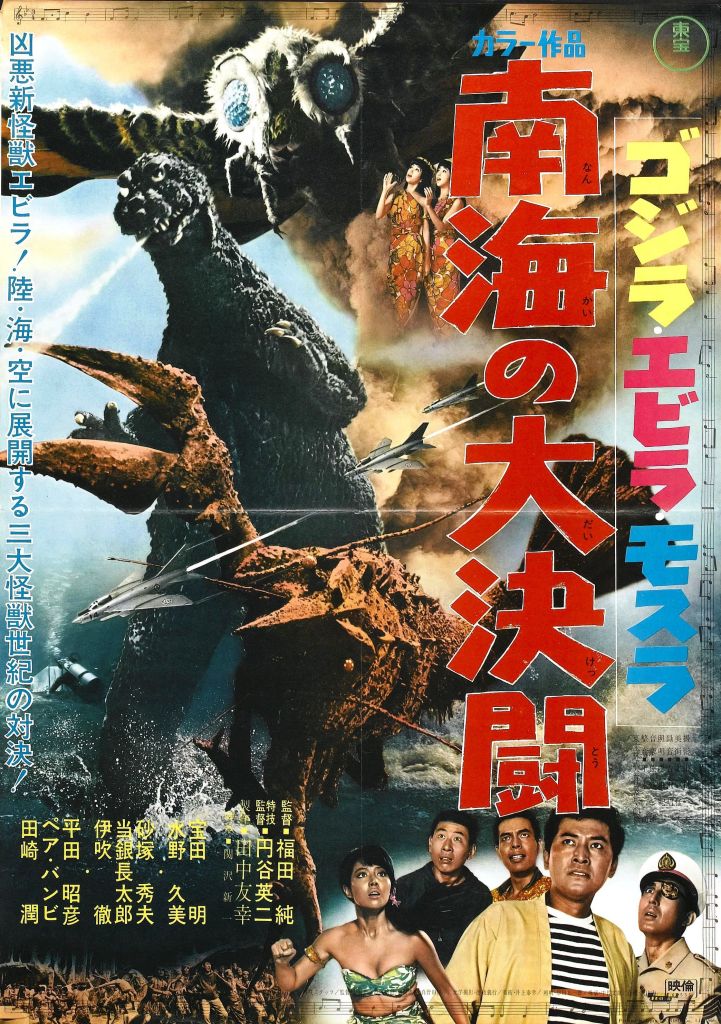
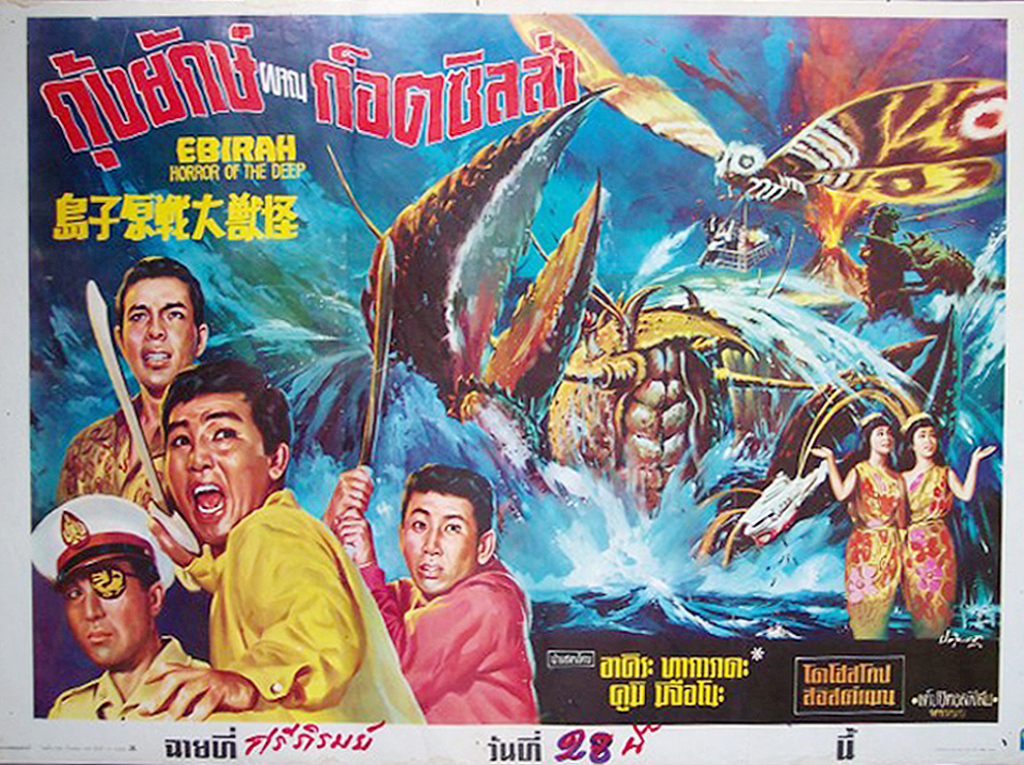
Godzilla_vs_sea_monster_poster_01

Immediately following Invasion of Astro Monster, which was perhaps Godzilla at his most recycled, we have Ebirah, Horror of the Deep, one of the freshest films in the series up to this point. Thanks, Toho, and not a minute too soon!
For Ebirah, we have a new director, Jun Fukuda, and his style is a serious breath of fresh air. While I would never want for this to sound like a dismissal of Ishiro Honda’s remarkable talents, I will say that there is certainly enough room under the kaiju umbrella for more than one voice at the helm of the Godzilla franchise, and if there was ever a time that new blood was needed, it was right around 1966. The movie also moves the action from Japan’s cities and countryside to a remote, tropical island, and this shift in setting only further accents just how off the badly beaten path this film was to the series at that time.

THE PLOT- Although his brother’s ship has been lost at sea, Ryota is utterly convinced that he is somehow alive. He’s so convinced, actually, that he ends up hijacking a boat and dragging three total strangers, one of whom is a damn bank robber, on a fool-hearty adventure to find and rescue his lost sibling, and the group wastes no time becoming shipwrecked themselves when they are attacked by a huge, lobster type monster named Ebirah, leaving them stranded on the shores of a mysterious island.

2636575320_d1f164c472_o

As the four soon come to realize, this island is controlled by a secretive paramilitary organization called The Red Bamboo, who have been using kidnapped natives from Infant Island as slave labor. Word of advice to the world’s paramilitary organizations; if you intend to kidnap islanders for slave labor, maybe pick a group that can’t pray to a giant, flying guardian monster to save them. I really hoped you’d use better judgment, guys.

Through their jungle adventures, our boys pick up a fifth friend, a female from Infant Island, and also discover Godzilla snoozing aggressively in a giant pile of boulders in one of the islands caves. Long story slightly less long, they wake up Godzilla, and shit get’s smashed. It’s really great!

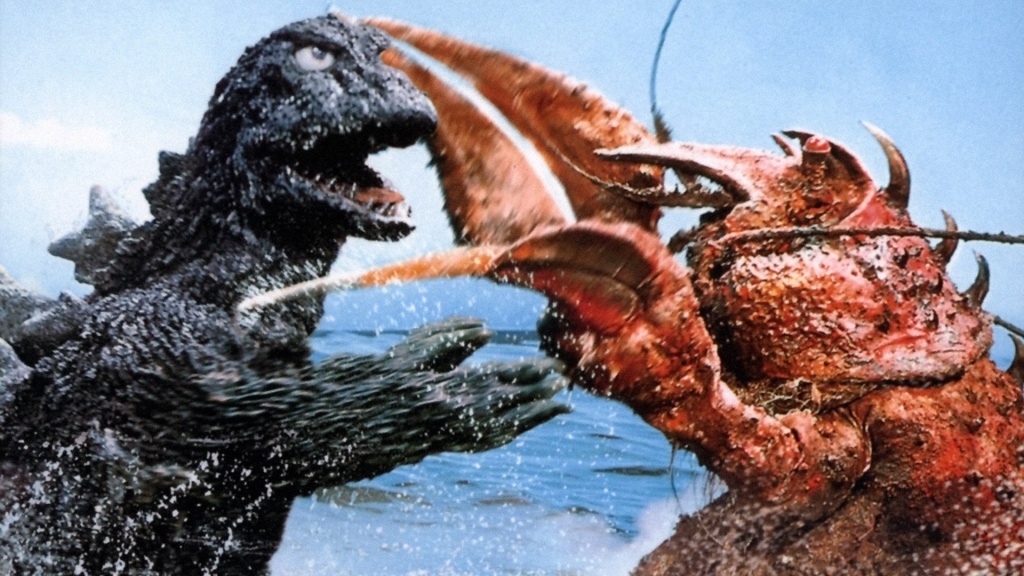
godzilla-vs-sea-monsterI imagine that Ebirah would be Godzilla’s most delicious foe.

First, let’s talk about what Fukuda does that rocks my business so hard- his directorial style feels much more in line with the youthful bounce of 60’s beach cinema than Honda’s classical, 50’s screen aesthetic. While Honda’s work is tops, Fukuda’s feels great, too, and it really works in Ebirah. Here we have a noticeably more dynamic use of composition and moving camera, we have occasional zooms and dolly’s, even some dutch angles. The monster encounters are, in my opinion, drastically improved by this new, more dramatic use of camera, with angles shifting from claustrophobic close ups which stress the size of these beasts, to frantic, sometimes first person perspectives used in the fights between Godzilla and Ebirah. At one point, Godzilla’s fire breath is belched directly into the camera- I’m pretty sure that’s the first time I’ve seen that in this series, correct me if I’m wrong. This might be a controversial statement, but I feel that Fukuda’s use of camera in Ebirah is more effective when dealing with monsters which we are supposed to believe are enormous than what I’ve seen in previous Hondra directed outings, and I can’t remember being as impressed by the visuals in one of these movies since the first Godzilla film back in ’54.

The music undergoes a shift, as well. Akira Ifukube always brought a strange, Japanese folk inspired Bushido dirge to the series, but for this film we have a new composer, Masaru Sato, and, like Fukuda, he brings things up to date with a bouncier, zanier beach pop sound, and even some traces of surf rock guitar. I think it works, and it certainly adds to the film’s upbeat tone. Again, no disrespect meant, Ifukube is an absolute master and his work in the Godzilla franchise cannot be praised enough, but right now, we needed something new, and we got it. As a result, this movie benefits, and so does the audience.

On the setting: The tropical island thing isn’t totally unseen in these Toho kaiju pictures, but ordinarily, the action is always moved back to Japan and out of these remote locations. Not so with Ebirah, here, that’s where the meat of the story sits, and the implications of this give us a very different film. By removing the inevitably of city smashing and innocent casualties that are unavoidable when Godzilla thrashes around well populated areas, he is here free to stomp bad guys exclusively, and in this way he can continue his path toward becoming a more heroic figure, something Toho seemed interested in pursuing at this time. It’s also a lot more cooperative with the notion of the film being more fun and less dark, which it absolutely is. Hell, the Godzilla/Ebirah battle scene starts off with a rousing game of monster volleyball, and then leads into some Dick Dale guitar/submarine beast throw down type stuff, I’d have to think that Fukuda went into this wanting us to have a positive experience.

godzilla_vs_sea_monster_fb_01

And I think you will. Only the stodgiest of Godzilla traditionalists would throw up their arms in protest of Fukuda’s treatment of Big Green, and my guess is most of those people died in the theater back in ’98 when Roland Emmerich’s American ‘Zilla film premiered, so we shouldn’t hear too many objections to this glowing review. Or will we?!?

A

GZ backGZ next

INVASION OF ASTRO-MONSTER!

Invasion of Astro-Monster ~ 1965, Ishiro Honda – Japan

Invasion_of_Astro-Monster_Poster_A

Rocky waters for the Godzilla franchise!

Following the awesome Ghidorah The Three Headed Monster we have Invasion of Astro-Monster, which is actually weirdly similar, but not anywhere near as good. Like the last film. We again have Godzilla and Rodan VS King Ghidorah, almost like they didn’t want to go get any new monsters costumes out of the garage, but we’re missing Mothra this time out, so in a sense it’s even a step back from it’s immediate prequel. Weird!

THE PLOT- A new Planet, called Planet X, is discovered in our solar system. We soon learn that Planet X is inhabited by an advanced race of humanoids, and they want our help. It seems that after he had his ass handed to him by our Earth monsters, King Ghidorah retreated to Planet X, a land where he could ruin everything indiscriminately without interference. The people of Planet X offer a trade; they can’t deal with Ghidorah’s shit anymore, so if we loan them Godzilla and Rodan they’ll give us the cure for cancer. Long story short, they’re a bunch of treacherous A-holes, and soon we end up with an invasion force from Planet X forcibly attempted to colonize Earth, and they happen to control Godzilla, Rodan AND King Ghidorah using electro magnetic waves now. It looks grim for Earth, but since most of you are aware that there are another twenty or so sequels to this film, I don’t think it’s out of line for me to spoil the end and say that they figure it out okay.

So, Invasion of Astro Monster feels way too much like it’s predecessor to be fresh. WAAAY too much like it. Also hindering the film is the light monster content; there just isn’t enough kaiju clobbering action to carry this picture. What we have instead is a greatly expanded role for extra-terrestrials, something that was hinted at in the prior film, but relatively unexplored. This time around we certainly get our fill of aliens, but they feel boring and they eat up way too much run time. Ghidorah: The Three Headed Monster had so much going for it, but Invasion of Astro-Monster just feels like an inferior sibling.

Also, this is the movie where Godzilla does his weird victory dance. I don’t know what in the hell that was about.

Godzilla-Dance

C-

GZ backGZ next