Atragon!!!

Atragon – 1963, Ishiro Honda – Japan
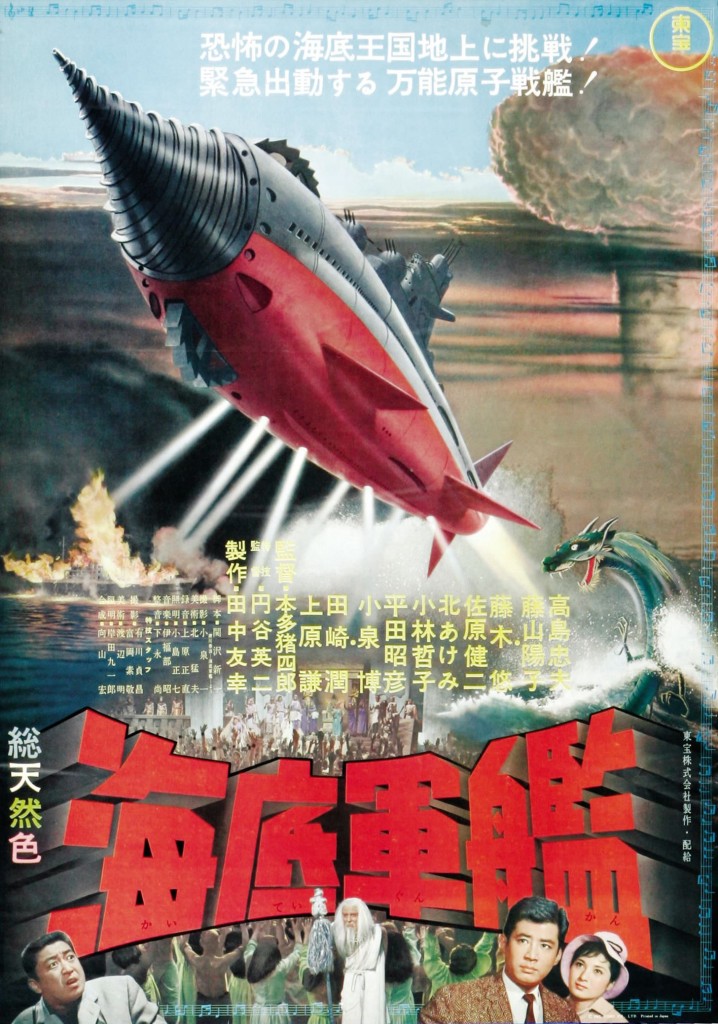
Atragon_poster_04

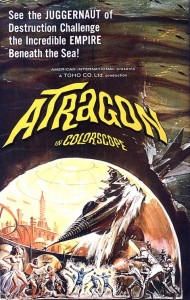
Somewhere out in the far edges of the extended Toho Zilla-Verese lives Atragon, a cool little movie about a futuristic submarine that must save the world from an invading, undersea Empire. That’s right, while Atragon may sound like the name of a wicked sweet dragon, or maybe a giant spider or something, that’s actually the name of the flying, submergible war ship featured prominently in the movie- and that’s because Atragon isn’t a kaiju film at all, but rather an action/adventure movie with elements of mystery, science fiction, fantasy, and horror blended in. It’s a good mix, a good movie, and nice reminder that Toho has made plenty of solid films that didn’t focus on towering, menacing lizards.

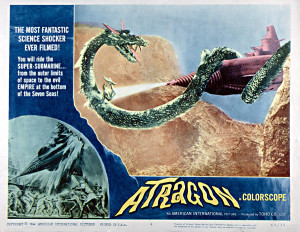
Now, that being said, there IS a giant monster in here- Manda, a serpentine, dragon type creature which later makes an appearance in Destroy All Monsters, and who also gets a name drop in a few other Godzilla flicks. Manda is the connection between Atragon and Godzilla, but his role is actually pretty minimal in this film, and oddly enough, that’s not a problem. We have plenty of fun without him.
atragon

THE PLOT~ Weird, vaporous frogmen have been sighted in Japanese harbors, prominent scientific minds have disappeared mysteriously, and earthquakes continue to strike our cities with increasing regularity- just what the hell is going on? I’ll tell you what’s going on, business-as-usual, according to Toho. Apparently an ancient, highly advanced civilization from a long lost, Atlantis style continent called Mu has chosen this time to reclaim the surface world as their rightful property. Their message to we ignorant, non-underwater masses? Simple; “Return the surface world to the sovereignty of Mu and declare yourself our Imperial colonies, plus also make that guy stop building Atragon, we are not cool with that. No Atragon.”

“Atragon?”

No one has any idea what in the hell Atragon is. They soon learn, however. Apparently Atragon is a top secret, highly advanced, multi-terrain warship being built by a rogue Japanese Naval captain who revolted during the second world war. Captain Jinguji, believed dead by official record, didn’t revolt to avoid his responsibility to Japan, however, quite the opposite; Junguji is a fanatical hold out who still buys in to the rhetoric of pre-war Japan, and he and his men boldly maintain that while Japan may have surrendered, they never did. It is their intention to use their new warship Atragon to reinstate Japan to it’s former glory, and rebuild their once proud empire.

That’s all well and good, but we need to focus on whats important right now; clearly, Mu being so anti-Atragon is a indication that it’s more than likely our only defense against their invasion, so a small group of unrelated characters who have all been swept up into this adventure must seek out Jinguji, and convince him to use the mighty Atragon to save the world, instead of conquering it, as was his intention. Long story short, this hombre takes some convincing.
atragon-aka-kaitei-gunkan-1963-everett

The subtext here is all about confronting the old Pre-war attitude of the Japanese culture, and embracing instead a less Nationalistic attitude toward your fellow man. That’s something that may have had more poignancy to a Japanese audience back in the 1960’s than it does today, but we’re not totally incapable of investing in Atragon or it’s characters simply because we’re so far removed from this context. The movie remains relatable somehow, and even without that connection, the spectacle, and the interpersonal dynamics of our characters entertain us just fine.

Atragon is really great, and it deserves attention. The thing is just slathered with intrigue from frame one, and actually, from the pacing, and how our mystery is explored through drastically rising stakes and continued revelations, the film feels more like Herge’s Tintin than traditional Toho fare, and that’s totally awesome. I love traditional Toho fare, but this is a highly enjoyable foray out of what I’m used to from them, and Ishiro Honda’s reliable expertise is appreciated here as much as it ever was with his monster films.

If I’m going to seek out any weak points in Atragon, it’s worth mentioning that it’s quite predictable. Double agents are obvious from their earliest appearance, and there’s never really any question as to if Jinguji will agree to use Atragon to save Earth, once the terms of our situation are laid out it’s pretty clear which ways things are going to go. Still, it remains an enjoyable trip.

atragon2

The other problem here is with Manda. Frankly, he looks terrible. One would expect better monster effects from the studio behind Godzilla, but Manda is executed remarkably poorly, all things considered. He also could have been in the film a little more, but maybe the less we see of him the better, given that he looks like such a laughably unconvincing puppet… Which, of course, is exactly what he is.

Atragon isn’t very well known in the States at this point, but It’s a pretty good little adventure flick. If you’re a fan of Toho, or of Japanese cinema from the 1960’s in general, and if you can handle some time away from Godzilla, I would highly encourage you to check this movie out.

A
GZ backGZ next

MOTHRA!!!!

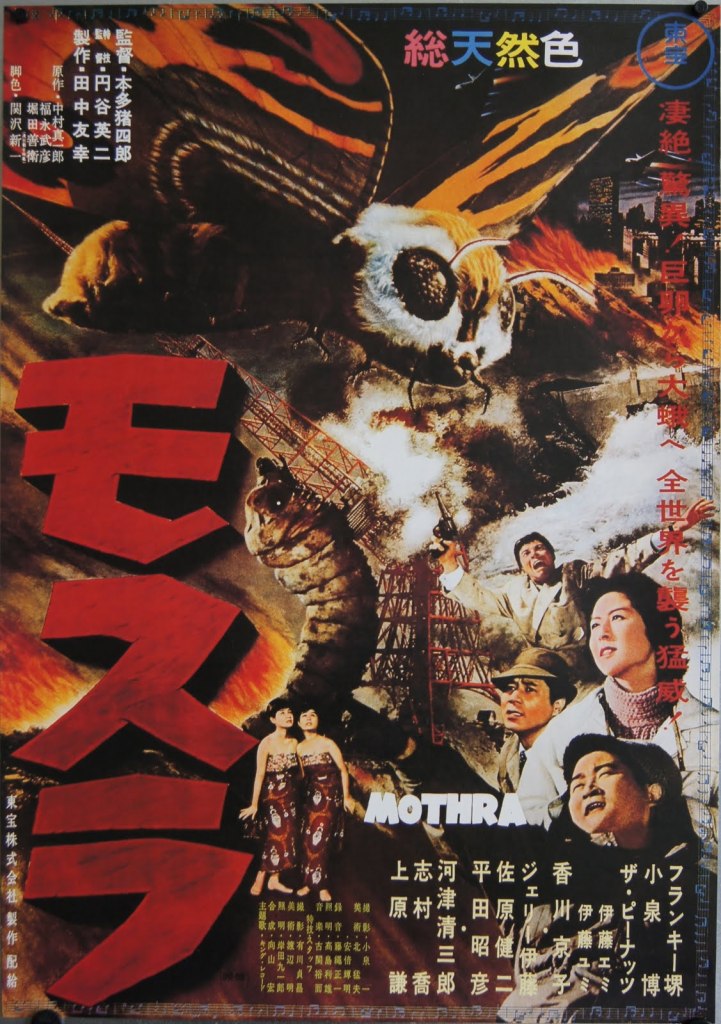
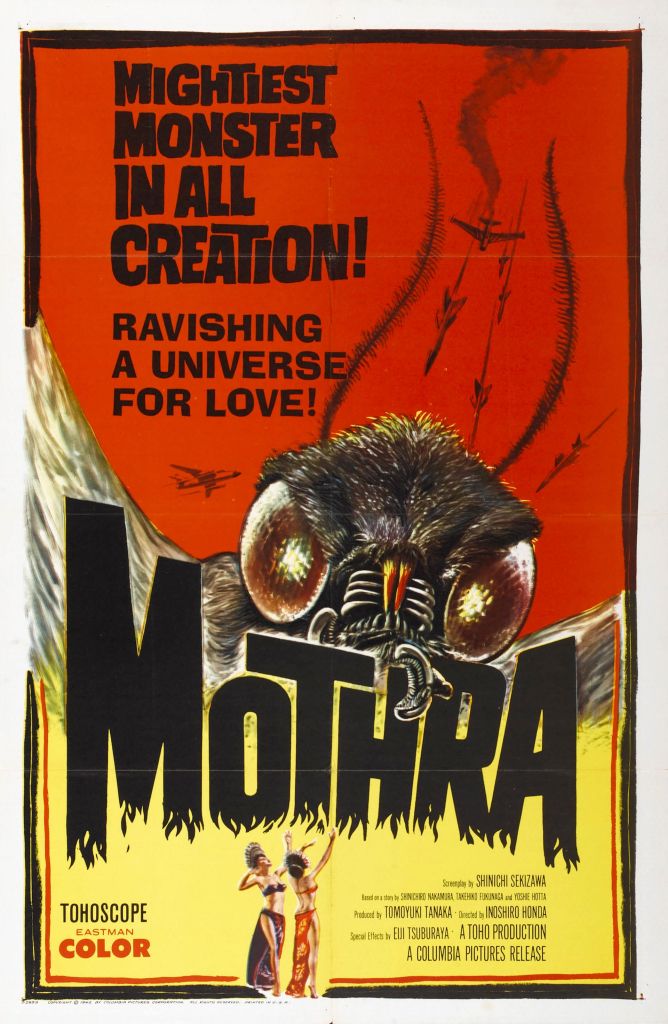
Mothra ~ 1961, Ishiro Honda – Japan

123011 mothra

When I was a child, I liked Mothra okay, but she was easily my least favorite giant monster… And my list of “giant monsters” was not short. Somehow, a giant bug failed to capture my interest the same way a giant, immortal, radioactive dinosaur with laser breath could (back thenI gave no shits about the understated.)  I know I saw Mothra as a kid, but the odds are that I payed little attention to it. Now, as an adult, I have gone back and re-watched it for the first time, and Mothra is really excellent. It’s a film that feels distinct and fresh, but still able to fit in nicely with it’s kaiju contemporaries. The characters are all likable, the story is entertaining, and the more spiritual feel is a welcome departure from the norm. Mothra ranks among my favorite Toho films at the time.

mothra_1962_poster_01

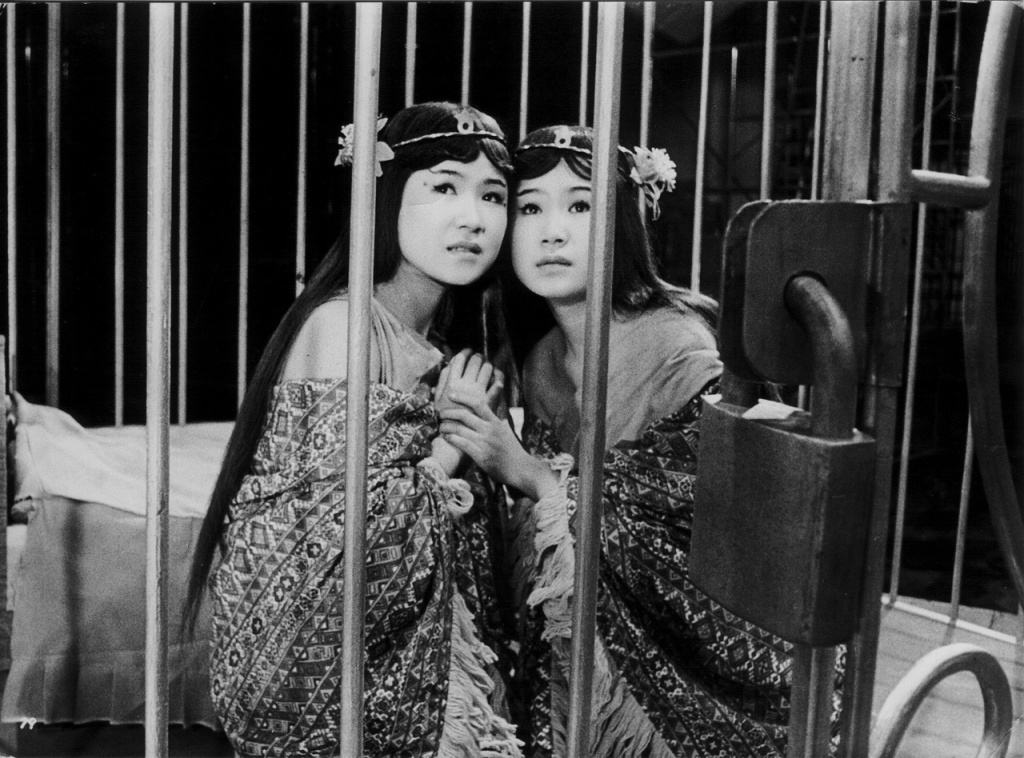
THE PLOT: An expedition is launched to investigate mysterious reports of natives living on Infant Island, a Polynesian island thought to have been uninhabited, and which had been exposed to radiation durring atomic testing in the Pacific. The expedition is made up of both scientists from Japan, and also Rolisica, a fictional nation looking to be something of an amalgam of the United States and the Soviet Union. Upon reaching Infant Island, natives are indeed discovered, as well as two creatures with the appearance of small, humanoid females.

Mothra_fairies

They’re like, seven inches tall? Small as hell.

Some evil Rolisican dude named Nelson snatches them up and takes them back to civilization with the fine idea of making some money off of them, much to the chagrin of our three main characters, because they’re the good guys. Long story short, the natives of Infant Island are pissed that we took their tiny ladies away, so they pray for Mothra to hatch and retrieve them. Mothra does hatch, and the rest of the film is a balance of trying to survive her onslaught, and trying to steal back the ladies from Nelson and get them home.

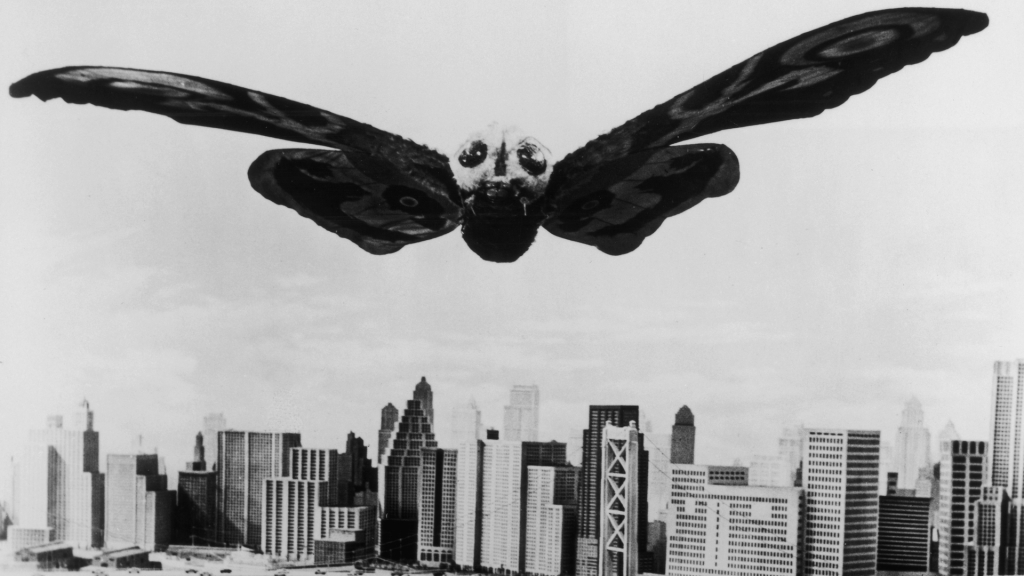
Mothra is a giant moth also, in case anyone didn’t know this.

Terror Over Tokyo

There she is!

The film deals with ethical questions of exploitation (both resources and human lives), international tensions, greed and commercialization, and more spiritual notions of global unity in a way that doesn’t line up with the perspective of other Toho flicks. In King Kong versus Godzilla, natives are exploited, but we aren’t really told that this is wrong, so much as that it’s just something we can do if we want. Mothra is a more humanistic film. It’s also very well put together, and quite enjoyable.

Maybe my favorite thing about this film is this dude;

Sakai

On the right.

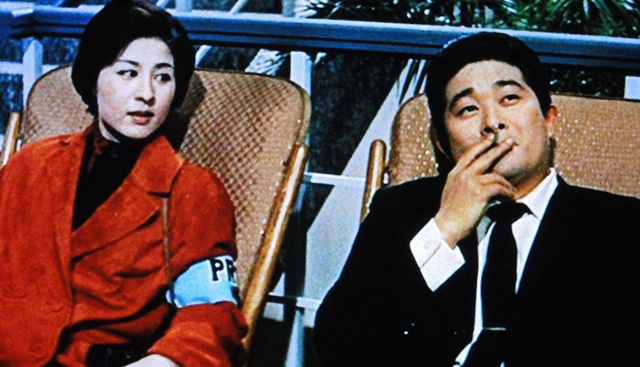
Furanki Sakai, who plays Senichiro ‘Sen-chan’ Fukuda, AKA “The Bulldog,” according to IMDB. In the subtitles on the version I watched, he was called Zen “The Snapping Turtle.” No matter what name/nickname combination is used in the version you see, Sakai is kicking out the jams. His character is believable, funny, likably, ballsy, and brave, he’s what I would maybe call a “lovable bad ass.” Honestly, he’s possibly my favorite human character in a Kaiju film ever; the only other known contender at this point being Don Frye’s Captain Gordon from Godzilla: Final Wars. Sakai’s character kinda feels like Lou Costello, if Lou Costello could also kick ass on occasion.

Another matter of note: The natives of Infant Island are apparently intended to be Polynesians, but the actors all appear to be Japanese people in black face. This same phenomena also appears in 1962’s King Kong Vs Godzilla, and it’s totally weird.

Mothra is really great, though.

A+

GZ backGZ next

RODAN!!!!

Rodan ~ 1956, Ishiro Honda – Japan

latest

Holy smokes, yes.

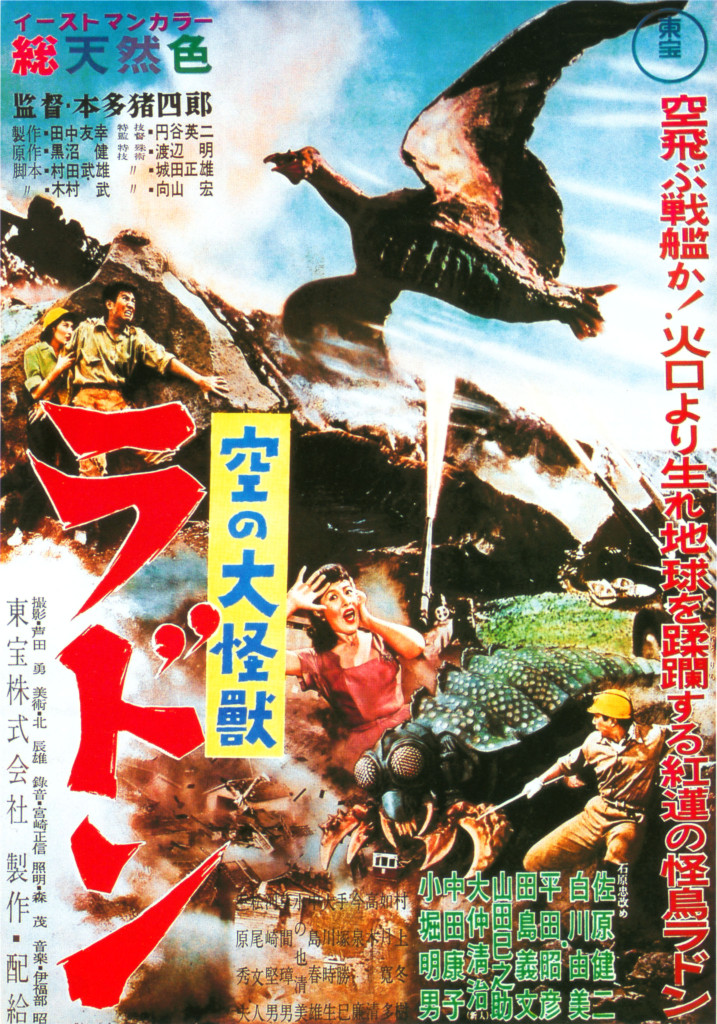
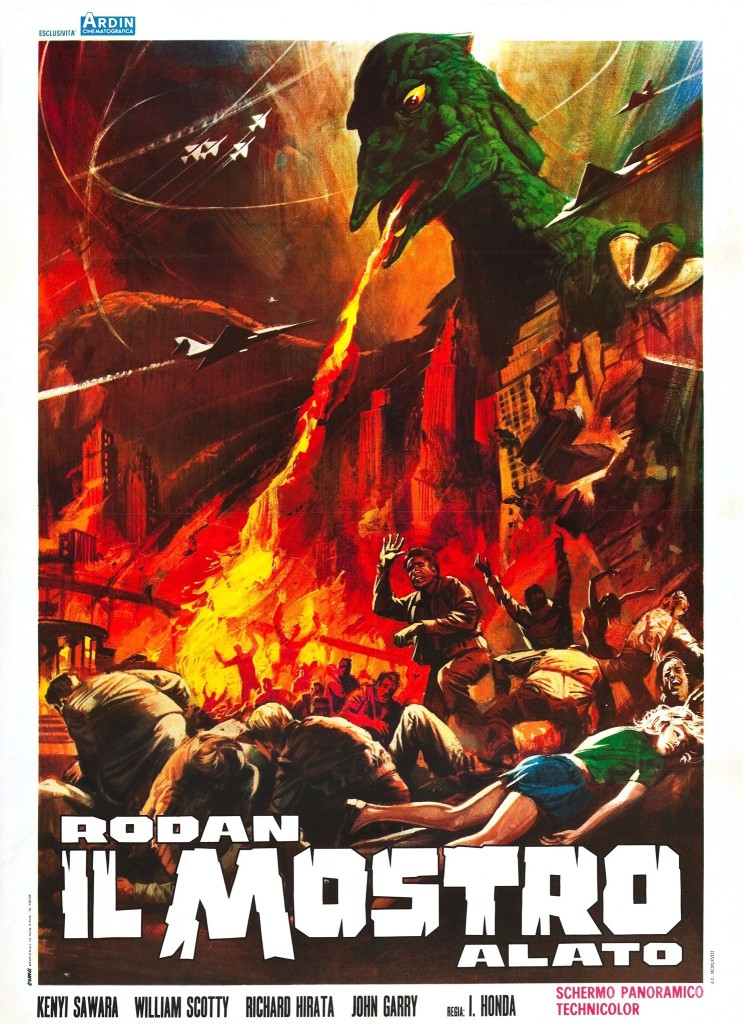
Rodan is a favorite of mine going way back. This is his/her/their first appearance, dating way back to the pre-Mothra days of 1956, and it holds up pretty darn well for the most part. With the possible exception of the ultra-grim Gojira, and the deliriously funky Godzilla Vs Hedorah, this is also one of the darker, scarier films in the entire expanded Godzilla universe, which is for sure cool. Rodan is also apparently Toho’s first Kaiju film to be shot in color, but it doesn’t feel overly vibrant or gimmicky, the palette is mostly browns, reds, and Earth tones. It’s just like Honda to use the fanciest new toy available such in a reserved, controlled fashion.

THE PLOT~ When a series of bizarre murders strikes a small, rural mining community at the base of Mt. Aso in Japan, rumors begin to spread that Goro, a missing miner with a reputation for hard fightin’, had gone all My Bloody Valentine on his colleagues and was currently hiding out deep within the chambers of the mine to escape the watchful eye of the law. Goro’s sister Kiyo is pretty upset when every person in town throws her brother under the bus like crazy, and her boyfriend Shigeru does his best to console her, but really, what do you say when your girlfriend is down in the dumps because her brother is wanted for viciously mutilating his coworkers? I had a hard time turning it all around when I took my ex-girlfriend to a Vietnamese restraint that we didn’t know was closed on Sunday. This task is doomed to fail.

Well, as it turns out, Shigeru gets lucky, because the real killer turns up and attacks them both inside Kiyo’s own home, and it sure as hell ain’t Goro. No, actually, it’s an enormous, menacing insect, the size of a damn Grizzly bear, so that really changes the course of the evening pretty drastically. “Good news, honey, you brother’s good name has been cleared! The bad news is that the last thing he saw before he died was the pincher end of this fucking abomination as it lacerated the shit out of him in the cold, dark tunnels of the mine he was confined to for most of his adult life. But again, very few people probably still think he was a murderer, so that’s the silver lining here.”

Rodan 2069825_jpg

Soon, the people of this small village discover that in fact there are dozens, if not more, of these giant insects currently living deep inside the mine, and this is a problem the really kind of have to deal with right away. After participating in an offensive strike against these monster potato bugs, Shigeru is lost inside the mine and presumed eaten. Next, a bunch of scientists pow wow to try and figure out what the hell is up, and predictably, they learn that these bugs are prehistoric somehow. Japan had a real bumper crop of prehistoric monsters reemerging back in the mid twentieth century.

Speaking of …! Around this time, the entire planet starts getting divebombed by some super fast, highflying UFO that has been horrifying the shit out of everyone, tearing up any plane that tries to chase it down, and causing sonic booms which have badly damaged several cities. Nobody knows it yet, but this object is actually Rodan, or Rodans, because there are two of these critters. But just what is a Rodan? A damn giant pterodactyl, that’s what- but they fly much too fast for anyone to get a decent look at them. At this point, most people assume Rodan to be some sort of craft, a theory supported by the fact that they seems to leave a vapor trail behind him/her while in flight… Which… Like, what is that? That’s… That’s gross, actually. It’s gotta be monster farts. Rodan has no engine.

So, back at Mt. Aso, our scientists make another startling discovery; Shigeru is alive after all, but he’s dazed as hell and wandering around the mountain like a freaking zombie. They grab him and take him in for hospitalization, and initially he seems to be suffering from total amnesia. When he regains his memory, he drops some serious shit on everybody- apparently he blacked out after the attack on Potato Bug base, and when he came to, he was in a huge cavern somewhere deep within the mine, just in time to see Rodan hatch. The horror he experiences is so great that he temporarily loses his mind, which is totally H.P. Lovecraft status. Cool.

Once Rodan is identified, the rest of the movie is mostly about trying to kill them, which is all pretty straight forward, until the end of the film. See, at this point, Rodan is little more than a winged retread of the same material Gojira explored two years earlier, but the movie distinguishes itself from it’s predecessor in a few key ways, all of which are really driven home in the film’s climax.

Firstly, Rodan is never shown to be quite as horrible as Godzilla. In Gojira/Godzilla: King of the Monsters, the metaphor is clear- this monster represents atomic warfare, he is an evil man hath wrought, and now the hens have come home to roost. In Rodan, the atomic bomb thing really isn’t as cut and dry- the idea that atomic weapons may have been responsible for waking Rodan up is certainly presented, but it’s not as fact- it’s more like “Hey, how is Rodan not dead like he should be?” To which, the answer given is “I dunno. H-bomb? We’re all screwed, though.” Without the direct and implicit ties to nuclear war, Rodan sort of comes across more like an agent of our mistreated environment. For one thing, these animals are freshly hatched- so all the zooming around and flapping at buildings is more a case of children at play than the deliberately destructive monster tantrums Godzilla is known for. The finale takes this concept even further; get ready for a major buzz kill:

At the climax of the movie, our Anti-Rodan team formulates a strategy whereby explosives are used to trigger a volcanic eruption in Mt. Aso. The locals are horrified because of the damage this will do to the environment and surrounding settlements, but the military flatly declares this a necessary compromise and pushes forward with the idea. As the two sibling monsters snooze peacefully inside their cavernous nests, Japan detonates their bombs, and indeed, Aso does erupt, but not before the twin Rodans can escape. However, apparently overcome by smoke, one of the monsters tumbles down into a river of lava, and the other Rodan, apparently much more sentimental than the monsters we are used to dealing with, chooses to join it’s sibling, and willingly lands next to it, thereby committing kaiju suicide… Both monsters die, engulfed in flames, and not at all in the bitter, violent battle we expected… Which… Honestly, is sort of heavy, and probably made all the army dudes feel like serious dicks.

1956-rodan-john-4

In the end, Rodan manages to pull the old switcheroo on us, and leaves us feeling like we’re the real monsters, who overstepped our bounds, could not deal with the consequences, and rather than learning to live in harmony with the surroundings we have created, we choose to suppress, exploit, and kill that which doesn’t suit us, and it’s not fair. This gives Rodan a different thesis, even with similar content and themes, and it makes the movie a tragedy every bit as potent as the post Hiroshima monster film that kickstarted the Kaiju phenomena.

1956-rodan-john-1

The are two noteworthy flaws in Rodan, one; Rodan is a flying monster, and therefore this movie serves up numerous aerial sequences, but they are all badly hampered by technological limitations. The resulting shots may have been easier to swallow in the 50’s, but of all the antiquated effects that we see in these old movies, these aerial sequences stand out as being beyond what modern eyes can excuse, this is a few steps passed ‘retro’ and well into “shlocky.” Two; although distinct in small ways, the movie is still a bit of a rehash. I’m not too bothered by that, though. Rehashing is something Toho would earn a damn black belt at in the coming years, and they often manage to do it while still delivering a fantastic film. This is one of those times. Rodan isn’t as well loved as Gojira, but it’s a movie I’ve always been fond of, and I highly recommend it.

A

GZ backGZ next

GODZILLA; KING OF THE MONSTERS

Godzilla; King of the Monsters~ 1956, Ishiro Honda and Terry Morse – USA/Japan

godzilla_1954_poster_06_tx800

In 1954, the Japanese released a brilliant, gloomy classic of science fiction/horror; Gojira. Two years later, we added a white guy, and it was finally ready for American consumption. This is that movie.

Raymond Burr plays Steve Martin  (……?!?!?!), a reporter bumming around Japan because, dammit, he can, he’s Steve Martin. While there, Martin is witness to a most strange phenomena; the appearance of Godzilla, a towering, dinosaur like monster, poised to wipe Japan off the map. Martin watches and reports what he sees back to a horrified listening audience around the world, but really, he doesn’t do much else. He’s just plopped in here to give close-minded Westerners someone to experience the movie through who isn’t Asian. Monster comes, smashes stuff, people scream, and a scientist sacrifices himself after reluctantly agreeing to use a highly dangerous new weapon he invented to save Japan from this catastrophe. Meanwhile, we have a few subplots going on, but their impact is enormously weakened due to the shift in focus to Raymond Burr.

White washed and watered down though it is, the movie remains great. The original Japanese version is inarguably superior, but King of the Monsters is still an extremely solid film, and much of the fear, tension, and the nuclear subtext is retained. The biggest weakness King of the Monsters has is that it isn’t Gojira, and that in the annals of film history, it will forever be a footnote to it’s Japanese counterpart, but that’s how it should be.

One interesting point; this movie illustrates a massive shift in public perception regarding how world governments behave. These days, 100% of the movie going audience would expect to have something like Godzilla hidden away, buried in a massive, multinational cover up, with media coverage utterly suppressed and an elaborate web of deceptions cast over the masses to shield them from the truth. That is a far cry from what Steve Martin experiences in King of the Monsters. When Martin arrives at the scene of an ongoing Japanese investigation into strange attacks on ships off the coast of Japan, he identifies himself as a reporter and simply asks an official what is going on. The response he gets is literally “Well… I’m not sure it should be printed…” followed by an immediate disclosure of all information available up to that point, after which Martin is continually given unhindered access to all of Japan, and is met with absolute and complete cooperation from authorities at all times. Not only is there no apparent interest in concealing any information, the Japanese government in this film is actively facilitating the needs of anyone who might want to know what’s up, and aiding them in spreading the news, too. In other words, the exact opposite of what we see in reality. While I believe that world governments were just as much a pack of dirty, selfish liars back in the 50’s as they are now, it’s interesting that something like this could be included in a motion picture back then and people would have bought it. Sign of the times, I guess.

A+

GZ backGZ next


GOJIRA!!!

Gojira ~ 1954, Ishiro Honda – Japan

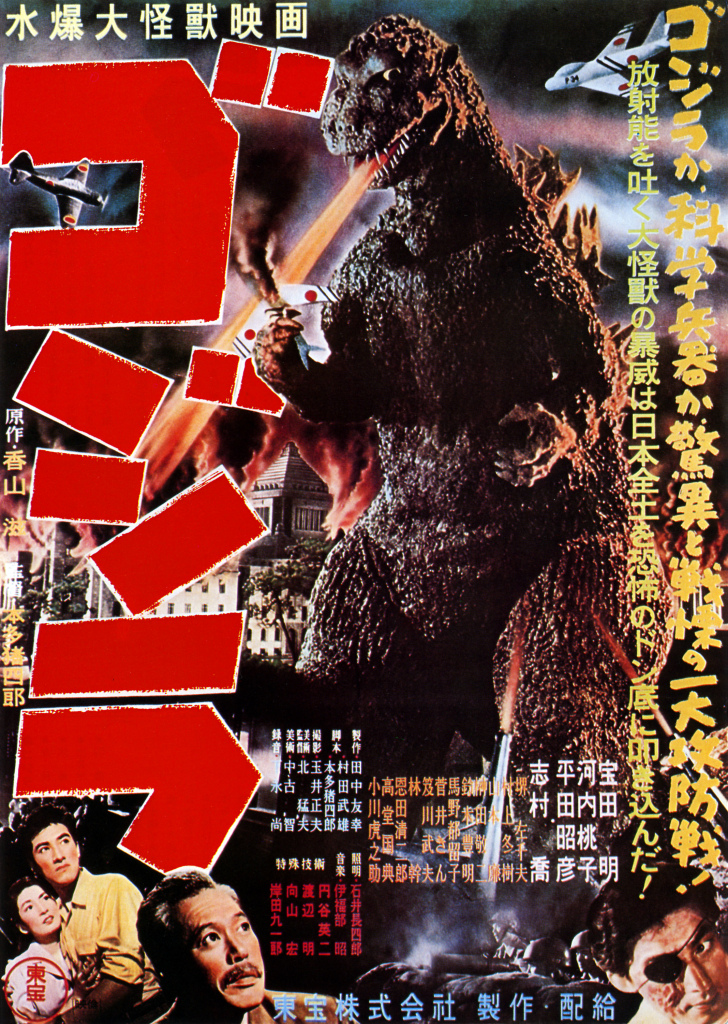
Gojira_1954_Japanese_poster

As a Westerner, by the time I had finally seen the original Japanese Gojira, I had already seen the Perry Masonified American version dozens of times. I had long been aware that the Japanese version was considered much better, but I was unprepared for just how much better it really was. I finally saw the original, Raymond Burr-less version about seven years ago, and while Godzilla: King of the Monsters is a sturdy, enjoyable monster classic on the level of Dracula or The Wolf Man, Gojira is a masterpiece, better compared to German Expressionist horror like Nosferatu or The Cabinet of Dr. Caligari. This shit’s off the chain.

The plot centers around mysterious phenomena occurring in and around Japan, the results of which leave many dead, and have Japan’s top minds speculating without much to go on. The film lingers in tense ambiguity for a lot longer than it’s American twin, and when Godzilla is finally revealed to be the cause of these strange occurrences, it remains some time until everybody is on the same page regarding not only his existence, but also what to do about it. Plus, when he first shows up, Godzilla looks a lot like Triumph the Insult Comic Dog.

010-godzillafest-godzilla-1954-01“Hey, Japan- your country looks really great!… FOR ME TO POOP ON!” 
There are also multiple human characters we actually care about in this movie, including Emiko and Ogata, two young lovers who face considerable challenges in pursuing a relationship with one another. Firstly, Emiko is already engaged via an arranged marriage to a brilliant, but reclusive scientist named Dr. Serizawa. Emiko does not want to marry Serizawa, but we definitely do not get the impression that he is at all a bad man. Additionally, Emiko’s father, Dr. Yamane, is at odds with Ogata, who feels that Godzilla should be destroyed. Yamane believes the monster to be far too valuable to science, and this disagreement between the two puts further strain on Emiko and Ogata’s relationship. Their romance is actually the heart of the picture, but in the American version it is minimized to such a severe degree that the film loses it’s emotional anchor completely. Presumably, the addition of Raymond Burr in the American cut was done in an attempt to give Western audiences someone to relate to, but it creates an enormous amount of separation from the film’s drama, and I think this is a mortal wound to the picture which downgrades it from an artfully crafted allegory to an easily dismissed B-movie. Burr feels far too safe, even when he’s crawling out of rubble, and he has no investment in the lives of the people around him, so neither do we. Like looking through a window at a storm, the American version has taken all of the bite out of the picture, where the Japanese version feels much more like being the person locked out in the wind and the rain, we feel the misery and the fear much more effectively.

Throughout Gojira, Godzilla’s status as a metaphor for atomic warfare and the ramifications thereof are well solidified, and the film takes this topic seriously. It adds a great deal of weight to the film, this is a tense, gloomy picture that is lightyears from the goofy, fun-time monster slugfests we’d see out of Godzilla in the 60’s and 70’s.  By 1954 standards, this shit is actually kinda scary. The photography is very high contrast, we see Godzilla’s fury in thick, jet blacks and flat whites, like the cover of a Darkthrone album, it exudes gloom and discomfort, and the movie really goes the distance in exposing the viewer to human casualties. In watching Gojira, it’s hard to disassociate the film’s proceedings with the historical events that they are meant to represent, so these civilian deaths are not easily shrugged off. This truly is no fun monster romp, Gojira feels like a movie about the horror of atomic war that just happens to use a monster to tell its story, which is exactly what it is, and because of how well this is done, and because of how direct this metaphor is, I think there is a strong case to be made for Godzilla being the single greatest Fictional monster created since Dracula. The book… Not the movie.

The multifaceted discussion on the topic of atomic war in the film feels very stark, but not preachy. Gojira doesn’t so much as all out demonize atomic war, as much as it just sort of lays it out there and says “This is what happens, and what happens is terrible.” And that’s the major question of our age, the term “mutually assured destruction” is now a part of our lexicon. It’s now very plausible that all life on the Earth could be snuffed out due to the actions of mankind. In the battle of Man VS Nature, we’ve finally got Earth in Checkmate. So, what does that mean, philosophically? Gojira digs into that. Is Gojira the most valid cinematic exploration of these ideas? I don’t know, but I know one thing, on that topic, this is Japan’s two cents, and they know a thing or two about nuclear war. It’s my belief that in the same way Frankenstein’s Monster was a means of exploring hubris in an age when mankind overstepping his bounds was hot in the zeitgeist, Gojira digs into a seminal cold war issue in a way no other horror film can lay claim to, and in so doing has earned a poignancy quickly abandoned by it’s sequels, but still very much worthy of appreciation. This makes Gojira an important movie.

On top of that, it’s also completely enjoyable as an out of context, classic monster flick, so I think it’s reasonable to expect this film to still pack a punch for younger generations upon whom the historical allegory is lost… As a horror film, a science fiction film, and a monster movie, Gojira belongs seated comfortably in a place reserved for the very best.

A+

GZ next

My Bloody Valentine (1981)!!!

My Bloody Valentine– 1981, George Mihalka

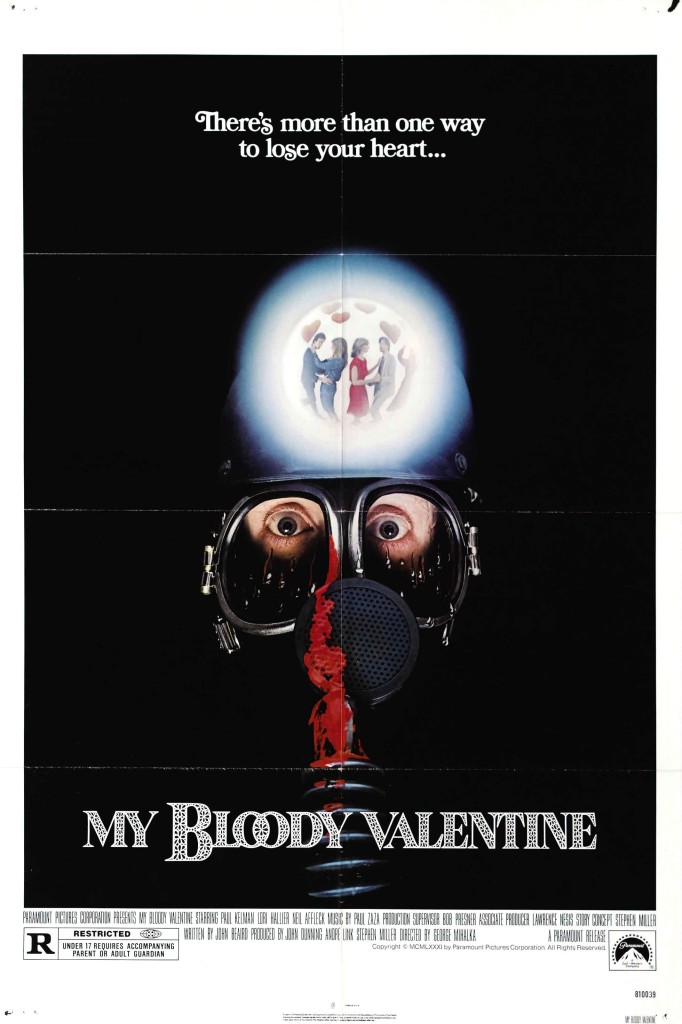
MyBloodyValentine

As of 2015 there have been a generous handful Valentine’s Day themed horror flicks made, and this one here is the best of the bunch, by far. I really expected that, by now, somebody would have made a horror film about a big fat guy in a diaper with tiny wings who shoots people with a bow and makes hilarious jokes, but if that movie exists, I can’t seem to find it. The closest we’ve come so far is the 2001 horror film Valentine, and dammit, that is a far cry from the glorious killer Cupid flick that I have imagined. Fortunately, My Bloody Valentine is a total classic, even if it doesn’t quench my thirst for absurdity, and it remains one of the best Holiday Themed slashers out there, even after thirty years. If you’re at all a slasher fan, you should track it down pronto, Tonto.

THE PLOT ~ A rural Canadian mining town finds it’s annual Valentine’s Day celebration disrupted by a string of gruesome murders, reminiscent of an infamous killing spree committed twenty years ago by a psychologically unhinged miner called Harry Warden. Believing Harry to be back in action, but not wanting to stir the townsfolk into a panic, local law enforcement does what it can to keep the news of the killings suppressed, while canceling all Valentine’s Day celebrations in accordance with the killer’s demands. The local youth aren’t into that shit, though. They want to party, and are fully willing to fight for their right to do so, regardless of the fact that License To Ill wouldn’t be released for five more years. Since they have literally no idea that people are being murdered in awesome ways all over town, these care-free future pickaxe victims conclude that the best course of action is to ignore the ban on Valentine’s Day celebrations, and to have a secret party anyway, no grown-ups allowed. But where would be best place for a secret Valentin’e Day party? Well, clearly, deep within the very mine where Harry Warden once cannibalized his peers, of course! Yes, he ate people toward the end of his mining career. So, that’s what they do- and guess how well that works out for them? Not real good.

There’s also a love triangle thing in here- which is actually the focal point of the plot, but that’s not very much fun to write about, and probably even worse for readers, so I’m mostly just going to hit you with the murder stuff. I really do think it’s best this way.

So, My Bloody Valentine is very much what you would expect it to be if you’re familiar with American/Canadian slashers of the early eighties, but if that’s the case, then you should also have seen this movie by now, because it’s a damn essential. It’s a close relative to Black Christmas, The Prowler, and the original Friday the 13th, and also owes a lot of influence to earlier Italian giallo films like Mario Bava’s Bay of Blood. Like those films, this is essentially a murder mystery, but with a much greater emphasis on sensationalized violence, and a focus on the role of the hapless victim, instead of seeing the story through the eyes of some bozo trying to solve the crime, as would be the case with most traditional murder mysteries. It’s distinct from the slashers that would follow it later in the 1980’s by being markedly less poppy, and by giving us characters who are much more realized and complex. We weren’t quite at the point where the audience just wanted to watch our killer tromp around and slice folks in half yet, so it was still important for the film to establish a somewhat believable world. My Bloody Valentine does that.

As a slasher, My Bloody Valentine has the title of “best Valentine’s Day horror film” on lock petty much for eternity. It’s a solid movie, and a damn fine horror film to boot. Our killer is both scary, and acceptably iconic, and the many red herrings doled out as the plot unravels keep the picture feeling interesting and surprising. This may even be the best horror film ever set in a mine, except for maybe Rodan, so suck it, The Stragneness.

Another fun fact that earns My Bloody Valentine mucho street cred amongst horror fanatics, It’s fairly violent. The picture is widely believed to have had nearly ten minutes of gore and violent content edited out of the picture before it was released, to appease the puritanical demands of the MPAA, and to date there is still no real uncut version of the film available. Subsequent versions have included additional unseen footage, but rumor has it there is still more sitting in a canister somewhere that we have yet to enjoy, so hopefully someone get’s that shit cut back together in the future. As it is, the theatrical cut leaves something to be desired if you’re coming into My Bloody Valentine after a gore-fest on par with Evil Dead, any of the Euro slashers, or even the aforementioned The Prowler, but it remains much stronger than, say, Halloween. I think My Bloody Valentine can hold it’s own against comparable slashers of the era in this respect, and it’s certainly good enough to warrant a viewing either way.

Before we wrap up, I want to briefly address my favorite part of the film; the character of Hollis. Hollis is a supporting character- but dammit if he isn’t a bad ass. He kinda looks like what you would get if Garfield the cat was a real human being- and also a little like the product of a cloning experiment involving John Candy and Teddy Roosevelt. As far as I’m concerned, this guy is the film’s main draw. End of paragraph.

A+

The Last Dragon!!!

The Last Dragon – 1985, Michael Schultz

the_last_dragon_1985-movie-poster

The Last Dragon is a slice of 1980’s zeitgeist so pure, potent, and unspoiled by new millennium angst that your immune system may not actually be prepared for it. It’s too bright eyed, too uninhibited, and most of you will likely find your health adversely effected as a result of viewing this motion picture. Full disclosure; I was born in the 80’s, and yet even I, an 80’s native, was not exempt from these maladies; at 45 minutes into the picture I began to develop nausea, headaches, vomiting, and an innovative, fresh, new breakdancing routine which is certain to win me fly honeys and mad street cred when I deploy it in the Bay Area next spring. This is your final warning, turn back, or suffer the consequences the 1980’s hath wrought.

THE PLOT~ Leroy Green (Also known as “Bruce Leroy”- awesome) is a naïve, virtuous inner-city youth with a weasely, peach fuzz mustache and a mastery of Kung Fu that is ALMOST unrivaled throughout Harlem. Completely devoted to the martial arts as a way of life, Leroy is on a quest to become a Master and reach the highest level of Kung Fu Bad Assary; obtaining a mystical power called “The glow.” They never really explain “the glow,” but it’s kind of like The Force, I think. And it’s also really awesome, and Leroy needs it.

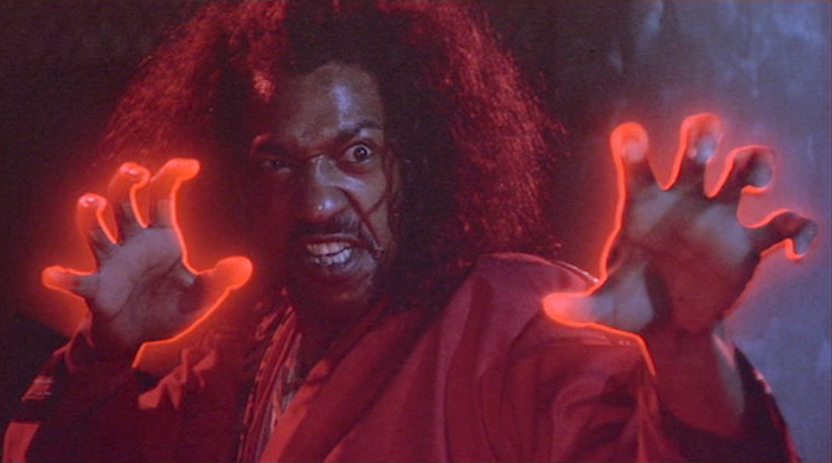
However, he is not without competition for Martial Arts supremacy, as a formidable rival soon appears in the form of Sho’Nuff, the Shogun of Harlem.

sho nuff

Sho’Nuff is a lanky, aggressive psychopath who leads your typical 1980’s Kung Fu street gang. They all wear costumes and have names like “Crunch” and “Cyclone,” so, you know, pretty standard stuff. Sho’Nuff is his own biggest fan, and he has a debilitating “Mirror mirror on the wall” type of narcissism that won’t allow him to rest until everybody knows he’s number one.  Nuff makes it his mission to bully Leroy into a showdown that would determine just who is the top Kung Fu Fist in town, but Leroy won’t bite. He knows that fighting for the sake of ego isn’t gonna get anybody The Glow, so he has no interest in this proposed showdown. His refusal only serves to piss Sho off, and soon things escalate until Leroy has no choice in the matter. But first…!

still-of-christopher-murney-in-the-last-dragon-(1985)

…We have Eddie Arkadian, a manipulative gangster with aspirations of puppet-mastering Angela, a Cindi Lauper-esque popstar, into the limelight, so that he can vicariously soak up her glory, and enjoy the spoils of radio wave domination. His home made pop starlet isn’t really getting it done, however, so like any gangster worth his salt, Eddie decides to break some rules to make this shit happen. His plan? To Force local TV personality and youth culture Goddess Laura Charles (Played by Vanity!) to showcase his Client on her music variety show. However, when Laura refuses, Arkadian’s ire is provoked, gangster style, and he decides to play rough.

Through equal parts coincidence and shady machinations, all of our characters become increasingly entangled with one another until the movie hits critical mass in the third act, at which point fools get a full fledged 1980’s Kung Fu beat down dropped on their heads. Every American home should be stocked with a copy of this film at all times.

The Last Dragon is a Kung Fu movie, but it’s total entry level Kung Fu, a step down even from The Karate Kid. It definitely has it’s fight scenes, but the martial arts are probably the least important element in the equation if we really dig in and look at what makes this thing tick. Much more prominent here is the music; the soundtrack to The Last Dragon is a monster, there was clearly a lot of importance placed on keeping this thing grooving, start to finish, and they pulled it off. The jams are all traditional, stupid 80’s pop, and for many of us, that hits the “guilty Pleasure” region of our brains with Robin Hood like precision. Through the music of the era, the mindless optimism of the 80’s is at it’s most infectious, so get ready to smile against your will, you grumpy bastards. It’s also definitely a comedy, and The Last Dragon does not take itself very seriously.

It is, however, sometimes difficult to pinpoint where this movie crosses over from comedy into legitimate insanity. Some aspects of the film do feel at least marginally insane for real… My favorite scene falls into that grey area, it goes like this;

Following up on a tip from his previous Sensai, Leroy travels to a Fortune Cookie factory somewhere in the city to seek the tutelage of another Kung Fu Master, who he believes resides nearby. We arrive at the factory before Leroy does, and what we see is a screaming abomination steeped in ignorance and shame. Three Asian factory employees have engaged in the 1980’s tradition of dancing like mental patients on a side walk in full view of mankind and God alike, and in this instance; the song they are dancing to is one of the most unlistenably humiliating 80’s pop jams on the entire soundtrack, a song called Suki Yaki Hot Saki Sue, which, I learned from the credits, is performed by someone called Raw Dog…. Yikes, you guys.

 dancin' menLOOK AT WHAT IS HAPPENING IN THIS PICTURE
These three ultra nerds are just pedal-to-the-medal grooving with such belligerent intensity, I would call this “dancing with extreme prejudice.” The most glorious thing about it is that they appear to be totally convinced that what they are doing is so, so very bad ass, when in truth, nothing could possibly be lamer. The experience is intense, like french kissing a hydrogen bomb an instant before detonation, and it only get’s worse once our guy arrives. Leroy, himself about the biggest square on the American East Coast, pleads for an audience with the Master, and in response he is heckled and belittled ruthlessly by the three people least qualified to make fun of anybody, ever. Their insults surpass “suck” in how poorly conceived and executed they are, and at one point, one of these guys appears to mock Leroy for being Asian. I don’t know if I’ve mentioned this yet, but Leroy is black, so this exchange is more than a little confusing, and if anyone other than Leroy had been subjected to such bush-league ridicule, they would have gone off on these bozos with brutal, beast like ferocity. They would be right to do so. If I could give you one illustration to help explain what it feels like to watch this scene, it would be this; this conflict is like the Tour DeFrance, only in this case, every participant has had the part of their brain that tells them how to ride a bike completely removed, and in it’s place, they were given an extra helping of whatever part of your brain tells you “You’re doing a great job, keep it up!”. It’s a massive tangle of humiliating failure that can’t stop fist pumping with hysterical pride over how good of a job it’s doing. I think this scene changed my life.

With that having been said, even these geeks are somehow likable, and actually, if we look at the rather large cast of characters in The Last Dragon, there’s not a turd in the bunch. All of our actors do a great job playing their parts, as well, especially  Faith Prince, who plays Angela, the would-be-pop star. While Angela probably isn’t going to be anyone’s favorite character in the movie, Prince really bats for the fences and plays this vulnerable, multi-dimensional role fantastically. You don’t usually see this much talent in a flick of this caliber, and in fact, if you keep your eyes peeled you’ll spot celebrated actors William H. Macy and Chazz Palminteri hiding in there as well. They must not have been famous yet.

Aside from the excellent cast, entertaining premise, and catchy, shame-drenched, 80’s soundtrack, the rest of the production also fares pretty well when scrutinized. I find myself getting carried away when I talk about how great The Last Dragon really is, but I don’t feel compelled to hold back, if I’m being honest. It’s just such a fun movie. There are a lot of great sequences throughout the film, like when Leroy’s little brother is kidnapped up by Arkadian’s thugs, and “dances” out of the ropes they tie him up with, or when Laura shows Leroy a music video about The Glow featuring Bruce Lee, even though she literally only just learned that The Glow even existed seconds earlier on the car ride to her studio. The final confrontation between Sho’Nuff and Leroy is also freaking rad, and over all, The Last Dragon is just a really good time.

shonuff

This is the sort that of movie that I, and so many of my peers, grew up with. If The Goonies was your jam when you were coming up, and if you were all about Short Circuit as a kid, then this movie could absolutely have held a spot in your regular VHS rotation. I’m legitimately saddened that I was already an adult the first time I saw it, and I vow to break this cycle of negligent parenting should I ever have children and/or decide to clone myself. Who knows how differently I could have turned out if I had seen this film before I got old and ruined my life! I think you should all watch this, if you can manage to suspend your cynicism for about ninety minutes, you could absolutely do worse.

A

Rare Exports

Rare Exports: A Christmas Tale ~ 2010, Jalmari Helander

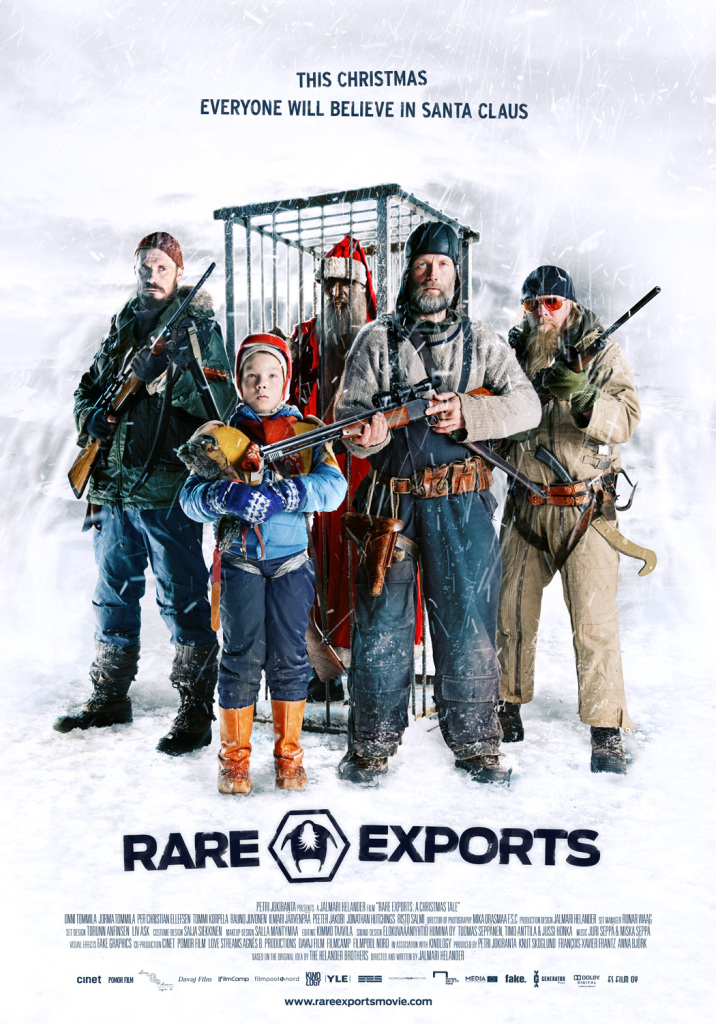
rare_exports_official_poster_en

From the land of folk metal and cell phones comes Rare Exports, an awesome and refreshingly original horror/fantasy film ideal for the Christmas season. Typically, these reviews get funnier the more I hate a movie… That being said, you may want to just skip this review now, because unfortunately, I don’t hate anything about Rare Exports. This one is a real keeper.

THE PLOT- Pietari and his father Rauno live in the rural Lapland region of Finland, in a valley bordered by an icy mountain range. Recently, a British dig team has taken up some sort of excavation atop a nearby mountain, and Rauno, who works as a reindeer farmer along with his friends Aimo and Piiparinen (no shit, that’s what Finnish names sound like) assume this to be some sort of geological study. Pietari and his friend Jusso know better. After sneaking up to the dig site and spying on the supposed Geologists, the two boys discover the truth; this is no mountain at all, but instead; a giant, ancient, burial mound long forgotten by human history. The occupant of this incredible, man made structure? A frozen, still living Santa Claus.

Horrified by the implications, Pietari immediately conducts research into the history of Santa Claus using ancient books which he somehow obtains, even though I can’t imagine where in the hell he found those, and what he discovers is that Santa has not always been the happy, jolly old man we now know him to be today. On the contrary, the original Santa bares a closer resemblance to a damn monster, and focused mostly on punishment, rather than reward. Freaking typical. Although no one takes him seriously, Pietari becomes concerned that a full-on Yuletide home invasion may nearly be upon him, and therefore begins taking safety precautions to protect himself from Santa’s impending reign of terror. This involves wearing butt-shielding inside his pants to protect him from Santa-administered spankings, and loading up the chimney with a bear trap, which he fails to warn his father about. Life in Finland looks really fun, you guys.

Meanwhile, for Rauno, Aimo and Piiparinen, things are looking horribly grim. The entire herd of reindeer, upon which their survival is entirely dependent, have turned up dead, a disaster which will financially devastate all three families. The men blame wolves, thought to have been driven down into the valley by commotion atop the mountain, but Pietari suspects Santa’s involvement right from the start. Furious, desperate, and not at all interested in Pietari’s Santa theories, Rauno rigs up an illegal trap to catch whatever wolves he can, for revenge, I guess, but much to his shock, he catches something else; a grizzled, naked old man with a long, white beard and a menacing disposition. With tensions high and no alternative solution to their crushing financial woes, Rauno, Aimo and Piiparinen decide to ransom this man, believing him to be one of the geologists from the mountain, even though he is clearly a monster older than human history, and also nude. From that point out things get progressively crazier, and it’s awesome.

So, at the root of Rare Exports, which was based loosely on a short film made by the same creative team, what we have is a coming of age story for young Pietari. When we first meet him, Pietari is childish in an exaggerated way, he carries a stuffed animal at all times, his best friend Jusso taunts him for still believing in Santa, that sort of thing. In general, Pietari is loved, but not respected, and the general consensus is that whatever it is, Pietari is too young to do it. Actually, we kind of get the feeling that he’s told he’s “too little” so often that he’s bought into the hype himself, and that what’s really keeping him from developing into an adult is how constantly people write him off for not being one already. This prolonged state of childlike open-mindedness actually gives him an edge, where Jusso would reject Santa outright in an attempt to appear as mature as possible, Pietari’s youthful perspective allows him to piece the situation together long before anyone else. When the time comes, Pietari bravely rises to the test, while Jusso’s posturing is revealed to be all bluster and no substance.

The film is told from Pietari’s perspective, which was a good choice. It adds to the charm significantly, and it gives the movie a modern fairy tale vibe, not unlike E.T. or Pan’s Labyrinth. Pietari’s exchanges with Jusso almost remind one of The Lost Boys, but in a good way, but the most impressive thing Rare Exports manages to do is that it makes us like Pietari, when it would have been so easy for him to come off as too whiney, or too much of a sudden know-it-all when the film climaxes and he’s  so much better informed than all of the adults. That’s such a tough balance, and if they hadn’t pulled it off, this thing would be dead in the water. They pulled it off wonderfully, though, and actually, pretty much all our characters are super likable. Aimo, Rauno, and Piiperinen are all solid dudes, and honestly, each time I come out of this film I do so wanting to spend more time with them. They’re well written, well acted, and believable, and even when their desperation pushes them to do bad things, we feel for them enough that we don’t end up hating their guts.

One weird thing about this film, however… I don’t think there’s a single woman in it. Pietari appears to have no mother, and, unless I missed someone, not a single female appears on camera, ever. I believe at one point Pietari phones the mother of another child, but we don’t see her, and as he checks to see if other children are okay, his little list does have some girl’s names on it, but we never meet any of these characters. I believe Rare Exports to have an entirely male cast. Is it just a major sausage fest over in Finland? What’s the deal? I’m not sure what this might be in liu of… Perhaps to exaggerate the lack of a female presence in Pietari’s life? Living without a mother in the harsh, frozen Finnish tundra can maybe make you feel like the world is just swarming with scruffy, old dudes, exclusively? Could having only one parent somehow have contributed to his immaturity? This is all speculation, but I thought it was worth bringing up, because it is admittedly pretty weird.

ANYWHOO…..

The ending is maybe a little overly sentimental and convenient, but it’s easy to forgive this after how charming the rest of the film is, and even at it’s most hokey, Rare Exports is great experience. I recommend it!

A+

THE DEVIL’S RAIN!!!

The Devil’s Rain ~ 1975, Robert Fuest

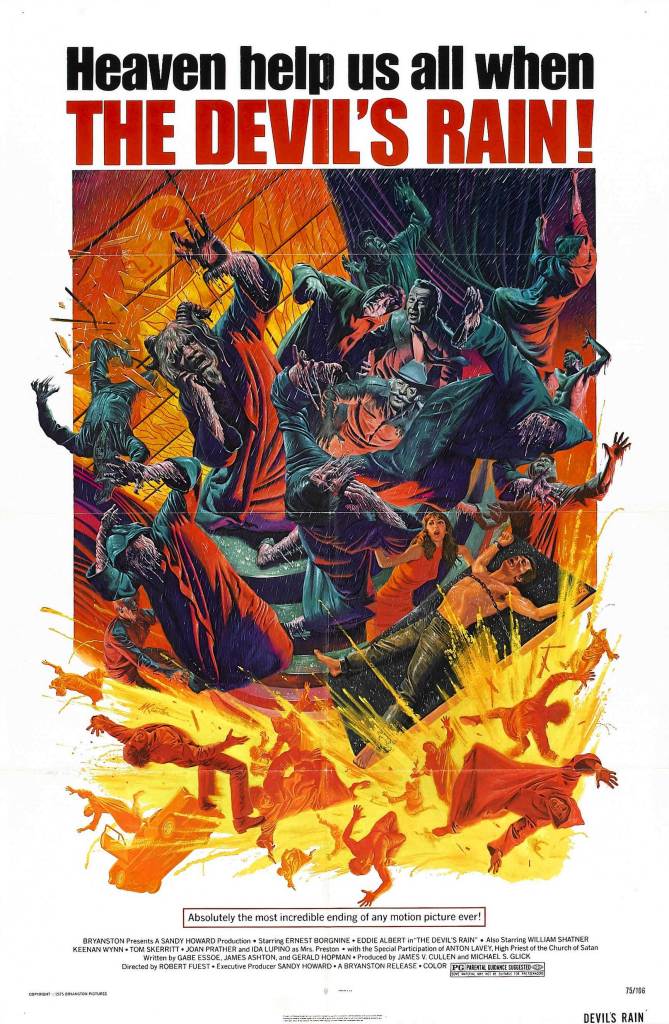
Devils-Rain-poster-1

What would it be like if Ernest Borgnine worshiped Satan and a bunch of people melted? It’s a question we’ve all asked ourselves at one time or another, and now, we have an answer; It would be awesome, and it would be just like this movie; The Devil’s Rain, starring, of course, Ernest Borgnine as well as William Shatner, and Tom Skerritt.

John Travolta is in it too… But you should probably watch it anyway.

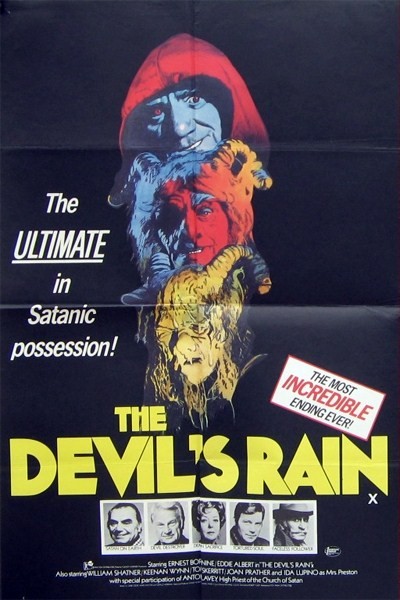
The Devil's Rain Poster

THE PLOT- Mark Preston (Willy “Beam Me Up” Shatner) and his family have been tormented by cult leader and Satanic O.G. Jonathan Corbis (Ernie “Eyebrows” Borgnine) for generations. Apparently, one of the Preston’s ancestors betrayed Corbis and stole some super important Satan book from him, and Corbis is being a real dick about getting it back. Mark charges off to confront Corbis, only to learn he’s bitten off more Satanism than he can chew, so the job falls to Mark’s brother Tom (played by Tom “Can’t my character’s name just be Tom?” Skerritt) to go set things straight with the man downstairs. Along the way we have thrills, chills, awesome monster makeup, and a ton of people who melt, eyeballs first. It’s awesome.

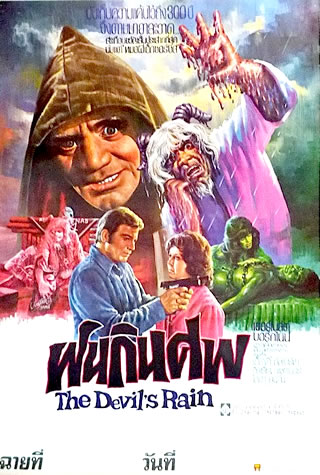
devilsrainThis freaking movie is rated PG! I couldn’t believe that after I had seen it. True, it does predate the introduction of the PG-13 rating but almost a full decade, but the real point I’m trying to make is that The Devil’s Rain really doesn’t feel like it’s holding back. It’s perfectly effective even without subject matter that would have earned it an R rating. Really, it’s a pretty quality Satanic Cult movie, and it feels like having people melt is an awesome gore loophole, since apparently that doesn’t count as actual blood and guts, but it does manage to satisfy the same gruesome fascination. We’re on to something here!
It’s also shot really well, and the acting is great. Skerritt, Shatner and especially Borgnine really bring their A-game, and the story is fun.

Highly recommended, and superior to a lot of it’s Satanic Cult film classmates. Now, if you want to see more people melt go track down Street Trash and The Incredible Melting Man.

A-

BASKET CASE!!!

Basket Case~ 1982, Frank Henenlotter

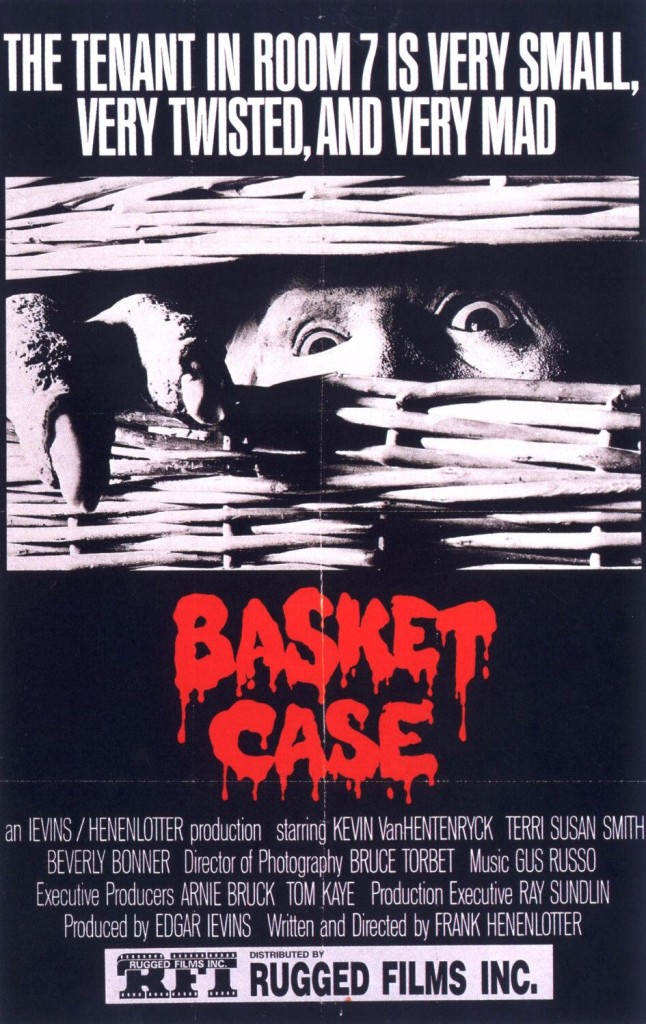
basket_case_xlg

Basket Case is the debut full length motion picture from Frank Henenlotter. It’s gritty, trashy, bloody, it’s a real classic. There’s also more going on under the hood in Basket Case than you might find in some of it’s 80’s grindhouse contemporaries, and it deserves reverence and praise  all day and all night. I love this movie, and it’s nice when there’s something to talk about in these reviews.

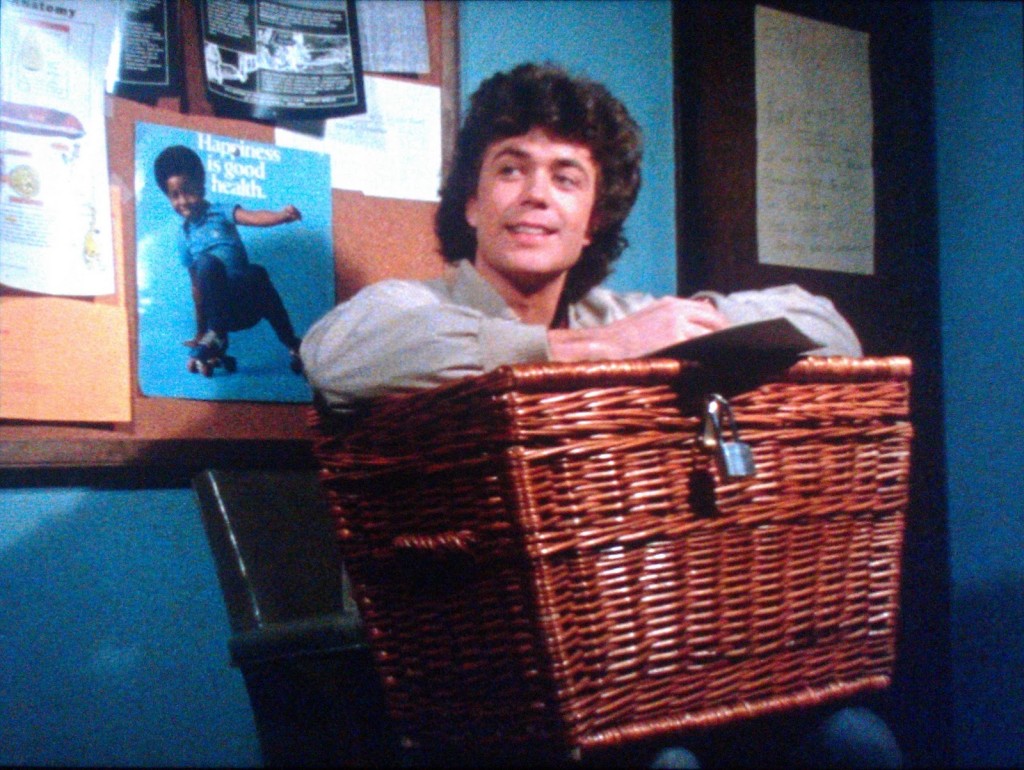
THE PLOT: Basket Base follows Duane, a lanky geek with giant hair and a flannel shirt, as he saunters awkwardly around the Big Apple carrying a large wicker basket. As you can imagine, the first pretty girl he meets wants to get herself a piece of that.

duane

There he is! Nothing weird going on there!

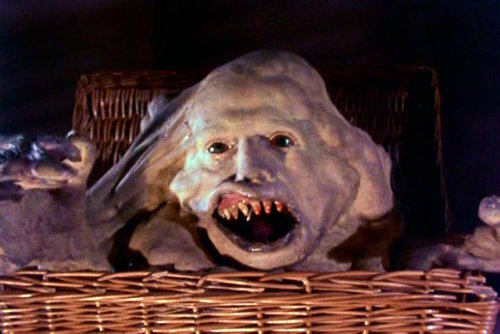
Duane predictably puts the attractive Susan on lock-down for future wrong-side-business. Little does Susan know, however, the contents of Duane’s giant nerd basket, or his mission in New York City… Duane was actually born with a conjoined twin, a monstrously deformed one, named Belial… Their parents made it very clear that they would love all their children equally when they chose to give the ugly one a Hebrew name meaning “worthless,” known to be the name of a particularly loathsome demon in the Catholic faith… Well, if the lopsided affections they had for their offspring wasn’t apparent from day one, things probably came into focus a little more for little Belial and Duane when mom and dad hired a team of doctors to come out to the house, separate the two, presumably killing Belial (but who cares), and then tossed Belial’s corpse into the trash. Secretly, he survives, though, and now he and Duane are grown up and in New York on a quest to track down each of the doctors responsible for their separation, so that Belial can maneuver his surprisingly mobile abomination of a body over and kill the shit out of them with his lumpy, deformed claws. So yeah, that giant, weirdo basket? That’s how Duane carries Belial around.

BasketCase-towatchpile

That’s him. He’s a total dick.

So, that’s pretty much the the movie. Other stuff happens, but that’s the set up.

So, here’s what’s special, beyond all the grue and the grit; what Henelotter has done here is to tell a story by bisecting the the human ego. In effect, Duane and Belial are the same character, with Duane making up the uncorrupted inner child, and Belial representing the parts of us that carry the burden of anger, fear, resentment, hate, and grudge. Belial is everything ugly inside of us all, smooshed into one angry little wad. He’s everything we need to learn to let go of in order to live a happy, healthy lives. At the beginning of the film, Duane’s commitment to Belial is absolute, but as he comes to see what his life could be without all the baggage, and as he starts to form new relationships, his dedication wanes, and he’s nearly able to let go of all these toxic emotions that have taken him down his destructive path… Only, by then, it’s too late.

In the end, the movie is about letting go of your Darth Vader and finding a way to hold onto your Anakin, because hate is destructive for all parties involved. What a positive message for a movie with full frontal (male) nudity and heaps of monster on human violence. Show this to your children.

This interesting dynamic of separating the human ego and exploring the resulting relationship is something Henenlotter would also play with in Brain Damage and Bad Biology, as well as in the two Basket Case sequels, albeit to a lesser extent… The sequels are not great, but this one sure is.

A+