GOJIRA!!!

Gojira ~ 1954, Ishiro Honda – Japan
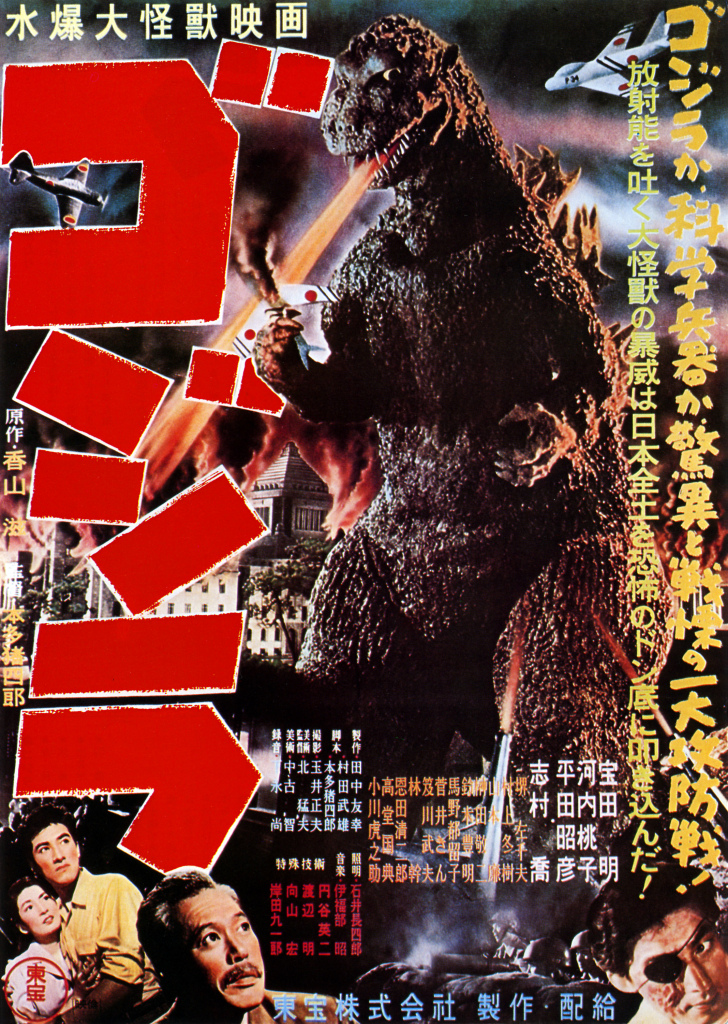
Gojira_1954_Japanese_poster

As a Westerner, by the time I had finally seen the original Japanese Gojira, I had already seen the Perry Masonified American version dozens of times. I had long been aware that the Japanese version was considered much better, but I was unprepared for just how much better it really was. I finally saw the original, Raymond Burr-less version about seven years ago, and while Godzilla: King of the Monsters is a sturdy, enjoyable monster classic on the level of Dracula or The Wolf Man, Gojira is a masterpiece, better compared to German Expressionist horror like Nosferatu or The Cabinet of Dr. Caligari. This shit’s off the chain.

The plot centers around mysterious phenomena occurring in and around Japan, the results of which leave many dead, and have Japan’s top minds speculating without much to go on. The film lingers in tense ambiguity for a lot longer than it’s American twin, and when Godzilla is finally revealed to be the cause of these strange occurrences, it remains some time until everybody is on the same page regarding not only his existence, but also what to do about it. Plus, when he first shows up, Godzilla looks a lot like Triumph the Insult Comic Dog.
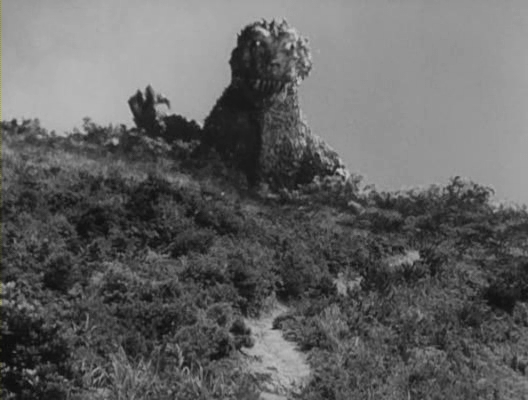
010-godzillafest-godzilla-1954-01“Hey, Japan- your country looks really great!… FOR ME TO POOP ON!” 

There are also multiple human characters we actually care about in this movie, including Emiko and Ogata, two young lovers who face considerable challenges in pursuing a relationship with one another. Firstly, Emiko is already engaged via an arranged marriage to a brilliant, but reclusive scientist named Dr. Serizawa. Emiko does not want to marry Serizawa, but we definitely do not get the impression that he is at all a bad man. Additionally, Emiko’s father, Dr. Yamane, is at odds with Ogata, who feels that Godzilla should be destroyed. Yamane believes the monster to be far too valuable to science, and this disagreement between the two puts further strain on Emiko and Ogata’s relationship. Their romance is actually the heart of the picture, but in the American version it is minimized to such a severe degree that the film loses it’s emotional anchor completely. Presumably, the addition of Raymond Burr in the American cut was done in an attempt to give Western audiences someone to relate to, but it creates an enormous amount of separation from the film’s drama, and I think this is a mortal wound to the picture which downgrades it from an artfully crafted allegory to an easily dismissed B-movie. Burr feels far too safe, even when he’s crawling out of rubble, and he has no investment in the lives of the people around him, so neither do we. Like looking through a window at a storm, the American version has taken all of the bite out of the picture, where the Japanese version feels much more like being the person locked out in the wind and the rain, we feel the misery and the fear much more effectively.

Throughout Gojira, Godzilla’s status as a metaphor for atomic warfare and the ramifications thereof are well solidified, and the film takes this topic seriously. It adds a great deal of weight to the film, this is a tense, gloomy picture that is lightyears from the goofy, fun-time monster slugfests we’d see out of Godzilla in the 60’s and 70’s.  By 1954 standards, this shit is actually kinda scary. The photography is very high contrast, we see Godzilla’s fury in thick, jet blacks and flat whites, like the cover of a Darkthrone album, it exudes gloom and discomfort, and the movie really goes the distance in exposing the viewer to human casualties. In watching Gojira, it’s hard to disassociate the film’s proceedings with the historical events that they are meant to represent, so these civilian deaths are not easily shrugged off. This truly is no fun monster romp, Gojira feels like a movie about the horror of atomic war that just happens to use a monster to tell its story, which is exactly what it is, and because of how well this is done, and because of how direct this metaphor is, I think there is a strong case to be made for Godzilla being the single greatest Fictional monster created since Dracula. The book… Not the movie.

The multifaceted discussion on the topic of atomic war in the film feels very stark, but not preachy. Gojira doesn’t so much as all out demonize atomic war, as much as it just sort of lays it out there and says “This is what happens, and what happens is terrible.” And that’s the major question of our age, the term “mutually assured destruction” is now a part of our lexicon. It’s now very plausible that all life on the Earth could be snuffed out due to the actions of mankind. In the battle of Man VS Nature, we’ve finally got Earth in Checkmate. So, what does that mean, philosophically? Gojira digs into that. Is Gojira the most valid cinematic exploration of these ideas? I don’t know, but I know one thing, on that topic, this is Japan’s two cents, and they know a thing or two about nuclear war. It’s my belief that in the same way Frankenstein’s Monster was a means of exploring hubris in an age when mankind overstepping his bounds was hot in the zeitgeist, Gojira digs into a seminal cold war issue in a way no other horror film can lay claim to, and in so doing has earned a poignancy quickly abandoned by it’s sequels, but still very much worthy of appreciation. This makes Gojira an important movie.

On top of that, it’s also completely enjoyable as an out of context, classic monster flick, so I think it’s reasonable to expect this film to still pack a punch for younger generations upon whom the historical allegory is lost… As a horror film, a science fiction film, and a monster movie, Gojira belongs seated comfortably in a place reserved for the very best.

A+

GZ next

PULGASARI!!!!

Pulgasari~ 1985, Chong Gon Jo and Sang-Ok Shin

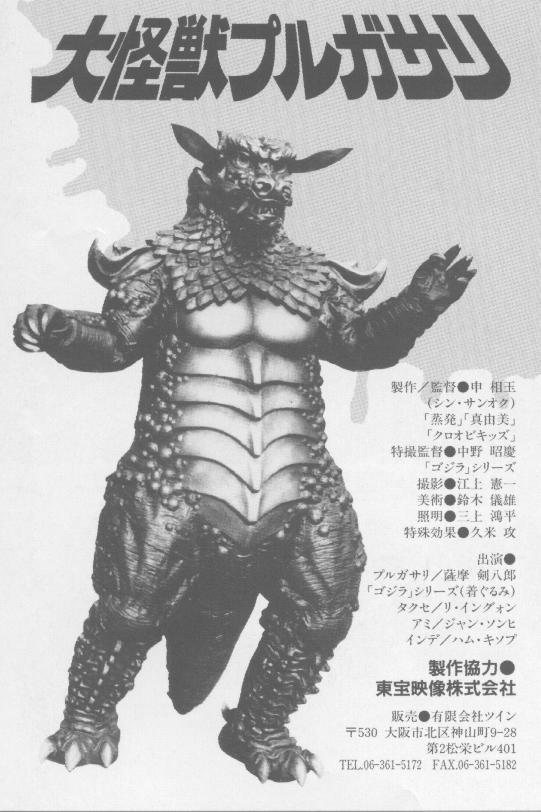
pulgasari-card2

In the case of Pulgasari, nothing that happens on film is as important as what happened behind the camera. For reals, you guys.

Pulgasari is a product of North Korea, produced by, and made under the watchful, giant glasses of Kim Jong-Il, then son of fascist dictator Kim-Il Sung. The film’s director, Sang-Ok Shin was a South Korean director who Kim Jong-Il deliberately arranged to be kidnapped and brought back to North Korea with the express purpose of forcing him to craft propaganda films. It’s a set up more than worthy of a film itself, and it really happened.

One of the films brought about through this insane, childish union of sheltered, detestable puppet master and horribly victimized kidnapee is Pulgasari; a confused bit of communist propaganda packaged as a quasi-Godzilla imitation.

As much as the desire to hate this movie because of it’s connection to Kim Jong-Il might motivate critical bias, the truth is that Shin’s directorial talent shines and the film is actually pretty good, and certainly fascinating due to it’s history. It’s rare that a blatant violation of human rights results in a corny monster movie, but this time we got lucky.

THE PLOT- Korea- Villagers toil in fruitless labor, slowly starving to death as their leach like government sucks them dry of resources without the faintest regard for their quality of life. (It’s difficult for me to place what era Pulgasari takes place in. They have no electricity, no medicine, no science and no technology to speak of, and it’s North Korea… So… 1998? I imagine that, throughout Pulgasari, there are people on the other side of the North/South border checking their E-mail.) As the people are slowly beaten down by their corrupt monarchy, a dying, imprisoned blacksmith fashions a tiny golem like figure of a monster out of mud and rice. With his dying breath, he prays to the gods to bring life to his creation, and then they totally do. As rebellion amongst the peasants leads to all out revolution, this small monster begins to devour metal, especially iron, growing exponentially in size and power as he does so. Soon, the all-but invincible beast is discovered and named Pulgasari, and the villagers use his might against their oppressors, eventually leading them to victory.

And for seven or eight minutes, everything is awesome, until the peasants realize that they were only able to achieve this feat due to their use of Pulgasari, whose voracious hunger for precious resources is ultimately unsustainable. Knowing that they lack the ability to satisfy his enormous hunger, the people conclude that ultimately, this responsibility would force them to invade foreign nations, and eventually this would lead to the fall of mankind altogether. Through tragic sacrifice, the Pulgasari is destroyed.

SO, WHAT’S GOING ON HERE- It’s a funny thing, Pulgasari is blatant communist propaganda, with Pulgasari himself serving as a stand in for Capitalism. The message is clear- Capitalism is a destructive force that will motivate societies to war and battle over resources and only by throwing off the shackles of this burden can we hope to achieve global unity and peace… But that message only really comes into focus at the very end of the picture. For the lion’s share of Pulgasari‘s run time, the movie really looks like a strong piece of anti-fascist sentiment, incredibly strange, given the overtly fascist nature of the powers responsible for creating Pulgasari. It really does take a government as obtuse as North Korea’s to use their fascist powers to create anti-fascist propaganda and have no idea why that’s ridiculous. Must be nice, simply ordering a multi-generation execution of anyone who points out the obvious.

So, as a piece of propaganda, the film is successful, but not exactly in the way Kim Jong-Il probably wanted… Or at least, maybe not in the way he would have wanted if the intellectual mechanism needed for him to second guess even his most basic of thoughts hadn’t withered and disappeared from his brain after a lifetime of being surrounded by terrified Yes-Men. I have no doubt this his biding was done to the letter, I just think that he could have realized that the implication against his own regime was clear if he could have thought about it a little more critically. I guess maybe someone could have helped to point that out during the writing process if execution wasn’t a 100% certainty attached to literally any form of criticism whatsoever.

But as a movie, it’s enjoyable, and fairly solid. The rear projection effects look like garbage, but the monster suit is more than passable, and Kim Jong-Il’s absolute control over his subjects and complete disregard for their safety helped net him some pretty impressive sweeping battlefield shots. One criticism, however- I was shocked to learn this movie was shot in the mid-eighties. It looks on par with Toho productions of the early sixties. I would have expected more cutting edge work from a hostage with a gun to his head.

Pulgasari is, strangely, an enjoyable experience, and the propaganda is blatant enough so as to fail at being effectively subversive. I’d say the circumstances around it make it pretty relevant, and it’s not even terrible. I recommend it to kaiju fans, and would say that it’s required viewing for fans of Mondo Macabro style bizarre world cinema.

B-

Frankenstein Conquers The World!

Frankenstein Conquers the World ~ 1966, Ishiro Honda, Japan

frankenstein_conquers_the_world_poster_01

Awesome. This is maybe my favorite kaiju film ever, but knowing that it exists is actually a lot more fun that watching it, and takes less time. Anyway… It’s a simple story- Nazis find the still beating heart of Frankenstein’s monster, Nazis give heart to the Japanese for safe-keeping, Japanese take heart to Japan, Americans drop atomic bomb on Frankenstein’s heart, small Japanese boy eats the now atomic Frankenstein heart (because who wouldn’t?), boy grows into a gigantic Frankenstein’s monster, gigantic Frankenstein’s monster wrestles floppy eared turtle dragon, everyone lives happily ever after. So, it’s fairly boiler plate, all things considered.

Frankenstein Conquers The World (In which Frankenstein most certainly does not conquer the world) is  a treasure from a bygone era where if it wasn’t several stories tall, the Japanese just flat out didn’t wanna hear about it. “Frankenstein’s monster? Sounds good, tell me more. Wait- he’s NOT several stories tall!? Well, that’s you’re problem. Fix that and we’ll talk.” Around this same time, however, the Germans were renaming Godzilla (And various other Toho film monsters) “Frankenstein” and re-dubbing the movies for German release to contain explanations that Dr. Frankenstein was actually responsible for the appearance of the film’s giant monsters, so it appears that those two nations have a mutual need to project onto each others monster related film output. Understandable.

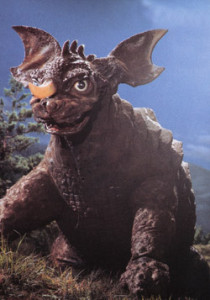
Frankenstein is not alone in Frankenstein Conquers the World, however. Baragon, an old Toho standby, turns up, eager to get Franken-Stomped ruthlessly for about 90 minutes.

baragonBehold- terror incarnate!

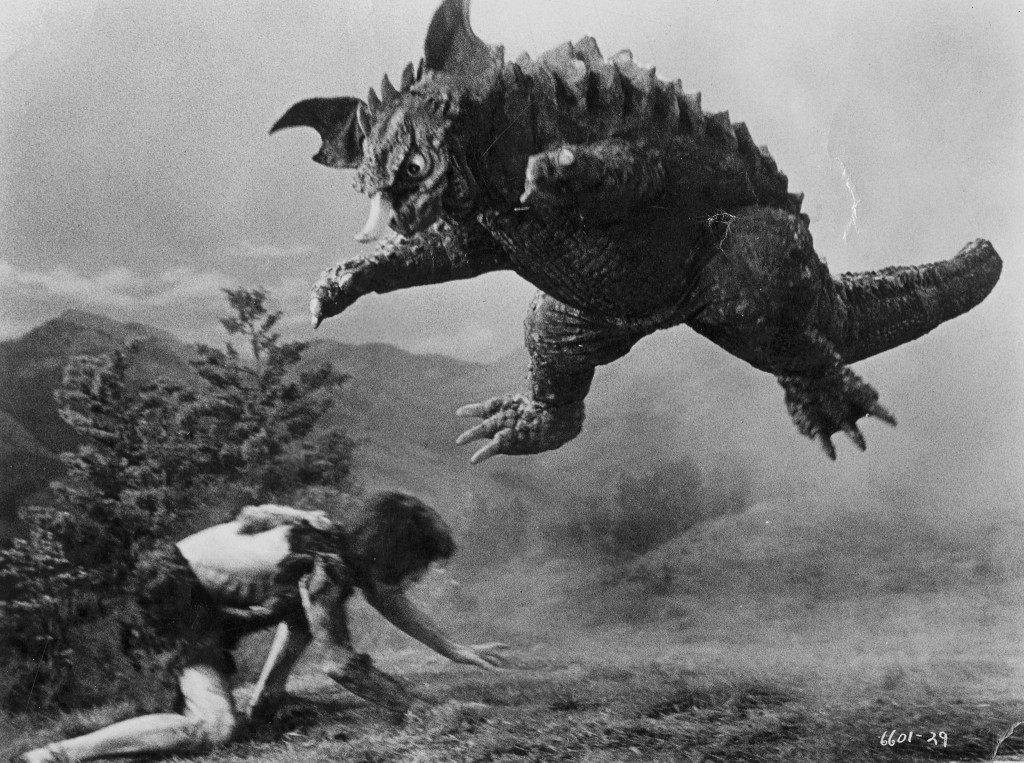
This same monster would also later turn up in other films to get slapped around by both Godzilla, and at one point, Ultraman, which kinda makes him the Homie-Hopper of the Kaiju world. I like to think of him more as the puppy dog of Godzilla’s extended family, however, because for a rampaging behemoth gone berserk, this thing is damn adorable, and if you’re anything like me, you’ll love watching his rhino horn, spiky back, and giant floppy, puppy dog ears wiggle about as he is relentlessly clobbered by a skyscraper sized Frankenstein over and over. This is probably a good time to remind readers that this is an actual movie, that was actually made. Presumably by adults.

baragon-vs-frankenstein

If we’re being serious, though, Frankenstein Conquers The World has it’s problems. Like many of the old Toho and related Kaiju films, the film is a little slow, and considering the ideal viewing audience for a movie like this is an unfocused gaggle of five year old boys, it would benefit from less talking and more furious monster combat. Today’s monster fans lack the attention span for lengthy exposition scenes shot in outdated 1960’s laboratories, regardless of their age. This isn’t enough to ruin the movie, though, and I recommend it highly for it’s sheer audacity, as well as for it’s no-holds-barred kaiju fisticuffs.

B+

GZ backGZ next

Big Man Japan

Today’s movie recommend is:

BIG MAN JAPAN– 2007, dir~ Hitoshi Matsumoto, Japan
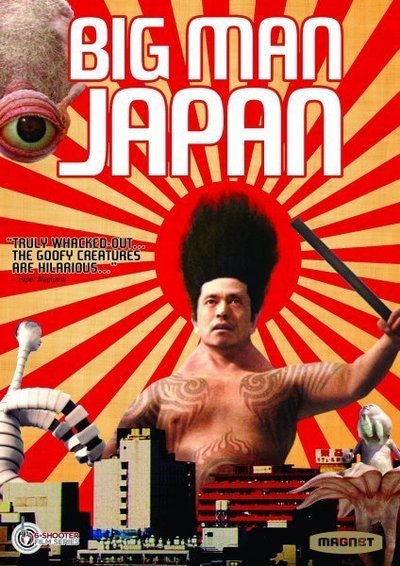
big man japan

Big Man Japan is a good example of the kind of film the Japanese seem to do well; it somehow manages to be zany as hell, while at the same time feeling vaguely tongue-in-cheek. Maybe that’s just the language barrier… Hard to say, but it’s certainly a smarter comedy/psychotronic mashup than say, Zombie Ass, or Vampire Girl VS. Frankenstein Girl, especially since the low brow humor is minimal, and there’s no sex or gore to speak of.  It’s a mockumentary style parody of the Japanese Kaiju genre, with an usually human protagonist; Big Man Japan. Big Man is an ordinary guy who inherited his role as the towering, monster clobbering defender of Japan from his father, grandfather, and so on and so fourth. Essentially obsolete in today’s Japan, his presence is more tolerated than celebrated by a culture which values tradition greatly, but at the same time demands the ultra-modern. Caught up in the crossfire of this contradiction is Big Man, who is obligated to devote his entire life to a people which no longer need nor truly appreciate him. If these ideas sound familiar, it’s because they’re probably the most inherently Japanese concepts of all time. That story has been told countless times through samurai fiction alone, the Japanese have wrestled with these ideas for literally centuries, but the way Big Man Japan explores them still manages to seem fresh, because it’s so grounded in human emotions, and because the historical context of the Samurai has been replaced with something equally Japanese; the Kaiju genre. The film climaxes with a Deus Ex Machina style American intervention which is even more telling about the likelihood of this being a thinly veiled exploration of Japan’s turbulent transition from the golden age of the samurai to it’s role as a major player on the international stage. Plus the monsters in this movie are wacky as hell. And it’s funny!

Is anybody still reading? The movie might feel a tad long, and the pacing may be difficult for people more accustomed to the flow of American Pop Cinema, but I would encourage just about anyone to give it a try, because it’s an extraordinarily likable movie, and I want others to enjoy it, too.

B+

more movies